









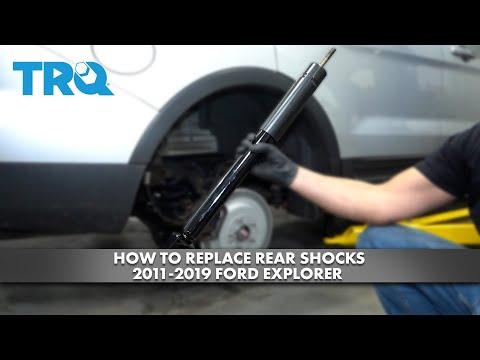






How to Replace Front & Rear Shock Absorbers on a 2019 Ford Explorer
Step-by-step DIY guide with tools, parts list, safety tips, and installation instructions for electronic CCD shocks
How to Replace Front & Rear Shock Absorbers on a 2019 Ford Explorer
Step-by-step DIY guide with tools, parts list, safety tips, and installation instructions for electronic CCD shocks


🔧 Explorer - Shock Absorber Replacement (Front & Rear)
You’ll be replacing the front strut assemblies and rear shock absorbers to restore ride comfort and handling. On the Platinum, the shocks are electronically controlled, so you’ll also unplug and reconnect small wiring connectors on each unit.
Difficulty Level: Intermediate | Estimated Time: 4–6 hours for all four
⚠️ Safety & Precautions
- ⚠️ Always support the Explorer with jack stands; never rely on the floor jack alone.
- ⚠️ You’ll be working near suspension components under tension. Do not loosen any spring-related fasteners unless the suspension is safely supported.
- ⚠️ Your Platinum uses adaptive (CCD) shocks. Always disconnect the sensor connector gently; do not pull on the wires.
- ⚠️ Wheels and suspension parts are heavy. Keep fingers clear of pinch points and lift with your legs.
- ⚠️ Disconnect the negative battery cable before unplugging or plugging shock electrical connectors to avoid electrical faults.
🔧 Required Tools
You'll need the following tools for this repair:
- 🛠️ Floor jack (rated 3-ton minimum)
- 🛠️ Jack stands (rated 3-ton minimum) - Qty: 4
- 🛠️ Wheel chocks
- 🛠️ Lug wrench (21mm)
- 🛠️ Socket set (8mm–24mm metric)
- 🛠️ Combination wrench set (8mm–24mm metric)
- 🛠️ Breaker bar 1/2"
- 🛠️ Torque wrench 3/8" drive (up to 80 Nm / 60 ft-lb)
- 🛠️ Torque wrench 1/2" drive (up to 250 Nm / 185 ft-lb)
- 🛠️ Torx bit set (including T30, T40)
- 🛠️ Trim clip removal tool
- 🛠️ Flathead screwdriver (medium)
- 🛠️ Needle-nose pliers
- 🛠️ Pry bar (12"–18")
- 🛠️ Penetrating oil spray
- 🛠️ Rubber mallet
- 🛠️ Spring compressor (external style, pair) (specialty)
- 🛠️ Paint marker or white marker pen
- 🛠️ Shop light or work lamp
- 🛠️ Mechanic’s gloves
- 🛠️ Safety glasses
🔩 Required Parts
HowToo sells all the parts you need for this repair:
- 🔩 Front left electronic strut assembly (CCD) - Qty: 1
- 🔩 Front right electronic strut assembly (CCD) - Qty: 1
- 🔩 Rear left electronic shock absorber (CCD) - Qty: 1
- 🔩 Rear right electronic shock absorber (CCD) - Qty: 1
- 🔩 New front strut upper mounting nuts - Qty: 6
- 🔩 New front strut-to-knuckle bolts and nuts - Qty: 4
- 🔩 New rear lower shock bolts and nuts - Qty: 2
- 🔩 New rear upper shock nuts - Qty: 2
- 🔩 Anti-seize compound - Qty: 1 tube
- 🔩 Penetrating oil - Qty: 1 can
- 🔩 Brake cleaner spray - Qty: 1 can
- 🔩 Paint marker (if not using a regular one) - Qty: 1
📋 Before You Begin
- Park the Explorer on a flat, solid surface, engage the parking brake, and place wheel chocks behind the wheels that will stay on the ground.
- Loosen (do not remove) the wheel lug nuts with the 21mm lug wrench before lifting the vehicle.
- Open the hood and disconnect the negative battery cable using a 10mm socket.
- Decide if you are replacing all four shocks. Best practice is to replace in axle pairs.
- Lightly spray lower shock and strut bolts with penetrating oil and let them soak for 10–15 minutes.
🔨 Step-by-Step Instructions
Follow these steps in order:
Step 1: Lift and Support the Explorer
- Use the floor jack to lift the front at the recommended front jacking point (center crossmember under the front).
- Place jack stands under the left and right front pinch welds or frame points, and slowly lower the vehicle onto them.
- Repeat for the rear if you are doing rear shocks: lift the rear by the rear subframe and support with jack stands at the rear frame points.
- Remove the wheels using the 21mm lug wrench and set them aside.
- Give the vehicle a shake test on stands.
Step 2: Front Strut – Access and Mark Camber Position
- Turn the steering wheel to give better access to the side you’re working on.
- Locate the front strut where it bolts to the steering knuckle (big aluminum or steel piece holding the hub).
- Use a wire brush if available and brake cleaner to clean around the two large lower strut-to-knuckle bolts.
- Use the paint marker to trace around the strut where it meets the knuckle. This helps keep alignment close when reassembling.
- Good marks can reduce alignment changes.
Step 3: Disconnect Front Strut Electrical Connector and Brackets
- Follow the small wire going to the top or side of the strut. This is the CCD (adaptive) shock connector.
- Use the trim clip removal tool or flathead screwdriver to gently release any plastic clips holding the wire to the strut body.
- Unplug the electrical connector by pressing the tab with your fingers or needle-nose pliers and pulling on the connector body, not the wires.
- If the brake hose or ABS wire is clipped to the strut, gently pop those clips out with the trim tool.
Step 4: Loosen Front Strut Top Mount Nuts
- Open the hood and locate the three nuts on top of each strut tower.
- Using a 15mm socket (size may vary slightly; confirm with your socket set) and ratchet, loosen all three nuts on the strut you’re working on, but do not remove them fully yet.
- Leave each nut threaded on a few turns to keep the strut from falling.
- Top nuts come fully off only after bottom is loose.
Step 5: Remove Front Strut from Steering Knuckle
- From the wheel well, support the lower control arm or knuckle slightly with the floor jack so it doesn’t drop when you remove the bolts.
- Use the breaker bar and appropriate socket (usually around 21mm–24mm) to remove the two large strut-to-knuckle nuts while holding the bolt heads with another wrench or socket.
- If the bolts are stuck, tap them out gently using a rubber mallet while supporting the knuckle.
- Once the bolts are out, the knuckle may move outward slightly. Keep it supported with the jack so there is no tension on brake hoses or CV axle.
- Reinstallation torque: Torque these bolts to manufacturer specification for strut-to-knuckle fasteners during reassembly.
Step 6: Remove Front Strut Assembly
- Now go back to the engine bay and, using the 15mm socket, remove the three top mount nuts fully while supporting the strut from below with your other hand.
- From the wheel well, carefully guide the strut out. You may need to tilt and rotate it slightly; a pry bar can gently help create space between the knuckle and body if tight.
- Set the old strut assembly on the ground in the same orientation as removed.
Step 7: (If Needed) Transfer Spring and Mount to New Front Strut
- If your replacement strut is a bare unit (no spring/top mount), you must transfer the coil spring and top mount.
- Attach the spring compressor (specialty) to opposite sides of the coil spring and tighten evenly with a ratchet until the spring is just loose in its seats.
- Use the correct size socket and possibly an Allen key in the strut shaft (if required) to remove the top nut.
- Lift off the top mount and carefully remove the spring.
- Install the spring onto the new strut in the same orientation, aligning the ends of the coil with the stops in the lower spring seat.
- Reinstall the top mount and nut, then tighten the nut to manufacturer specification.
- Slowly release the spring compressor, making sure the spring stays correctly seated.
- Pre-assembled “complete struts” avoid this entire step.
Step 8: Install New Front Strut
- Guide the new strut up into the strut tower from the wheel well.
- From the engine bay, start the three top mount nuts by hand using a 15mm socket or fingers. Do not fully tighten yet.
- Align the bottom of the strut with the steering knuckle, using the floor jack under the lower control arm to help move things into position.
- Install the new strut-to-knuckle bolts and nuts by hand first.
- Use a socket and wrench to snug them, then final torque to manufacturer specification for strut-to-knuckle bolts.
- Align your paint marks as closely as possible to preserve alignment.
Step 9: Tighten Front Strut Top Nuts and Reconnect Wiring
- From the engine bay, use the 15mm socket and torque wrench to tighten the three top mount nuts to manufacturer specification for strut top mount nuts.
- Back in the wheel well, clip the brake hose and ABS wire back into their holders on the strut if applicable.
- Reconnect the CCD shock electrical connector until it clicks, and re-secure any wire clips using the trim clip removal tool to push them back into place.
Step 10: Repeat for the Other Front Side
- Repeat Steps 2–9 for the other front strut.
- Do one side fully, then the other.
Step 11: Rear Shock – Access and Support Suspension
- Move to the rear wheel well. The rear shock is separate from the coil spring and runs from the lower control arm up to the body.
- Place the floor jack under the rear lower control arm near the shock mounting point and raise it slightly to support the arm (this prevents the suspension from dropping).
- Clean the lower and upper mounting areas with brake cleaner and brush if needed.
Step 12: Disconnect Rear Shock Wiring and Brackets
- Locate the CCD electrical connector on the rear shock body or near the top.
- Use the trim clip removal tool or flathead screwdriver to release any clips holding the wiring to the shock.
- Press the connector tab and unplug the rear shock electrical connector carefully.
Step 13: Remove Rear Shock – Lower and Upper Bolts
- At the bottom of the shock, use the appropriate socket (commonly 18mm–21mm) and breaker bar to loosen and remove the lower bolt and nut while the arm is supported by the floor jack.
- At the top of the shock, access the upper nut from the wheel well or trunk area (depending on trim). Use the correct size socket and wrench to remove it.
- Remove the shock from the vehicle.
- Reinstallation torque: Torque upper and lower shock fasteners to manufacturer specification during reassembly.
Step 14: Install New Rear Shock
- Position the new rear shock in place.
- Install the upper mounting nut first by hand with the correct socket, but do not fully tighten yet.
- Insert the lower bolt through the control arm and shock eye, threading the nut on by hand.
- Use the floor jack to raise the control arm until it is approximately at normal ride height (you can judge by how it looked before or raise until the vehicle just starts to lift off the rear stand slightly).
- With the suspension at ride height, tighten the upper and lower fasteners using the torque wrench to manufacturer specification for rear shock upper and lower fasteners.
- Tightening at ride height prevents bushing preload.
- Reconnect the CCD shock electrical connector and reattach any wire clips using the trim tool.
Step 15: Repeat for the Other Rear Side
- Repeat Steps 11–14 for the other rear shock.
Step 16: Reinstall Wheels and Lower the Explorer
- Reinstall all four wheels using the 21mm lug wrench. Start lug nuts by hand to avoid cross-threading.
- Raise the vehicle slightly with the floor jack, remove the jack stands, then lower the Explorer to the ground.
- Use the torque wrench and 21mm socket to torque all lug nuts in a star pattern to manufacturer wheel lug nut specification.
Step 17: Reconnect Battery and Clear Any Messages
- Reconnect the negative battery cable using a 10mm socket and tighten snugly.
- Turn the ignition on and check the dash for any suspension or warning lights.
✅ After Repair
- Start the engine and slowly turn the steering wheel lock-to-lock while stationary to ensure no noises or binding from the front struts.
- Drive slowly over a small bump near your home to listen for clunks or rattles. If you hear any, recheck that all bolts and nuts are tight and that shocks are seated correctly.
- Schedule a four-wheel alignment. Even with paint marks, front camber and toe can change after strut replacement.
- Over the first 50–100 km, avoid hard cornering and very rough roads if possible while things settle.
💰 DIY vs Shop Cost
Shop Cost: $1,200–$1,800 (all four electronic shocks, parts + labor)
DIY Cost: $600–$1,000 (all four electronic shocks, parts only)
You Save: $600–$800 by doing it yourself!
Shop labor rates vary but typically run $100–$150/hour. This repair takes a shop approximately 3–4 hours.
🎯 Ready to get started?
HowToo makes it easy: same-day/2-day shipping on every part, plus all the tools and specialty tools you need! Check out the parts and tools sections below to add everything to your cart.
Guide for replace for these Ford vehicles
| Year Make Model | Sub Model | Engine | Body Style |
|---|