









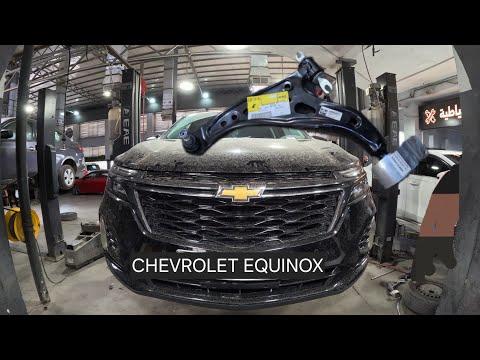






How to Replace Front Lower Control Arms on a 2020 Chevy Equinox
Step-by-step DIY control arm replacement with tools, parts list, torque specs, safety tips, and cost comparison
How to Replace Front Lower Control Arms on a 2020 Chevy Equinox
Step-by-step DIY control arm replacement with tools, parts list, torque specs, safety tips, and cost comparison


🔧 Equinox - Control Arm Replacement
You’ll be replacing the front lower control arms on your Equinox, which connect the wheels to the subframe and hold the ball joint and bushings. Worn control arms or bushings can cause clunks, vibration, pulling, or uneven tire wear. This job mainly involves safely lifting the front, removing the wheel, unbolting the arm, and installing a new one.
Difficulty Level: Intermediate | Estimated Time: 3-4 hours (both sides, first-time DIYer)
⚠️ Safety & Precautions
- ⚠️ Always support the vehicle with jack stands, never rely only on a floor jack.
- ⚠️ Work on firm, level ground with the parking brake firmly set and transmission in Park.
- ⚠️ Keep hands and tools away from the coil spring and pinch points while removing the control arm.
- ⚠️ Wear safety glasses and mechanic gloves to protect from rust, sharp edges, and pinches.
- ⚠️ After suspension work, a professional wheel alignment is required to avoid tire wear and poor handling.
- Battery disconnection is not required for this job.
🔧 Required Tools
You'll need the following tools for this repair:
- 🛠️ Floor jack (rated 3-ton minimum)
- 🛠️ Jack stands (rated 3-ton minimum, Qty: 2)
- 🛠️ Wheel chocks
- 🛠️ Lug wrench (19mm)
- 🛠️ Socket set (8mm-21mm)
- 🛠️ Ratchet 3/8" drive
- 🛠️ Ratchet 1/2" drive
- 🛠️ Breaker bar 1/2" drive
- 🛠️ Torque wrench 3/8" drive (up to 80 Nm / 60 ft-lb)
- 🛠️ Torque wrench 1/2" drive (up to 250 Nm / 185 ft-lb)
- 🛠️ Combination wrench set (10mm-21mm)
- 🛠️ Pry bar (medium length)
- 🛠️ Ball joint separator (pickle fork) (specialty)
- 🛠️ Hammer (2-3 lb)
- 🛠️ Flathead screwdriver (medium)
- 🛠️ Torque angle gauge (specialty)
- 🛠️ Paint marker or chalk
- 🛠️ Penetrating oil spray
- 🛠️ Wire brush
- 🛠️ Safety glasses
- 🛠️ Mechanic gloves
- 🛠️ Shop light or flashlight
🔩 Required Parts
HowToo sells all the parts you need for this repair:
- 🔩 Front left lower control arm with ball joint (FWD) - Qty: 1
- 🔩 Front right lower control arm with ball joint (FWD) - Qty: 1
- 🔩 New control arm bolts and nuts kit (front lower) - Qty: 1 set (GM uses torque-to-yield hardware; replace, do not reuse)
- 🔩 Anti-seize compound - Qty: 1 tube
- 🔩 Penetrating oil - Qty: 1 can
- 🔩 Paint marker or touch-up paint - Qty: 1
📋 Before You Begin
- Park your Equinox on level ground, set the parking brake, and place wheel chocks behind the rear wheels.
- Loosen, but do not remove, the front wheel lug nuts slightly with the 19mm lug wrench while the vehicle is on the ground.
- Gather all tools and parts before lifting the vehicle to avoid moving around with the car in the air.
- Plan to replace both front lower control arms as a pair for even wear and handling.
🔨 Step-by-Step Instructions
Follow these steps in order:
Step 1: Lift and support the front of the vehicle
- Use the floor jack under the front center jacking point (behind the front bumper on the subframe) to raise the front of the Equinox.
- Place jack stands under the factory pinch weld points on both sides, then slowly lower the vehicle onto the stands with the floor jack.
- Leave the floor jack just touching the subframe as a backup, without lifting off the stands.
- Verify stability by gently rocking the vehicle by hand; it should not move.
Step 2: Remove the front wheels
- Use the 19mm lug wrench to fully remove the lug nuts from both front wheels.
- Remove the wheels and set them aside lying flat.
- Keep lug nuts together so none are lost.
Step 3: Locate the lower control arm and fasteners
- The lower control arm is the curved metal arm running from the front subframe to the steering knuckle (where the wheel hub is).
- On each side you’ll see:
- One rear bushing bolt attaching the arm to the subframe.
- One front bushing bolt attaching the arm to the subframe.
- One ball joint stud and nut attaching the arm to the steering knuckle.
- Spray all bolts and nuts with penetrating oil and let it soak for at least 5–10 minutes.
Step 4: Loosen the ball joint nut at the steering knuckle
- Use a wire brush to clean exposed threads on the ball joint stud.
- Use the appropriate socket (usually 18mm or 21mm) with a ratchet to loosen the ball joint nut but do not remove it fully yet; leave it threaded on by a few turns.
- The nut staying on protects threads when separating.
Step 5: Separate the ball joint from the steering knuckle
- Position the ball joint separator (pickle fork) between the control arm ball joint and the steering knuckle.
- Tap the pickle fork with a hammer to drive it in until the joint pops loose from the knuckle.
- If needed, use a pry bar under the arm while tapping the knuckle with the hammer (on the side, never on the stud).
- Once the taper joint is free, remove the ball joint nut completely with the socket and ratchet.
Step 6: Support the steering knuckle
- Use a bungee cord or wire hooked to the spring or strut (you can twist some stiff wire with pliers) to hold the steering knuckle so it doesn’t flop outward and stress the CV axle.
- Do not let the knuckle hang by the brake hose or axle.
Step 7: Mark the control arm bushing positions
- Use a paint marker to mark around the control arm bushing brackets where they meet the subframe.
- This gives you a visual reference when installing the new control arm to keep alignment close.
Step 8: Remove the front and rear control arm bolts
- Use the appropriate socket (typically 18mm or 21mm) with a breaker bar to loosen the front and rear bushing bolts that attach the arm to the subframe.
- Once loose, switch to a ratchet to remove the bolts fully; support the control arm with your free hand as you remove the last bolt.
- Note bolt direction and position so you can install the new ones the same way.
Step 9: Remove the old control arm
- Pull the control arm out from the subframe mounts and away from the steering knuckle.
- You may need a pry bar to lever the arm out of tight bushing brackets.
- Compare the old arm to the new one on the ground to confirm shape, length, and ball joint orientation match.
Step 10: Install the new control arm into the subframe
- Slide the new control arm into the subframe bushing brackets, starting with the rear bushing, then the front.
- Install the new front and rear control arm bolts by hand, threading them a few turns to avoid cross-threading.
- Use a socket and ratchet to snug the bolts lightly, but do not fully torque them yet.
- Line up the bushing brackets with the paint marks you made earlier.
Step 11: Attach the ball joint to the steering knuckle
- Use a floor jack under the outer end of the control arm to gently raise it until the ball joint stud lines up with the hole in the knuckle.
- Guide the stud into the knuckle by hand.
- Install the new ball joint nut by hand, then tighten with the appropriate socket and ratchet.
- Final torque for the ball joint nut: Torque to 70 Nm (52 ft-lbs) plus 90° using the torque wrench and torque angle gauge.
Step 12: Preload the suspension before tightening bushing bolts
- This prevents twisting the rubber bushings at rest height.
- Keep the Equinox on jack stands, but use the floor jack under the control arm ball joint area to raise the arm until the hub center is close to normal ride height (roughly where it was with the wheels on the ground).
- Arm should look close to level, not hanging down.
Step 13: Torque the control arm bushing bolts
- With the arm held at ride height, use the correct socket and 1/2" torque wrench on the front and rear bushing bolts.
- Torque front bushing bolt: Torque to 140 Nm (103 ft-lbs) plus 90°.
- Torque rear bushing bolt: Torque to 140 Nm (103 ft-lbs) plus 90°.
- Use the torque angle gauge for the additional 90° turn on each (this is a quarter turn).
Step 14: Repeat steps 3–13 on the other side
- Perform the same process on the opposite control arm.
- Doing both sides keeps steering and braking balanced.
Step 15: Reinstall wheels
- Place each wheel back onto the hub and hand-thread all lug nuts.
- Use the 19mm lug wrench to snug the lug nuts in a star pattern while the vehicle is still on jack stands (do not fully torque yet).
Step 16: Lower the vehicle and final torque lug nuts
- Use the floor jack to raise the Equinox slightly, remove the jack stands, then slowly lower the vehicle to the ground.
- Use the 19mm socket and torque wrench to torque the lug nuts to 140 Nm (103 ft-lbs) in a star pattern.
✅ After Repair
- Start the engine and gently turn the steering wheel from lock to lock, listening for any unusual noises from the front suspension.
- Take a short, low-speed test drive around your area, checking for clunks, pulling, or vibration when braking or going over small bumps.
- Schedule a professional four-wheel alignment as soon as possible; control arm replacement changes wheel angles.
- After the first drive, recheck all accessible bolts visually and make sure there are no loose or missing fasteners.
💰 DIY vs Shop Cost
Shop Cost: $650-$900 (parts + labor, both front lower control arms)
DIY Cost: $220-$380 (parts only, both arms + hardware)
You Save: $270-$680 by doing it yourself!
Shop labor rates vary but typically run $100-$150/hour. This repair takes a shop approximately 2-3 hours.
🎯 Ready to get started?
HowToo makes it easy: same-day/2-day shipping on every part, plus all the tools and specialty tools you need! Check out the parts and tools sections above to add everything to your cart.