








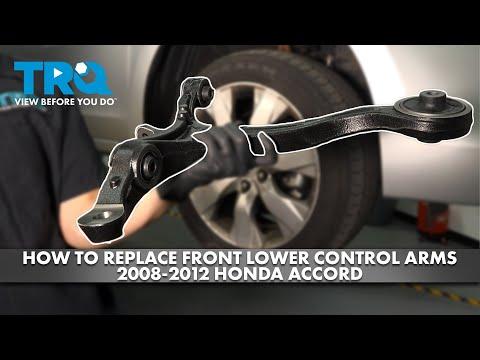







How to Replace Front Lower Control Arms on a 2008-2012 Honda Accord (DIY Guide)
Step-by-step instructions with tools, parts list, safety tips, and alignment notes for a smooth repair
How to Replace Front Lower Control Arms on a 2008-2012 Honda Accord (DIY Guide)
Step-by-step instructions with tools, parts list, safety tips, and alignment notes for a smooth repair for 2008, 2009, 2010, 2011, 2012


🔧 Accord - Control Arm Replacement
On your Accord, “control arms” can mean the front lower control arm (most common) or one of the rear multi-link arms. The steps, parts, and torque specs are different depending on which arm(s) you’re replacing.
Quick questions (so I give the correct procedure): 1) Are you replacing front control arms or rear control arms? 2) Are you replacing the whole arm assembly (with bushing/ball joint) or just bushings?
Difficulty Level: Intermediate | Estimated Time: 1.5-3.0 hours per side (front lower arm)
⚠️ Safety & Precautions
- 🛑 Support the car with jack stands on solid points; never rely on a floor jack alone.
- 🧤 Wear safety glasses; separating a ball joint can release suddenly.
- 🔥 Work on a cool suspension; avoid touching hot exhaust components near the front subframe.
- 📏 Plan for an alignment after control arm work; tire wear and pulling can happen if skipped.
- 🔋 Battery disconnect is not required for front lower control arm replacement.
🔧 Required Tools
You'll need the following tools for this repair:
- Floor jack (rated 3-ton minimum)
- Jack stands (rated 3-ton minimum)
- Wheel chocks
- Safety glasses
- Mechanic gloves
- Breaker bar (1/2")
- Torque wrench (10–250 Nm range)
- Socket set (10mm–22mm, 1/2")
- Wrench set (10mm–22mm)
- Pry bar (24")
- Hammer (2 lb)
- Needle-nose pliers
- Ball joint separator (specialty)
- Penetrating oil
- Paint marker
🔩 Required Parts
HowToo sells all the parts you need for this repair:
- Front lower control arm (left) - Qty: 1
- Front lower control arm (right) - Qty: 1
- Lower ball joint cotter pin - Qty: 2
- Lower ball joint castle nut - Qty: 2
- Lower control arm mounting bolts and nuts - Qty: 1 kit
📋 Before You Begin
- 🅿️ Park on level ground, set the parking brake, and place wheel chocks behind the rear tires.
- 🔓 Slightly loosen the front wheel lug nuts using a 19mm socket and breaker bar before lifting.
- 🧴 Spray penetrating oil on the control arm bolts and the ball joint nut using penetrating oil; wait 5–10 minutes.
- 🖊️ Use a paint marker to mark bolt positions/washers so you can reassemble the same way.
🔨 Step-by-Step Instructions
Follow these steps in order:
Step 1: Lift and secure the front end
- Use a floor jack (rated 3-ton minimum) to lift the front of the car at the approved front jacking point.
- Set the car down onto jack stands (rated 3-ton minimum) placed at strong frame/subframe points.
- Remove the wheel using a 19mm socket.
Step 2: Locate the front lower control arm and ball joint
- The front lower control arm is the large arm under the front suspension that connects the knuckle to the subframe.
- The ball joint is the pivot at the outer end (near the wheel). A ball joint separator is a tool that pops the joint apart without damaging parts.
Step 3: Remove the ball joint cotter pin and nut
- Straighten and remove the cotter pin using needle-nose pliers.
- Remove the ball joint castle nut using the correct size socket set (10mm–22mm, 1/2") and breaker bar (1/2").
- Don’t reuse cotter pins.
Step 4: Separate the ball joint from the steering knuckle
- Install and operate the ball joint separator (specialty) until the joint “pops” free.
- If needed, tap the knuckle boss with a hammer (2 lb) while keeping the separator tensioned.
- Use a pry bar (24") to gently guide the control arm down once separated.
Step 5: Remove the control arm mounting bolts
- Support the control arm with your hand or a floor jack (rated 3-ton minimum) so it doesn’t drop suddenly.
- Remove the inner control arm bolts/nuts using a socket set (10mm–22mm, 1/2") and wrench set (10mm–22mm).
- Remove the control arm from the subframe.
Step 6: Install the new control arm (do not final-tighten bushings yet)
- Position the new arm in place and start all mounting bolts by hand.
- Tighten the mounting bolts snug using a ratchet from your socket set (10mm–22mm, 1/2"), but do not fully torque yet.
- Hand-start bolts to avoid cross-threading.
Step 7: Reconnect the ball joint to the knuckle
- Guide the ball joint stud into the knuckle using a pry bar (24") as needed.
- Install the new castle nut using the correct size socket.
- Torque to OEM specification using a torque wrench, then continue tightening slightly until the cotter pin hole aligns.
- Install a new cotter pin using needle-nose pliers and bend the ends over.
Step 8: Final-torque the control arm bushing bolts at ride height
- Put the wheel back on using a 19mm socket and snug the lug nuts.
- Lower the car so the suspension is at normal ride height (vehicle on the ground).
- Torque the control arm mounting bolts to OEM specification using a torque wrench.
- This prevents bushing “preload,” which can tear the bushing early.
Step 9: Torque the wheel lug nuts
- Use a torque wrench (10–250 Nm range) and 19mm socket to tighten the lug nuts in a star pattern.
- Torque to OEM specification.
✅ After Repair
- 🧪 Road test at low speed first; listen for clunks over small bumps.
- 🔍 Recheck that the cotter pin is installed and bent correctly.
- 📏 Get a 4-wheel alignment as soon as possible.
- 🛞 Watch the steering wheel position; off-center indicates alignment is needed.
💰 DIY vs Shop Cost
Shop Cost: ₹18,000–₹45,000 (parts + labor, per pair front)
DIY Cost: ₹8,000–₹25,000 (parts only, per pair front)
You Save: ₹10,000–₹20,000 by doing it yourself!
Shop labor rates vary but typically run ₹1,200–₹2,500/hour. This repair takes a shop approximately 1.5–3.0 hours.
🎯 Ready to get started?
HowToo makes it easy: same-day/2-day shipping on every part, plus all the tools and specialty tools you need! Check out the parts and tools sections below to add everything to your cart.
Guide for Suspension Control Arm replace for these Honda vehicles
| Year Make Model | Sub Model | Engine | Body Style |
|---|---|---|---|
| 2012 Honda Accord | - | - | - |
| 2011 Honda Accord | - | - | - |
| 2010 Honda Accord | - | - | - |
| 2009 Honda Accord | - | - | - |
| 2008 Honda Accord | - | - | - |