









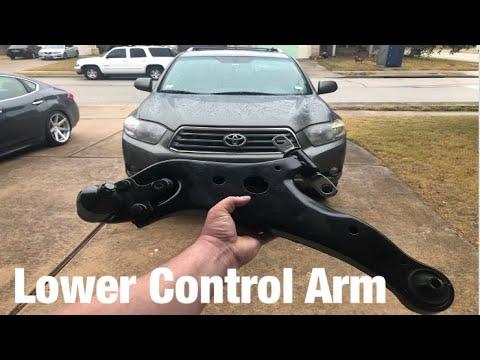







How to Replace Front Lower Control Arm Bushings on a 2013 Toyota Highlander
Step-by-step suspension bushing repair guide with tools, parts, torque specs, and safety tips for 2008, 2009, 2010, 2011, 2012, 2013, 2014, 2015, 2016, 2017, 2018, 2019
How to Replace Front Lower Control Arm Bushings on a 2013 Toyota Highlander
Step-by-step suspension bushing repair guide with tools, parts, torque specs, and safety tips for 2008, 2009, 2010, 2011, 2012, 2013, 2014, 2015, 2016, 2017, 2018, 2019


🔧 Highlander - Front Lower Control Arm Bushing Replacement
On your Highlander, the main serviceable suspension bushings most commonly replaced are the front lower control arm bushings. Toyota typically services these by replacing the complete lower control arm assembly rather than pressing individual bushings in and out, which is safer and more beginner-friendly.
Assumption: This guide covers front lower control arm replacement to renew the suspension bushings.
Difficulty Level: Advanced | Estimated Time: 3-5 hours
⚠️ Safety & Precautions
- ⚠️ Your Highlander is a hybrid; do not touch orange high-voltage cables or hybrid components.
- ⚠️ Support the vehicle with jack stands only; never work under a vehicle held up by a jack alone.
- ⚠️ Suspension parts can be under tension, so keep hands clear when loosening control arm and ball joint fasteners.
- ⚠️ The front lower control arm mounting bolts must be final-tightened with the suspension at normal ride height to avoid twisting the new bushings.
- ⚠️ A wheel alignment is required after this repair.
- ⚠️ Battery disconnect is not normally required for this repair if you are only working on the suspension.
🔧 Required Tools
You'll need the following tools for this repair:
- Floor jack (rated 3-ton minimum)
- Jack stands (rated 3-ton minimum)
- Wheel chocks
- Safety glasses
- Mechanic gloves
- 21mm lug nut socket
- 1/2-inch drive breaker bar
- 1/2-inch drive torque wrench (150 ft-lb minimum)
- 3/8-inch drive ratchet
- 1/2-inch drive ratchet
- 14mm socket
- 17mm socket
- 19mm socket
- 22mm socket
- 14mm wrench
- 17mm wrench
- 19mm wrench
- 22mm wrench
- Needle-nose pliers
- Ball joint separator (specialty)
- Pry bar 18-inch
- Rubber mallet
- Paint marker
- Penetrating oil
- Wire brush
🔩 Required Parts
HowToo sells all the parts you need for this repair:
- Front lower control arm assembly, left - Qty: 1
- Front lower control arm assembly, right - Qty: 1
- Front lower ball joint cotter pins - Qty: 2
- Front lower control arm mounting bolts and nuts - Qty: 1 set
- Sway bar end link nuts - Qty: 2
📋 Before You Begin
- Park your Highlander on flat, solid ground.
- Set the parking brake and place wheel chocks behind the rear wheels.
- Loosen the front lug nuts slightly before lifting the vehicle.
- Spray penetrating oil on the control arm bolts, ball joint nut, and sway bar link nut 10-15 minutes before removal.
- A ball joint separator is a tool that safely separates the tapered ball joint stud from the steering knuckle without hammering directly on the joint.
- If bolts are heavily rusted, stop and consider professional help because seized suspension bolts can break or damage the subframe.
🔨 Step-by-Step Instructions
Follow these steps in order:
Step 1: Loosen the Front Wheel Lug Nuts
- Use a 21mm lug nut socket and 1/2-inch drive breaker bar to loosen each front lug nut about half a turn.
- Do not fully remove the lug nuts while the tires are still on the ground.
- Tip: Break nuts loose before lifting.
Step 2: Raise and Support the Front of the Vehicle
- Use a floor jack rated 3-ton minimum to lift the front of your Highlander at the front center jacking point.
- Place jack stands rated 3-ton minimum under the approved front support points.
- Lower the vehicle gently onto the jack stands.
- Lightly shake the vehicle to confirm it is stable before working underneath.
Step 3: Remove the Front Wheels
- Use the 21mm lug nut socket to remove the loosened lug nuts.
- Remove both front wheels and set them flat aside.
Step 4: Mark the Control Arm Position
- Use a paint marker to mark the current position of the lower control arm mounting points.
- These marks help you place the new arm close to the original position until the alignment is done.
- Tip: Marks help, but alignment is still required.
Step 5: Disconnect the Sway Bar End Link
- Use a 17mm socket and 17mm wrench to remove the sway bar end link nut from the lower control arm.
- If the end link stud spins, hold the stud with the correct wrench while turning the nut with the 17mm socket.
- Move the sway bar link away from the control arm.
Step 6: Remove the Ball Joint Cotter Pin and Nut
- Use needle-nose pliers to straighten and pull out the cotter pin from the lower ball joint stud.
- Use a 19mm socket or 22mm socket, depending on the installed nut size, to loosen and remove the lower ball joint castle nut.
- A castle nut is the slotted nut that uses a cotter pin to keep it from backing off.
Step 7: Separate the Lower Ball Joint from the Steering Knuckle
- Install the ball joint separator between the lower control arm ball joint area and the steering knuckle.
- Tighten the separator slowly using the matching 19mm socket or 22mm socket until the taper pops free.
- Do not hammer directly on the ball joint threads.
- Tip: Leave fingers clear when it pops.
Step 8: Remove the Front Lower Control Arm Mounting Bolts
- Use a 19mm socket and 19mm wrench to remove the front lower control arm mounting bolt and nut.
- Use a 22mm socket and 22mm wrench to remove the rear lower control arm mounting bolt and nut.
- Support the arm with one hand while removing the final bolt so it does not drop suddenly.
Step 9: Remove the Lower Control Arm
- Use an 18-inch pry bar to carefully work the lower control arm out of the subframe pockets.
- Use a rubber mallet only if the arm needs gentle persuasion.
- Do not pry against brake hoses, CV axles, hybrid wiring, or aluminum steering parts.
Step 10: Install the New Lower Control Arm
- Position the new front lower control arm assembly into the subframe pockets by hand.
- Use a rubber mallet if needed to gently seat the bushings into place.
- Install the front and rear mounting bolts by hand first to avoid cross-threading.
- Snug the bolts with a 19mm socket, 22mm socket, 19mm wrench, and 22mm wrench, but do not fully torque them yet.
Step 11: Reconnect the Ball Joint
- Guide the lower ball joint stud into the steering knuckle by hand.
- Install the castle nut and tighten it using a 19mm socket or 22mm socket.
- Torque to 123 Nm (91 ft-lbs).
- Use needle-nose pliers to install a new cotter pin through the castle nut and ball joint stud.
- If the cotter pin hole does not line up, tighten the nut slightly more until it lines up. Do not loosen it to align the hole.
Step 12: Reconnect the Sway Bar End Link
- Insert the sway bar end link stud into the lower control arm.
- Install a new nut by hand.
- Use a 17mm socket and 17mm wrench to tighten it.
- Torque to 74 Nm (55 ft-lbs).
Step 13: Repeat on the Other Side
- Repeat Steps 5 through 12 on the opposite front lower control arm.
- Replace both sides as a pair if the bushings are worn, cracked, or oil-soaked.
Step 14: Set Suspension to Normal Ride Height
- Use the floor jack under the lower control arm area to raise each side until the suspension is close to normal ride height.
- Normal ride height means the suspension is compressed like the vehicle is sitting on its wheels.
- This prevents the new rubber bushings from being locked in a twisted position.
Step 15: Final-Torque the Control Arm Bolts
- Use the 1/2-inch drive torque wrench with the 19mm socket and 22mm socket to final-tighten the control arm mounting bolts.
- Front lower control arm front bolt: Torque to 135 Nm (100 ft-lbs).
- Front lower control arm rear bolt: Torque to 181 Nm (133 ft-lbs).
- Use the matching 19mm wrench or 22mm wrench to hold the nut while torquing the bolt.
Step 16: Reinstall the Front Wheels
- Install both front wheels by hand.
- Thread the lug nuts on by hand first.
- Use a 21mm lug nut socket to snug the lug nuts in a star pattern.
Step 17: Lower the Vehicle and Torque Lug Nuts
- Use the floor jack to lift the vehicle slightly and remove the jack stands.
- Lower the vehicle fully to the ground.
- Use a 1/2-inch drive torque wrench and 21mm lug nut socket to tighten the lug nuts in a star pattern.
- Torque to 103 Nm (76 ft-lbs).
✅ After Repair
- ✅ Turn the steering wheel lock-to-lock while parked and listen for clunks or binding.
- ✅ Test drive slowly at first and listen for knocking, popping, or wandering.
- ✅ Schedule a professional four-wheel alignment immediately after replacing the control arms.
- ✅ Recheck the front lug nut torque after 25-50 miles.
- ✅ If the steering wheel is off-center or the vehicle pulls, avoid highway driving until the alignment is completed.
💰 DIY vs Shop Cost
Shop Cost: $750-$1,300 (parts + labor, before alignment)
DIY Cost: $250-$550 (parts only)
You Save: $500-$750 by doing it yourself!
Shop labor rates vary but typically run $100-$150/hour. This repair takes a shop approximately 2.5-4.0 hours.
🎯 Ready to get started?
HowToo makes it easy: same-day/2-day shipping on every part, plus all the tools and specialty tools you need! Check out the parts and tools sections below to add everything to your cart.