








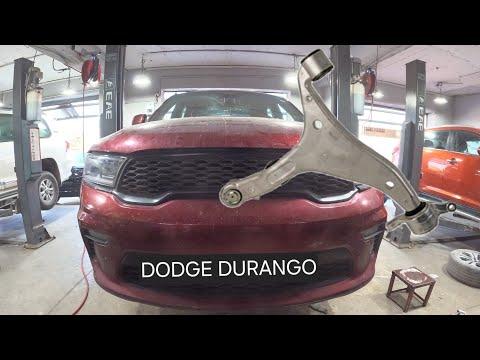







How to Replace Front Lower Ball Joints on a 2018 Dodge Durango (DIY Guide)
Step-by-step instructions, required tools/parts, safety tips, and alignment/torque spec notes
How to Replace Front Lower Ball Joints on a 2018 Dodge Durango (DIY Guide)
Step-by-step instructions, required tools/parts, safety tips, and alignment/torque spec notes


🔧 Durango - Ball Joint Replacement
Ball joints are the pivot points that let your front suspension move while keeping the wheel aligned. On your Durango, ball joint service can mean replacing just the joint or replacing the entire control arm (many are serviced that way), and the steps differ.
Difficulty Level: Advanced | Estimated Time: 3-6 hours
⚠️ Safety & Precautions
- ⚠️ Support the SUV on jack stands; never rely on a jack.
- ⚠️ Keep hands clear when separating the ball joint; suspension can release suddenly.
- ⚠️ If you remove brake parts, do not let the caliper hang by the hose.
- ⚠️ You will need a professional wheel alignment afterward.
🔧 Required Tools
You'll need the following tools for this repair:
- Floor jack (rated 3-ton minimum)
- Jack stands (rated 3-ton minimum)
- Wheel chocks
- Safety glasses
- Mechanic gloves
- Breaker bar 1/2"
- Torque wrench 1/2" drive (20-250 ft-lbs range)
- Socket set metric (10mm-24mm)
- Wrench set metric (10mm-24mm)
- Pry bar
- Needle-nose pliers
- Hammer (2-3 lb)
- Ball joint separator (specialty)
- Ball joint press kit (specialty)
- Paint marker
- Bungee cord
🔩 Required Parts
HowToo sells all the parts you need for this repair:
- Front lower ball joint - Qty: 1 (or 2 if doing both sides)
- Front lower control arm assembly - Qty: 1 (if ball joint is non-serviceable)
- New ball joint nut/cotter pin hardware kit - Qty: 1
- Chassis grease - Qty: 1 (only if joint has grease fitting)
- Penetrating oil - Qty: 1
📋 Before You Begin
- Park on level ground, steering wheel straight, and set the parking brake.
- Chock the rear wheels with wheel chocks.
- Loosen the front lug nuts 1/2 turn using a breaker bar before lifting.
- Spray penetrating oil on the ball joint nut and the joint-to-knuckle area.
🔨 Step-by-Step Instructions
Follow these steps in order:
Step 1: Confirm which ball joint design you have
- With the wheel off, look at the ball joint where it meets the control arm.
- If you see a pressed-in joint with a snap ring, it’s typically serviceable with a ball joint press kit (specialty).
- If the joint looks integrated/riveted or the arm is sold as an assembly, you replace the front lower control arm assembly instead.
- If unsure, send a clear photo of the joint.
Step 2: Lift and secure the front end
- Use a floor jack (rated 3-ton minimum) to lift the front at the approved jacking point.
- Set the SUV onto jack stands (rated 3-ton minimum).
- Remove the wheel using a socket set metric (10mm-24mm).
Step 3: Support the suspension
- Place the floor jack (rated 3-ton minimum) lightly under the lower control arm to support it.
- This helps prevent a sudden drop when the ball joint separates.
Step 4: Remove the ball joint nut
- If your joint uses a cotter pin, remove it with needle-nose pliers.
- Remove the ball joint nut using the correct size from your socket set metric (10mm-24mm) and a breaker bar 1/2".
Step 5: Separate the ball joint from the steering knuckle
- Install a ball joint separator (specialty) between the knuckle and ball joint stud and tighten until it pops free.
- Use a hammer (2-3 lb) only if needed on the knuckle boss (not on the stud threads).
- Keep the nut loosely threaded to catch it.
Step 6A: If the ball joint is press-in (serviceable)
- Remove any retaining clip/snap ring using needle-nose pliers.
- Use the ball joint press kit (specialty) to press the old joint out of the control arm.
- Press the new joint in squarely using the ball joint press kit (specialty) until fully seated.
- Reinstall the snap ring (if equipped) using needle-nose pliers.
Step 6B: If the ball joint is non-serviceable (control arm replacement)
- Mark cam bolt/washer positions with a paint marker to help keep alignment close.
- Remove the control arm-to-frame bolts using a socket set metric (10mm-24mm) and wrench set metric (10mm-24mm).
- Remove the control arm and install the new control arm in the same orientation.
- Snug the bolts but do not final-torque them yet.
Step 7: Reconnect the ball joint to the knuckle
- Guide the stud back into the knuckle by raising/lowering the arm with the floor jack (rated 3-ton minimum).
- Install the new nut using a socket set metric (10mm-24mm).
- Torque to factory spec (exact value depends on joint/arm version) using a torque wrench 1/2" drive (20-250 ft-lbs range).
- If it uses a cotter pin, align the castle nut and install a new pin with needle-nose pliers.
Step 8: Final-torque control arm bolts at ride height (if control arm was loosened/changed)
- Lower the SUV so the suspension sits at normal ride height (or support the control arm to simulate ride height).
- Final-torque the control arm pivot bolts using a torque wrench 1/2" drive (20-250 ft-lbs range).
- Torque to factory spec (varies by bolt location).
Step 9: Reinstall wheel
- Install the wheel and hand-tighten lug nuts using a socket set metric (10mm-24mm).
- Lower the SUV and torque the lug nuts in a star pattern using a torque wrench 1/2" drive (20-250 ft-lbs range).
- Torque to factory spec.
✅ After Repair
- Turn the steering lock-to-lock and listen for clunks.
- Test drive slowly and re-check for looseness/noise.
- Get a 4-wheel alignment as soon as possible.
- If the joint has a grease fitting, add grease using chassis grease until the boot just starts to swell.
💰 DIY vs Shop Cost
Shop Cost: $600-$1,500 (parts + labor)
DIY Cost: $120-$700 (parts only)
You Save: $480-$800 by doing it yourself!
Shop labor rates vary but typically run $100-$150/hour. This repair takes a shop approximately 3-6 hours.
🎯 Ready to get started?
HowToo makes it easy: same-day/2-day shipping on every part, plus all the tools and specialty tools you need! Check out the parts and tools sections below to add everything to your cart.