









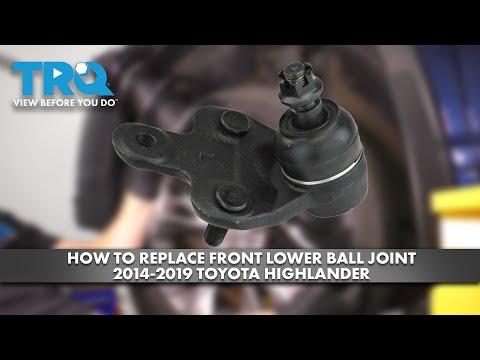







How to Replace Front Lower Ball Joints on a 2017 Toyota Highlander
Step-by-step lower control arm guide with tools, parts, torque specs, and safety tips for 2008, 2009, 2010, 2011, 2012, 2013, 2014, 2015, 2016, 2017, 2018, 2019
How to Replace Front Lower Ball Joints on a 2017 Toyota Highlander
Step-by-step lower control arm guide with tools, parts, torque specs, and safety tips for 2008, 2009, 2010, 2011, 2012, 2013, 2014, 2015, 2016, 2017, 2018, 2019


🔧 Highlander - Front Lower Ball Joint Replacement
This repair replaces the front lower ball joint, which connects the steering knuckle to the lower control arm and allows the suspension to move while steering. On your Highlander Hybrid, the lower ball joint is serviced as part of the front lower control arm assembly, so the practical repair is replacing the lower control arm rather than pressing out only the joint.
Difficulty Level: Advanced | Estimated Time: 2.5-4 hours per side
⚠️ Safety & Precautions
- ⚠️ Your Highlander Hybrid has high-voltage hybrid components. Do not touch orange high-voltage cables or hybrid system parts.
- ⚠️ Work on level ground only and support the vehicle with jack stands. Never rely on a floor jack alone.
- ⚠️ Disconnect the 12V negative battery cable before working near the front subframe area to reduce accidental power-up risk.
- ⚠️ The vehicle is heavy. Use a floor jack and jack stands rated for at least 3 tons.
- ⚠️ Ball joints and control arms hold suspension load. Keep hands clear when separating the joint from the steering knuckle.
- ⚠️ An alignment is required after replacing a lower control arm.
🔧 Required Tools
You'll need the following tools for this repair:
- 3-ton floor jack
- 3-ton jack stands
- Wheel chocks
- Safety glasses
- Mechanic gloves
- 21mm lug nut socket
- 1/2-inch drive breaker bar
- 1/2-inch drive ratchet
- Torque wrench rated to 200 ft-lbs
- 17mm socket
- 19mm socket
- 22mm socket
- 17mm wrench
- 19mm wrench
- 22mm wrench
- 10mm wrench
- Ball joint separator tool (specialty)
- Pry bar
- Needle-nose pliers
- Hammer
- Paint marker
- Trim clip remover
- Penetrating oil
🔩 Required Parts
HowToo sells all the parts you need for this repair:
- Front lower control arm with ball joint - Qty: 1 per side
- Front lower ball joint cotter pin - Qty: 1 per side
- Front lower ball joint castle nut - Qty: 1 per side
- Lower control arm mounting bolts - Qty: as needed
- Lower control arm mounting nuts - Qty: as needed
📋 Before You Begin
- Park your Highlander on level ground, set the parking brake, and place wheel chocks behind the rear wheels.
- Turn the ignition off and keep the key away from the vehicle so the hybrid system cannot ready itself.
- Open the hood and use a 10mm wrench to disconnect the 12V negative battery cable.
- Spray penetrating oil on the lower ball joint nut and lower control arm mounting bolts before removal.
- A ball joint separator is a tool that pushes the ball joint stud out of the steering knuckle without damaging the knuckle.
- A cotter pin is a small bent metal pin that locks a castle nut in place so it cannot loosen.
🔨 Step-by-Step Instructions
Follow these steps in order:
Step 1: Loosen the Front Wheel
- Use a 21mm lug nut socket and 1/2-inch drive breaker bar to loosen the front wheel lug nuts about one turn.
- Do not remove the lug nuts yet.
- Break lugs loose before lifting.
Step 2: Raise and Support the Vehicle
- Use a 3-ton floor jack to lift the front of your Highlander at the front center jacking point.
- Place 3-ton jack stands under the approved front side support points.
- Lower the vehicle gently onto the jack stands.
- Shake the vehicle lightly to confirm it is stable before working underneath.
Step 3: Remove the Wheel
- Use a 21mm lug nut socket and 1/2-inch drive ratchet to remove the lug nuts.
- Remove the wheel and set it flat under the side of the vehicle as an extra safety backup.
Step 4: Remove Any Lower Splash Shield Blocking Access
- Use a trim clip remover to remove plastic clips from the lower splash shield if it blocks the control arm bolts.
- Use a 10mm wrench or 10mm socket only if small shield bolts are fitted.
- Set the clips aside in order so they go back in the same locations.
Step 5: Mark the Control Arm Position
- Use a paint marker to mark the position of the lower control arm mounts before removal.
- This helps you install the new arm close to the original position, but it does not replace a wheel alignment.
Step 6: Remove the Lower Ball Joint Cotter Pin and Nut
- Use needle-nose pliers to straighten and pull out the cotter pin from the lower ball joint stud.
- Use a 19mm socket or 19mm wrench to loosen and remove the castle nut from the lower ball joint stud.
- If the nut is tight, use a 1/2-inch drive breaker bar carefully.
Step 7: Separate the Ball Joint from the Steering Knuckle
- Install the ball joint separator tool (specialty) between the lower control arm ball joint and the steering knuckle.
- Tighten the separator using the correct socket from your tool kit until the stud pops free.
- Use a hammer only to tap the knuckle boss lightly if needed. Do not hammer the threaded ball joint stud.
- A loud pop is normal.
Step 8: Support the Knuckle
- Use a pry bar carefully to guide the control arm away from the knuckle.
- Do not let the steering knuckle hang by the brake hose or wheel speed sensor wire.
- If needed, rest the knuckle in a natural position without pulling on the brake hose.
Step 9: Remove the Lower Control Arm Mounting Bolts
- Use a 19mm socket, 22mm socket, 19mm wrench, or 22mm wrench as needed to remove the front and rear lower control arm mounting bolts and nuts.
- Use a 1/2-inch drive breaker bar if the bolts are tight.
- Note the direction each bolt is installed before removing it.
- Remove the lower control arm from the vehicle.
Step 10: Install the New Lower Control Arm
- Position the new front lower control arm with ball joint into the subframe mounts.
- Install the mounting bolts and nuts by hand first to avoid cross-threading.
- Use a 19mm socket, 22mm socket, 19mm wrench, or 22mm wrench to snug the bolts only. Do not fully torque them yet.
- Final torque happens at ride height.
Step 11: Connect the Ball Joint to the Steering Knuckle
- Guide the new ball joint stud into the steering knuckle by hand.
- Install the new castle nut by hand.
- Use a 19mm socket and torque wrench rated to 200 ft-lbs to tighten the ball joint nut to Torque to 103 Nm (76 ft-lbs).
- Continue tightening slightly only if needed to align the castle nut slot with the cotter pin hole.
- Use needle-nose pliers to install and bend the new cotter pin.
Step 12: Set the Suspension at Ride Height
- Use a 3-ton floor jack under the lower control arm outer area to raise the suspension until the arm is near normal driving height.
- Do not lift the vehicle off the jack stand while doing this.
- This prevents twisting the new control arm bushings.
Step 13: Torque the Lower Control Arm Mounting Bolts
- Use a 19mm socket, 22mm socket, matching wrench, and torque wrench rated to 200 ft-lbs to tighten the lower control arm mounting fasteners.
- Tighten the front lower control arm mounting bolt to Torque to 145 Nm (107 ft-lbs).
- Tighten the rear lower control arm mounting bolt to Torque to 145 Nm (107 ft-lbs).
- If your replacement hardware includes different torque instructions from the part maker, follow those instructions.
Step 14: Reinstall the Splash Shield
- Use a trim clip remover by hand to reinstall the plastic clips.
- Use a 10mm wrench or 10mm socket to reinstall any small shield bolts until snug.
Step 15: Reinstall the Wheel
- Install the wheel by hand and start all lug nuts by hand.
- Use a 21mm lug nut socket and 1/2-inch drive ratchet to snug the lug nuts in a star pattern.
Step 16: Lower the Vehicle and Torque the Lug Nuts
- Use the 3-ton floor jack to raise the vehicle slightly and remove the 3-ton jack stands.
- Lower the vehicle fully to the ground.
- Use a 21mm lug nut socket and torque wrench rated to 200 ft-lbs to tighten the lug nuts in a star pattern to Torque to 103 Nm (76 ft-lbs).
Step 17: Reconnect the 12V Battery
- Use a 10mm wrench to reconnect the 12V negative battery cable.
- Make sure the terminal is tight and does not twist by hand.
✅ After Repair
- Start your Highlander and turn the steering wheel slowly left and right to check for binding or clunking.
- Drive slowly in a safe area and listen for unusual noises.
- Get a professional 4-wheel alignment as soon as possible.
- Recheck the lug nut torque after 25-50 miles using a 21mm lug nut socket and torque wrench.
- If warning lights appear after reconnecting the battery, drive straight for a short distance and turn the steering wheel lock-to-lock. If lights remain, scan for codes.
💰 DIY vs Shop Cost
Shop Cost: $450-$850 per side (parts + labor + alignment)
DIY Cost: $120-$300 per side (parts only)
You Save: $250-$500 per side by doing it yourself!
Shop labor rates vary but typically run $100-$150/hour. This repair takes a shop approximately 1.5-2.5 hours per side plus alignment time.
🎯 Ready to get started?
HowToo makes it easy: same-day/2-day shipping on every part, plus all the tools and specialty tools you need! Check out the parts and tools sections below to add everything to your cart.