









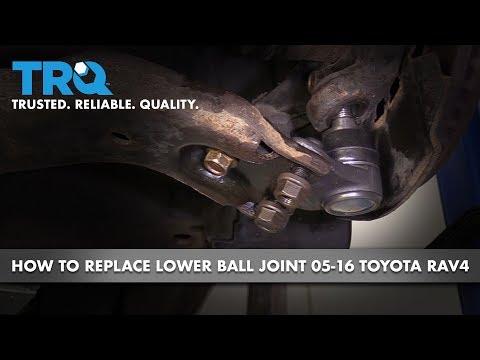







How to Replace Front Lower Ball Joints on a 2016 Toyota RAV4
Step-by-step instructions with tools, parts, torque specs, and safety tips for 2006, 2007, 2008, 2009, 2010, 2011, 2012, 2013, 2014, 2015, 2016, 2017, 2018
How to Replace Front Lower Ball Joints on a 2016 Toyota RAV4
Step-by-step instructions with tools, parts, torque specs, and safety tips for 2006, 2007, 2008, 2009, 2010, 2011, 2012, 2013, 2014, 2015, 2016, 2017, 2018


🔧 Ball Joints - Front Lower Ball Joint Replacement
Assumption: this covers the front lower ball joints on your RAV4. The ball joint is the pivot point between the lower control arm and steering knuckle, and worn joints can cause clunks, wandering, and uneven tire wear.
Difficulty Level: Advanced | Estimated Time: 3-5 hours
⚠️ Safety & Precautions
- Use jack stands on solid ground. Never work under a vehicle supported only by a jack.
- Chock the rear wheels before lifting the front.
- Loosen axle and suspension fasteners only with the vehicle safely supported.
- Do not let the steering knuckle hang by the brake hose or ABS wire.
- After repair, get a front-end alignment. This job changes suspension geometry.
- Battery disconnect is not required.
🔧 Required Tools
You'll need the following tools for this repair:
- Floor jack (rated 3-ton minimum)
- Jack stands (rated 3-ton minimum)
- Wheel chocks
- Safety glasses
- Mechanic gloves
- 21mm socket
- 19mm socket
- 17mm socket
- 14mm socket
- Torque wrench
- Ratchet
- Breaker bar
- Pry bar
- Ball joint separator (specialty)
- Hammer
- Penetrating oil
- Bungee cord or mechanic's wire
🔩 Required Parts
HowToo sells all the parts you need for this repair:
- Front lower ball joint - Qty: 2
- Ball joint cotter pin - Qty: 2
- Ball joint nut - Qty: 2
📋 Before You Begin
- Park on level ground and set the parking brake.
- Chock the rear wheels.
- Break the front wheel lug nuts loose before lifting.
- Spray penetrating oil on the ball joint nuts and bolts ahead of time.
🔨 Step-by-Step Instructions
Follow these steps in order:
Step 1: Raise and support the front end
- Use a floor jack to lift the front of the vehicle at the proper lift point.
- Set the vehicle securely on jack stands.
- Remove the front wheel with a 21mm socket.
- Shake the vehicle lightly before working.
Step 2: Free the ball joint from the steering knuckle
- Use a 17mm socket and breaker bar to remove the ball joint nut.
- Remove the cotter pin first if equipped, using pliers if needed.
- Use a ball joint separator to break the taper loose from the knuckle.
- If needed, tap the knuckle lightly with a hammer while applying pressure with the separator.
Step 3: Remove the ball joint from the lower control arm
- Use a 14mm socket or 17mm socket to remove the ball joint mounting bolts, depending on fastener style.
- Support the steering knuckle with a bungee cord or mechanic's wire.
- Remove the old ball joint from the control arm.
- Do not pull on the brake hose.
Step 4: Install the new ball joint
- Position the new ball joint in the lower control arm.
- Start the mounting bolts by hand.
- Use a torque wrench and 14mm socket or 17mm socket to tighten the mounting bolts.
- Torque to 59 Nm (44 ft-lbs) for the ball joint mounting bolts.
Step 5: Reconnect the ball joint to the knuckle
- Align the ball joint stud with the steering knuckle.
- Install the new nut using a 17mm socket.
- Torque to 49 Nm (36 ft-lbs), then continue until the cotter pin hole lines up if applicable.
- Install a new cotter pin.
Step 6: Reassemble the wheel and repeat on the other side
- Reinstall the wheel and hand-tighten the lug nuts.
- Lower the vehicle with the floor jack.
- Use a 21mm socket and torque wrench to tighten the lug nuts.
- Torque to 103 Nm (76 ft-lbs).
- Repeat the same procedure on the other side if both ball joints are being replaced.
✅ After Repair
- Start the vehicle and turn the steering wheel lock-to-lock while stationary.
- Listen for clicking, popping, or binding.
- Road test at low speed first.
- Schedule a front-end alignment as soon as possible.
- If any warning lights appear, recheck the suspension and steering connection points.
💰 DIY vs Shop Cost
Shop Cost: $450-$900 (parts + labor)
DIY Cost: $90-$220 (parts only)
You Save: $360-$680 by doing it yourself!
Shop labor rates vary but typically run $100-$150/hour. This repair takes a shop approximately 3-5 hours.
🎯 Ready to get started?
HowToo makes it easy: same-day/2-day shipping on every part, plus all the tools and specialty tools you need! Check out the parts and tools sections below to add everything to your cart.