









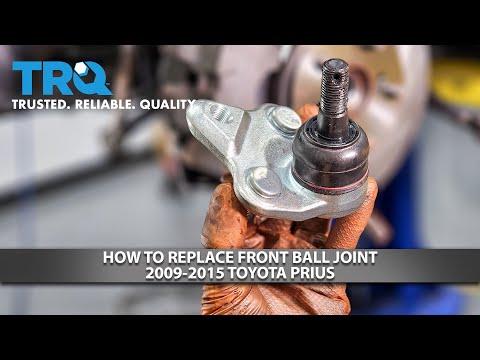







How to Replace Front Lower Ball Joints on a 2016 Toyota Prius
Step-by-step instructions with tools, torque specs, safety tips, and alignment advice for 2016, 2017, 2018, 2019, 2020, 2021, 2022
How to Replace Front Lower Ball Joints on a 2016 Toyota Prius
Step-by-step instructions with tools, torque specs, safety tips, and alignment advice for 2016, 2017, 2018, 2019, 2020, 2021, 2022


🔧 Ball Joints - Replacement
Assumption: This covers the front lower ball joints on both sides of your Prius.
The front lower ball joints connect the front suspension to the steering knuckle. If they have play, noise, or torn boots, they should be replaced to restore safe steering and prevent uneven tire wear.
Difficulty Level: Advanced | Estimated Time: 3-5 hours
⚠️ Safety & Precautions
- Support the car securely on jack stands before working underneath.
- Hybrid system: keep the vehicle OFF and the key fob far away.
- Do not place any part of your body under the car unless it is fully supported.
- Use a ball joint separator carefully to avoid sudden release of the steering knuckle.
- After service, the front end should be aligned.
🔧 Required Tools
You'll need the following tools for this repair:
- Floor jack (rated 3-ton minimum)
- Jack stands (rated 3-ton minimum)
- Wheel chocks
- Safety glasses
- Mechanic gloves
- 21mm lug wrench or socket
- 10mm socket
- 12mm socket
- 14mm socket
- 17mm socket
- 19mm socket
- Torque wrench
- Ratchet
- Breaker bar
- Ball joint separator (specialty)
- Pickle fork (specialty)
- Penetrating oil
- Paint marker
- Bungee cord or mechanic's wire
🔩 Required Parts
HowToo sells all the parts you need for this repair:
- Front lower ball joint - Qty: 2
- Ball joint cotter pins - Qty: 2
- Front lower ball joint nuts - Qty: 2
- Front suspension fastener hardware kit - Qty: 1
📋 Before You Begin
- Park on level ground and set the parking brake.
- Loosen the front wheel lug nuts before lifting the car.
- Raise the front and support it with jack stands.
- Turn the steering wheel for better access to each side as needed.
🔨 Step-by-Step Instructions
Follow these steps in order:
Step 1: Raise and secure the front
- Use a floor jack to lift the front of the car at the approved lift points.
- Set the car down on jack stands and confirm it is stable.
- Remove both front wheels with a 21mm lug wrench or socket.
Step 2: Remove access components
- Use a 10mm socket to remove any small splash shield fasteners that block access.
- If needed, use a 14mm socket to move the brake hose bracket out of the way.
- Do not let the brake caliper hang by the hose; support it with bungee cord or mechanic's wire.
Step 3: Separate the ball joint from the steering knuckle
- Spray penetrating oil on the ball joint nut and stud area.
- Use a 19mm socket to remove the castle nut from the ball joint stud.
- Remove the cotter pin first if equipped.
- Use a ball joint separator (specialty) to break the taper loose from the knuckle.
- Tap the tool lightly; do not hit the stud directly.
Step 4: Remove the ball joint from the control arm
- Use a 17mm socket and 12mm socket as needed to remove the ball joint mounting bolts.
- Remove the ball joint from the lower control arm.
- Repeat the same process on the other side.
Step 5: Install the new ball joint
- Position the new ball joint in the lower control arm.
- Install the mounting bolts by hand first.
- Use a torque wrench to tighten the ball joint mounting bolts to 49 Nm (36 ft-lbs).
- Insert the ball joint stud into the steering knuckle.
- Install the new nut and tighten with a 19mm socket to 71 Nm (52 ft-lbs).
- Install a new cotter pin if the design uses one.
Step 6: Reassemble the front end
- Reinstall any brackets or splash shield fasteners with a 10mm socket and 14mm socket.
- Reinstall both front wheels.
- Lower the car and tighten the lug nuts with a torque wrench to 103 Nm (76 ft-lbs).
Step 7: Repeat on the other side
- Replace the other front ball joint using the same steps.
- Replace both sides to keep steering balanced.
✅ After Repair
- Start the car and turn the steering wheel lock-to-lock while parked.
- Check for clunks, binding, or looseness.
- Test drive slowly and listen for noise over bumps.
- Get a professional front-end alignment as soon as possible.
💰 DIY vs Shop Cost
Shop Cost: $450-$900 (parts + labor)
DIY Cost: $90-$220 (parts only)
You Save: $360-$680 by doing it yourself!
Shop labor rates vary but typically run $100-$150/hour. This repair takes a shop approximately 3-5 hours.
🎯 Ready to get started?
HowToo makes it easy: same-day/2-day shipping on every part, plus all the tools and specialty tools you need! Check out the parts and tools sections below to add everything to your cart.