









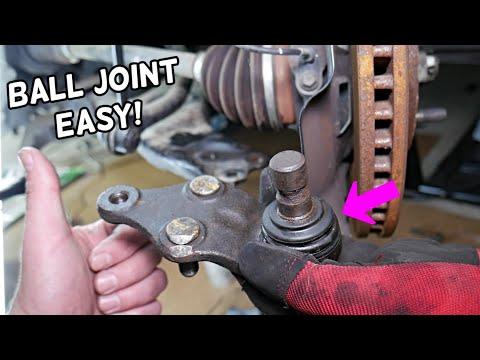







How to Replace Front Lower Ball Joints on a 2016 Kia Optima (Step-by-Step Guide)
Tools, parts, press vs control arm options, torque specs, safety tips, and alignment advice
How to Replace Front Lower Ball Joints on a 2016 Kia Optima (Step-by-Step Guide)
Tools, parts, press vs control arm options, torque specs, safety tips, and alignment advice for 2016


🔧 Optima - Front Lower Ball Joint Replacement
The front lower ball joint connects the steering knuckle to the lower control arm and lets the suspension move while you steer. On your Optima, this job is done at the front wheels and usually requires separating the knuckle and pressing the joint out/in (or replacing the entire lower control arm if the ball joint isn’t sold separately).
Difficulty Level: Advanced | Estimated Time: 2.5-5.0 hours
⚠️ Safety & Precautions
- ⚠️ Support the car with jack stands—never work under a car held only by a jack.
- ⚠️ Keep the car OFF (not READY) and keep the key fob away; hybrids can start systems quietly.
- ⚠️ Avoid pulling or stressing any orange high-voltage cables (they’re HV wiring).
- ⚠️ Wear eye protection; rust flakes and debris fall when separating joints.
- ⚠️ After any ball joint/control arm work, a wheel alignment is strongly recommended.
🔧 Required Tools
You'll need the following tools for this repair:
- Floor jack (rated 3-ton minimum)
- Jack stands (rated 3-ton minimum)
- Wheel chocks
- Safety glasses
- Mechanic gloves
- Breaker bar 1/2"
- Torque wrench 1/2" (20–200 ft-lbs range)
- Torque wrench 3/8" (10–80 ft-lbs range)
- 21mm socket
- 17mm socket
- 19mm socket
- 14mm socket
- 12mm socket
- 17mm wrench
- 19mm wrench
- Pry bar (18")
- Needle-nose pliers
- Hammer (2 lb)
- Ball joint separator tool (pickle fork) (specialty)
- Ball joint press kit (C-frame press) (specialty)
- Penetrating oil
- Wire brush
- Bungee cord
🔩 Required Parts
HowToo sells all the parts you need for this repair:
- Front lower ball joint - Qty: 2 Replace in pairs
- Front lower ball joint pinch bolt/nut kit - Qty: 2
- Cotter pins (assorted) - Qty: 1 pack
- Front lower control arm assembly - Qty: 2 If ball joint is not serviceable
📋 Before You Begin
- Park on level ground, shift to Park, and chock the rear wheels.
- Turn the car OFF and keep the key fob at least 15 feet away.
- Crack the front lug nuts loose before lifting (about 1/2 turn) using a 21mm socket and breaker bar.
- Lift the front with a floor jack and support securely on jack stands under the proper front support points.
- “Knuckle” = the part the wheel hub bolts to.
🔨 Step-by-Step Instructions
Follow these steps in order:
Step 1: Remove the front wheel
- Remove the lug nuts using a 21mm socket and take the wheel off.
Step 2: Support the steering knuckle
- Place a floor jack lightly under the lower control arm/knuckle area to prevent the suspension from dropping suddenly.
- Use a bungee cord to steady the knuckle if needed.
Step 3: Locate the lower ball joint connection
- Turn the steering left/right by hand to get better access.
- Clean the fasteners with a wire brush and soak with penetrating oil.
Step 4: Remove the ball joint-to-knuckle fastener (common setup)
- On many Optima front ends, the ball joint stud is clamped into the knuckle with a pinch bolt.
- Remove the pinch bolt/nut using a 17mm socket and 17mm wrench.
- Torque to 69–83 Nm (51–61 ft-lbs) on reassembly.
- If it uses a castle nut + cotter pin instead: pull the cotter pin with needle-nose pliers, remove the nut with a 19mm socket, then reassemble with a new cotter pin and Torque to 88–108 Nm (65–80 ft-lbs).
Step 5: Separate the ball joint from the knuckle
- Install the ball joint separator tool (pickle fork) at the joint and strike it with a 2 lb hammer until the taper releases.
- Use a pry bar (18") as needed to push the control arm down while guiding the knuckle up.
- Keep fingers clear; it can “pop” free.
Step 6: Determine which repair your Optima uses
- Path A (Press-in ball joint): The ball joint presses into the control arm.
- Path B (Non-serviceable ball joint): The ball joint is integrated—replace the entire lower control arm assembly.
Step 7A: (Path A) Press the old ball joint out
- Set up the ball joint press kit (C-frame press) with the correct cups to support the control arm.
- Drive the joint out by tightening the press with a breaker bar 1/2".
- If it fights you, re-check cup alignment.
Step 8A: (Path A) Press the new ball joint in
- Align the new joint squarely in the bore and press it in using the ball joint press kit (C-frame press) (specialty).
- Press until fully seated (flush against the control arm shoulder).
Step 7B: (Path B) Replace the lower control arm assembly
- Remove the control arm-to-subframe bolts using a 19mm socket and breaker bar.
- If equipped with an additional bracket/fastener, remove it using a 14mm socket or 17mm socket as applicable.
- Install the new control arm in the same orientation.
- Torque control arm mounting bolts to 147–176 Nm (108–130 ft-lbs).
- Final-tighten with suspension at ride height.
Step 9: Reinstall the ball joint into the knuckle
- Guide the ball joint stud back into the knuckle.
- Install the new pinch bolt/nut using a 17mm socket and 17mm wrench, then Torque to 69–83 Nm (51–61 ft-lbs).
- If your setup uses a castle nut, tighten with a 19mm socket and Torque to 88–108 Nm (65–80 ft-lbs), then install a new cotter pin using needle-nose pliers.
Step 10: Reinstall the wheel
- Reinstall the wheel and hand-thread the lug nuts.
- Lower the car off the jack stands using the floor jack.
- Tighten lug nuts in a star pattern with a torque wrench 1/2": Torque to 108–118 Nm (80–87 ft-lbs).
✅ After Repair
- Start the car and turn the steering wheel lock-to-lock while parked; listen for clunks.
- Test drive slowly over small bumps; re-check for noise.
- Get a 4-wheel alignment as soon as possible to prevent tire wear.
- After 50–100 miles, re-check lug nut torque using a torque wrench 1/2": Torque to 108–118 Nm (80–87 ft-lbs).
💰 DIY vs Shop Cost
Shop Cost: $450-$1,100 (parts + labor)
DIY Cost: $80-$350 (parts only)
You Save: $370-$750 by doing it yourself!
Shop labor rates vary but typically run $100-$150/hour. This repair takes a shop approximately 2.5-4.0 hours.
🎯 Ready to get started?
HowToo makes it easy: same-day/2-day shipping on every part, plus all the tools and specialty tools you need! Check out the parts and tools sections below to add everything to your cart.
Guide for Suspension Ball Joint replace for these Kia vehicles
| Year Make Model | Sub Model | Engine | Body Style |
|---|---|---|---|
| 2016 Kia Optima | - | - | - |