









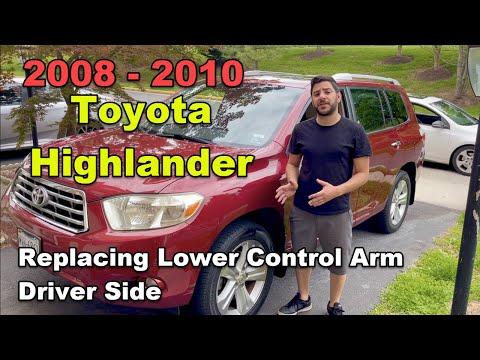



How to Replace Front Control Arms on a 2013 Toyota Highlander
Step-by-step suspension repair guide with tools, parts, torque specs, and alignment tips for 2009, 2010, 2011, 2012, 2013, 2014, 2015, 2016, 2017, 2018, 2019
How to Replace Front Control Arms on a 2013 Toyota Highlander
Step-by-step suspension repair guide with tools, parts, torque specs, and alignment tips for 2009, 2010, 2011, 2012, 2013, 2014, 2015, 2016, 2017, 2018, 2019


🔧 Highlander - Front Control Arm Replacement
Replacing the front lower control arms on your Highlander restores proper suspension support, alignment stability, and ride control. The control arm holds the wheel hub in position with bushings and a ball joint, so the vehicle must be safely lifted and aligned afterward.
Difficulty Level: Advanced | Estimated Time: 3-5 hours
⚠️ Safety & Precautions
- ⚠️ Suspension parts hold vehicle weight and steering geometry; support your Highlander securely before loosening anything.
- ⚠️ Never work under a vehicle supported only by a floor jack.
- ⚠️ Replace control arms in pairs if the bushings or ball joints are worn on both sides.
- ⚠️ Do not tighten control arm bushing bolts while the suspension is hanging; this can preload and tear the bushings.
- ⚠️ A wheel alignment is required after replacement.
- ⚠️ Battery disconnect is not required for this repair.
🔧 Required Tools
You'll need the following tools for this repair:
- 21mm socket
- 19mm socket
- 17mm socket
- 14mm socket
- 10mm socket
- 21mm wrench
- 19mm wrench
- 17mm wrench
- 14mm wrench
- 1/2-inch breaker bar
- 1/2-inch ratchet
- 3/8-inch ratchet
- 1/2-inch extension 6-inch
- Torque wrench 1/2-inch drive
- Torque wrench 3/8-inch drive
- Ball joint separator (specialty)
- Pry bar 24-inch
- Rubber mallet 16-ounce
- Needle-nose pliers
- Flathead screwdriver 1/4-inch tip
- Paint marker
- Floor jack rated 3-ton minimum
- Jack stands rated 3-ton minimum
- Wheel chocks
- Safety glasses
- Mechanic gloves
🔩 Required Parts
HowToo sells all the parts you need for this repair:
- Front lower control arm assembly - Driver side - Qty: 1
- Front lower control arm assembly - Passenger side - Qty: 1 if replacing in pairs
- Front lower ball joint cotter pin - Qty: 1 per side
- Front lower ball joint castle nut - Qty: 1 per side if not included
- Control arm mounting bolts and nuts - Qty: As needed if corroded or damaged
📋 Before You Begin
- ✅ Park your Highlander on level ground.
- ✅ Set the parking brake and place wheel chocks behind the rear wheels.
- ✅ Loosen the front wheel lug nuts slightly before lifting the vehicle.
- ✅ A control arm bushing is a rubber mount that lets the suspension move quietly while holding alignment.
- ✅ A ball joint is a pivot joint that lets the steering knuckle move while staying attached to the suspension.
- ✅ Plan for a professional alignment immediately after the repair.
🔨 Step-by-Step Instructions
Follow these steps in order:
Step 1: Loosen the Front Wheel Lug Nuts
- Use a 21mm socket and 1/2-inch breaker bar to loosen the front lug nuts about half a turn.
- Do not remove the lug nuts yet.
- Loosen wheels before lifting.
Step 2: Raise and Support the Vehicle
- Use a floor jack rated 3-ton minimum to lift the front of your Highlander at the front center jacking point.
- Place jack stands rated 3-ton minimum under the proper front support points.
- Lower the vehicle gently onto the stands.
- Shake the vehicle lightly by hand to confirm it is stable.
Step 3: Remove the Front Wheel
- Use a 21mm socket and 1/2-inch ratchet to remove the loosened lug nuts.
- Remove the wheel and set it flat under the side of the vehicle as a backup safety measure.
Step 4: Mark Control Arm Bolt Positions
- Use a paint marker to mark the position of the control arm mounting bolts and washers.
- This helps keep the alignment close enough to drive carefully to an alignment shop.
- It does not replace a real alignment.
Step 5: Detach the Stabilizer Link if Needed
- Use a 17mm socket, 17mm wrench, and 3/8-inch ratchet to remove the stabilizer bar link nut from the control arm if it blocks removal.
- If the stud spins, hold the stud with the appropriate wrench while turning the nut with the 17mm wrench.
- Move the link aside by hand.
Step 6: Remove the Ball Joint Cotter Pin
- Use needle-nose pliers to straighten and remove the cotter pin from the lower ball joint castle nut.
- A cotter pin is a small bent safety pin that keeps the nut from backing off.
- Use a flathead screwdriver 1/4-inch tip if needed to help lift the pin end.
Step 7: Loosen the Lower Ball Joint Nut
- Use a 19mm socket and 1/2-inch breaker bar to loosen the lower ball joint castle nut.
- Leave the nut threaded on a few turns while separating the joint.
- This keeps the control arm from dropping suddenly.
Step 8: Separate the Ball Joint from the Control Arm
- Use a ball joint separator (specialty) to separate the lower ball joint stud from the control arm.
- If needed, tap the separator with a rubber mallet 16-ounce.
- Once separated, remove the nut fully with the 19mm socket and 1/2-inch ratchet.
- Move the knuckle and ball joint stud clear of the control arm by hand.
Step 9: Remove the Rear Control Arm Mounting Bolt
- Use a 19mm socket, 19mm wrench, and 1/2-inch breaker bar to loosen the rear control arm mounting bolt and nut.
- Remove the bolt with the 1/2-inch ratchet and 19mm socket.
- Keep track of washer orientation.
Step 10: Remove the Front Control Arm Mounting Bolt
- Use a 19mm socket, 19mm wrench, 1/2-inch extension 6-inch, and 1/2-inch breaker bar to loosen the front control arm mounting bolt.
- Remove the bolt with the 1/2-inch ratchet and 19mm socket.
- Support the arm by hand as the final bolt comes out.
Step 11: Remove the Old Control Arm
- Use a pry bar 24-inch to gently work the control arm out of the subframe mounts.
- Do not pry against brake lines, axle boots, or wiring.
- Remove the control arm from the vehicle.
Step 12: Compare the New Control Arm
- Place the old and new control arms side by side.
- Confirm the bushing positions, ball joint hole, and mounting points match.
- Use the paint marker to transfer any orientation marks if helpful.
Step 13: Install the New Control Arm
- Position the new control arm into the subframe mounts by hand.
- Use a rubber mallet 16-ounce to gently help seat it if needed.
- Install the front and rear mounting bolts by hand only.
- Do not fully tighten the bushing bolts yet.
Step 14: Reconnect the Lower Ball Joint
- Guide the lower ball joint stud into the control arm by hand.
- Install the castle nut by hand.
- Use a 19mm socket and torque wrench 1/2-inch drive to tighten the lower ball joint nut to Torque to 103 Nm (76 ft-lbs).
- Install a new front lower ball joint cotter pin using needle-nose pliers.
- If the cotter pin hole does not line up, tighten the nut slightly more until it lines up. Do not loosen it to align the hole.
Step 15: Reattach the Stabilizer Link if Removed
- Place the stabilizer link back into the control arm by hand.
- Install the nut by hand.
- Use a 17mm socket, 17mm wrench, and torque wrench 3/8-inch drive to tighten the stabilizer link nut to Torque to 74 Nm (55 ft-lbs).
Step 16: Preload the Suspension Before Final Tightening
- Place the floor jack rated 3-ton minimum under the outer end of the control arm.
- Raise the control arm carefully until it sits close to normal ride height.
- Normal ride height means the suspension is positioned like the vehicle is sitting on the ground.
- This protects the rubber bushings from twisting and tearing early.
Step 17: Torque the Control Arm Mounting Bolts
- With the suspension preloaded, use a 19mm socket, 19mm wrench, and torque wrench 1/2-inch drive to tighten the front control arm mounting bolt to Torque to 137 Nm (101 ft-lbs).
- Use the 19mm socket, 19mm wrench, and torque wrench 1/2-inch drive to tighten the rear control arm mounting bolt to Torque to 137 Nm (101 ft-lbs).
- Lower the floor jack from the control arm slowly.
Step 18: Repeat on the Other Side if Replacing in Pairs
- Use the same steps and same tools on the opposite front control arm.
- Replacing both sides keeps suspension behavior even.
Step 19: Reinstall the Front Wheel
- Install the wheel by hand.
- Start all lug nuts by hand to avoid cross-threading.
- Use a 21mm socket and 1/2-inch ratchet to snug the lug nuts in a star pattern.
Step 20: Lower the Vehicle and Torque Lug Nuts
- Use the floor jack rated 3-ton minimum to lift the vehicle slightly off the jack stands.
- Remove the jack stands rated 3-ton minimum.
- Lower the vehicle to the ground.
- Use a 21mm socket and torque wrench 1/2-inch drive to tighten the wheel lug nuts in a star pattern to Torque to 103 Nm (76 ft-lbs).
✅ After Repair
- ✅ Bounce the front of your Highlander gently and listen for clunks.
- ✅ Check that all tools are removed from under the vehicle.
- ✅ Take a short, slow test drive and listen for knocking, popping, or pulling.
- ✅ Get a professional wheel alignment immediately after the repair.
- ✅ Recheck lug nut torque after 25-50 miles.
- ✅ If the steering wheel is off-center or the vehicle pulls, drive only carefully to the alignment shop.
💰 DIY vs Shop Cost
Shop Cost: $650-$1,150 (parts + labor + alignment)
DIY Cost: $180-$450 (parts only, alignment extra)
You Save: $350-$600 by doing it yourself!
Shop labor rates vary but typically run $100-$150/hour. This repair takes a shop approximately 2-3 hours plus alignment time.
🎯 Ready to get started?
HowToo makes it easy: same-day/2-day shipping on every part, plus all the tools and specialty tools you need! Check out the parts and tools sections below to add everything to your cart.