








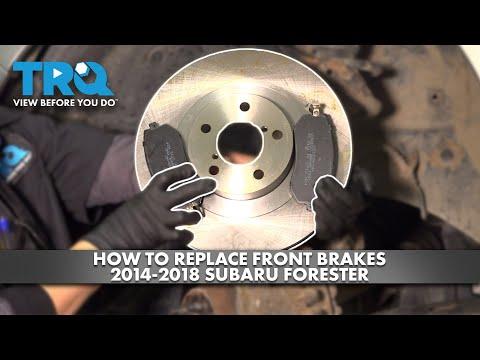







How to Replace Front Brake Pads & Rotors on a 2014-2018 Subaru Forester (DIY Guide) (Engine: Flat 4 2.0L)
Step-by-step instructions with tools, parts list, torque specs, safety tips, and pad/rotor break-in procedure
How to Replace Front Brake Pads & Rotors on a 2014-2018 Subaru Forester (DIY Guide) (Engine: Flat 4 2.0L)
Step-by-step instructions with tools, parts list, torque specs, safety tips, and pad/rotor break-in procedure for 2014, 2015, 2016, 2017, 2018


🔧 Forester - Front Brake Pads & Rotor Replacement
You’ll remove the front wheels, take off the front brake calipers, replace the pads and rotors, then torque everything back to spec. This restores braking performance and eliminates pulsation/grinding caused by worn pads or warped rotors.
Difficulty Level: Intermediate | Estimated Time: 2-4 hours
⚠️ Safety & Precautions
- 🛑 Work on level ground and chock the rear wheels.
- 🛑 Support your Forester with jack stands—never rely on a floor jack alone.
- 🛑 Brakes make dust—wear a dust mask and use brake cleaner, not compressed air.
- 🛑 Do not let the caliper hang by the brake hose; support it with a bungee cord.
- 🛑 Keep grease off pad/rotor friction surfaces; clean rotors with brake cleaner before install.
- 🛑 Battery disconnect is not required for this repair.
🔧 Required Tools
You'll need the following tools for this repair:
- Floor jack (rated 3-ton minimum)
- Jack stands (pair, rated 3-ton minimum)
- Wheel chocks
- Safety glasses
- Nitrile gloves
- Dust mask
- 19mm socket
- 14mm socket
- 17mm socket
- 3/8" ratchet
- 1/2" breaker bar
- Torque wrench (10–200 Nm range)
- Flat-blade screwdriver
- C-clamp (6" or larger)
- Bungee cord
- Wire brush
- Rubber mallet
- Drip pan
🔩 Required Parts
HowToo sells all the parts you need for this repair:
- Front brake pad set - Qty: 1
- Front brake rotors - Replace in pairs - Qty: 2
- Front brake pad hardware kit (clips/shims) - Qty: 1
- Brake lubricant (silicone-based) - Qty: 1
- Brake cleaner - Qty: 2
- DOT 3 brake fluid - Qty: 1 quart
- Anti-seize compound - Qty: 1
📋 Before You Begin
- 🧰 Park on level ground, turn the engine off, and set the parking brake.
- 🧰 Loosen the front wheel lug nuts slightly with a 19mm socket and breaker bar before lifting.
- 🧰 Open the hood and check the brake fluid reservoir level. If it’s near “MAX,” remove a little fluid with a clean syringe/turkey baster into a drip pan (pushing pistons back can overflow it).
- 🧰 A C-clamp is a screw clamp used to slowly press the caliper piston back in.
🔨 Step-by-Step Instructions
Follow these steps in order:
Step 1: Lift and secure the front end
- Place wheel chocks behind the rear tires.
- Use a floor jack to lift the front of your Forester at the proper front jacking point.
- Set the vehicle onto jack stands and gently test stability.
Step 2: Remove the front wheels
- Remove lug nuts using a 19mm socket and 3/8" ratchet.
- Remove both front wheels and set them aside.
Step 3: Remove the front caliper (do not disconnect the hose)
- Turn the steering wheel to give yourself more room at the caliper you’re working on.
- Remove the caliper slide pin bolts using a 14mm socket and 3/8" ratchet.
- Lift the caliper off the bracket and suspend it with a bungee cord.
- Torque to 27 Nm (20 ft-lbs) for caliper slide pin bolts during reassembly.
Step 4: Remove the old pads and hardware
- Pull the pads out of the bracket by hand; use a flat-blade screwdriver if needed.
- Remove the pad clips/shims (hardware) from the bracket.
- Clean the bracket pad landing areas with a wire brush.
Step 5: Remove the caliper bracket
- Remove the two caliper bracket bolts using a 17mm socket and breaker bar.
- Set the bracket aside.
- Torque to 114 Nm (84 ft-lbs) for caliper bracket bolts during reassembly.
Step 6: Remove the old rotor
- Pull the rotor straight off the hub.
- If stuck, tap around the rotor hat with a rubber mallet to break rust free.
- Tap evenly; don’t hit the studs.
Step 7: Prep the hub and install the new rotor
- Clean the hub face with a wire brush so the rotor sits flat.
- Apply a very thin film of anti-seize compound to the hub face (avoid studs).
- Spray both sides of the new rotor with brake cleaner and wipe clean (removes packing oil).
- Install the new rotor onto the hub.
Step 8: Reinstall the caliper bracket with new hardware
- Install the new pad clips/hardware onto the bracket.
- Reinstall the bracket and tighten bolts using a 17mm socket and torque wrench.
- Torque to 114 Nm (84 ft-lbs).
Step 9: Compress the caliper piston
- Place an old brake pad against the caliper piston face.
- Use a C-clamp to slowly press the piston fully back into the caliper.
- Watch the brake fluid reservoir while compressing; remove fluid if it approaches overflow.
Step 10: Install the new pads and lubricate correctly
- Apply a thin layer of brake lubricant (silicone-based) to pad backing plates and contact points where the pads touch the clips (do not lube the friction material).
- Install the inner and outer pads into the bracket.
Step 11: Reinstall the caliper
- Slide the caliper over the new pads.
- Install slide pin bolts using a 14mm socket and torque wrench.
- Torque to 27 Nm (20 ft-lbs).
Step 12: Reinstall wheels and torque lug nuts
- Reinstall the wheels and hand-thread the lug nuts.
- Lower the vehicle with the floor jack, remove jack stands, and set the vehicle on the ground.
- Tighten lug nuts in a star pattern using a 19mm socket and torque wrench.
- Torque to 120 Nm (89 ft-lbs).
✅ After Repair
- 🔍 Before driving, pump the brake pedal 10–15 times until it feels firm (this seats the pistons against the pads).
- 🔍 Check brake fluid level and top off with DOT 3 brake fluid if needed.
- 🔍 Check for leaks and listen for abnormal grinding or clunks on a short test drive.
- 🔍 Bed-in (break-in) the pads/rotors: make 6–10 moderate stops from ~35–40 mph down to ~5 mph, letting brakes cool a bit between stops; avoid hard stops for the first ~200 miles.
💰 DIY vs Shop Cost
Shop Cost: $450-$800 (parts + labor)
DIY Cost: $180-$350 (parts only)
You Save: $270-$450 by doing it yourself!
Shop labor rates vary but typically run $100-$150/hour. This repair takes a shop approximately 1.5-2.5 hours.
🎯 Ready to get started?
HowToo makes it easy: same-day/2-day shipping on every part, plus all the tools and specialty tools you need! Check out the parts and tools sections below to add everything to your cart.
Guide for Disc Brake Pad Set replace for these Subaru vehicles
| Year Make Model | Sub Model | Engine | Body Style |
|---|---|---|---|
| 2018 Subaru Forester | - | Flat 4 2.0L | - |
| 2017 Subaru Forester | - | Flat 4 2.0L | - |
| 2016 Subaru Forester | - | Flat 4 2.0L | - |
| 2015 Subaru Forester | - | Flat 4 2.0L | - |
| 2014 Subaru Forester | - | Flat 4 2.0L | - |