















How to Replace Front Brake Pads and Rotors on a 2020 Toyota GR Supra
Step-by-step front brake service with tools, parts list, safety tips, and key torque specs
How to Replace Front Brake Pads and Rotors on a 2020 Toyota GR Supra
Step-by-step front brake service with tools, parts list, safety tips, and key torque specs


🔧 Supra - Front Brake Pads & Rotor Replacement
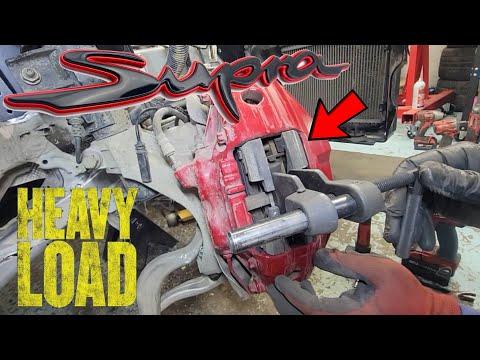
You’ll remove the front wheels, take off the front brake calipers and old pads, replace the front rotors, then install new pads and reassemble everything to factory torque specs. This restores safe stopping power and prevents vibration/pulsation from worn or warped rotors.
Difficulty Level: Intermediate | Estimated Time: 2-4 hours
⚠️ Safety & Precautions
- 🛑 Work on a flat surface and support your Supra with jack stands—never rely on a jack alone.
- 🔥 Brakes get extremely hot; let everything cool fully before touching calipers/rotors.
- 🧤 Don’t breathe brake dust; use brake cleaner and wear a dust mask.
- ⚠️ Do not press the brake pedal with a caliper removed.
- 🔒 Keep brake fluid off paint; it damages finishes quickly.
🔧 Required Tools
You'll need the following tools for this repair:
- Floor jack (rated 3-ton minimum)
- Jack stands (rated 3-ton minimum)
- Wheel chocks
- 17mm socket
- 1/2" drive breaker bar
- 1/2" drive torque wrench (20-200 Nm range)
- Ratchet (3/8" drive)
- Socket set (8mm-18mm)
- E-Torx socket set (E12-E18)
- Hex bit socket set (6mm-10mm)
- Torx bit socket set (T30-T50)
- Flat trim tool
- Small pick tool
- Brake caliper hanger hook
- Brake piston spreader tool (specialty)
- Wire brush
- Rubber mallet
- Micrometer or vernier caliper (specialty)
- Brake cleaner spray
- Shop rags
- Nitrile gloves
- Safety glasses
- Dust mask
🔩 Required Parts
HowToo sells all the parts you need for this repair:
- Front brake pad set - Qty: 1
- Front brake rotors - Replace in pairs - Qty: 2
- Front pad wear sensor - If equipped - Qty: 1
- Brake pad hardware kit - If applicable - Qty: 1
- Brake caliper bolts - If one-time-use on your Supra - Qty: 2-4
- Brake rotor retaining screw - If equipped - Qty: 2
- High-temperature brake lubricant - Qty: 1
- Blue threadlocker - Qty: 1
📋 Before You Begin
- 🧭 Park on level ground, put the transmission in Park, and set the parking brake.
- 🧱 Chock the rear wheels with wheel chocks.
- 🧴 Open the hood and check the brake fluid level; if it’s near “MAX,” be ready to remove a little fluid when you push pistons back.
- 🧰 Lay out parts for left vs right so nothing gets mixed.
🔨 Step-by-Step Instructions
Follow these steps in order:
Step 1: Confirm which front caliper style you have
- Look through the wheel spokes with a flashlight.
- If you see two cross pins + a spring clip holding pads in, you have a fixed multi-piston caliper (common on your Supra).
- If you see a single sliding caliper with rubber boots over guide pins, follow the “Sliding Caliper” notes in Steps 6-8.
Step 2: Loosen wheel bolts and lift the front
- Use a 17mm socket and breaker bar to loosen the front wheel bolts 1/2 turn while the car is on the ground.
- Lift the front using a floor jack (rated 3-ton minimum) at the correct front center jack point, then support both sides with jack stands (rated 3-ton minimum).
- Remove the wheel bolts with a 17mm socket and take off both front wheels.
Step 3: Remove the caliper (do not let it hang)
- Turn the steering wheel to give yourself space to work.
- Remove the caliper mounting bolts using the correct E-Torx socket or hex bit socket (your Supra commonly uses E-Torx here).
- Lift the caliper off the rotor and support it with a brake caliper hanger hook.
- Never hang a caliper by the hose.
Step 4: Remove the old brake pads
- Fixed caliper style:
- Use a small pick tool to help remove the anti-rattle spring clip (if fitted).
- Drive the pad retaining pins out using a flat trim tool and rubber mallet, then slide the pads out.
- Sliding caliper style:
- Use the correct hex bit socket to remove the guide pin bolts, then lift the caliper and remove pads.
Step 5: Retract the brake pistons
- Install the old pad against the pistons and use a brake piston spreader tool (specialty) to push the pistons back slowly and evenly. A piston spreader is a screw-type tool that presses the pistons in without damaging them.
- Watch the brake fluid reservoir while compressing; if it rises too much, remove a small amount with rags and care.
Step 6: Remove the rotor retaining screw (if equipped)
- Use the correct Torx bit socket (commonly T30) to remove the rotor retaining screw.
- If the screw is stuck, tap the bit firmly into the head with a rubber mallet before turning.
Step 7: Remove the old rotor
- If the rotor is stuck to the hub, spray around the hub center with brake cleaner spray and strike the rotor hat with a rubber mallet until it frees up.
- Clean the hub face with a wire brush and wipe with shop rags so the new rotor sits perfectly flat.
Step 8: Install the new rotor
- Clean the new rotor friction surfaces with brake cleaner spray and shop rags (this removes protective oil).
- Install the rotor onto the hub and reinstall the retaining screw using a Torx bit socket.
- Torque to 16 Nm (12 ft-lbs) for the rotor retaining screw (typical for this platform).
Step 9: Install new pads and hardware
- Apply a thin layer of high-temperature brake lubricant to pad backing plate contact points and hardware touch points.
- Do not get lubricant on the pad friction material or rotor face.
- Install the new pads in the same orientation as removed.
- If your Supra has a wear sensor, install the new front pad wear sensor and route the wire exactly like the original using the flat trim tool to open/close clips.
Step 10: Reinstall the caliper and torque fasteners
- Reinstall the caliper over the new pads/rotor.
- Apply blue threadlocker to the caliper mounting bolt threads if specified by the bolt/kit.
- Tighten the caliper mounting bolts using the correct E-Torx socket or hex bit socket.
- Torque to 110 Nm (81 ft-lbs) for the front caliper mounting bolts (common spec on this platform; verify if your bolts/kit specify otherwise).
Step 11: Reinstall wheels and torque wheel bolts
- Put the wheels back on and hand-thread all wheel bolts.
- Snug the bolts in a star pattern using a 17mm socket and ratchet (3/8" drive).
- Lower the car and final-torque using a 1/2" drive torque wrench.
- Torque to 140 Nm (103 ft-lbs) for the wheel bolts.
Step 12: Build pedal pressure before moving the car
- With the car still parked, press the brake pedal slowly 10-15 times until it feels firm.
- This seats the pads against the rotors after piston retraction.
✅ After Repair
- 🧪 Check brake fluid level and top off only if needed.
- 🔍 Inspect for leaks, loose wiring (wear sensor), and verify nothing rubs the wheel.
- 🛣️ Perform a careful road test: low-speed stops first, then moderate stops.
- 🧼 Bed-in the new pads/rotors following the pad manufacturer’s procedure; avoid hard stops when cold for the first 200-300 miles.
- 🧾 If a brake warning light stays on (wear sensor), recheck the sensor connection and routing.
💰 DIY vs Shop Cost
Shop Cost: $900-$1,600 (parts + labor)
DIY Cost: $300-$900 (parts only)
You Save: $600-$700 by doing it yourself!
Shop labor rates vary but typically run $100-$150/hour. This repair takes a shop approximately 2-3 hours.
🎯 Ready to get started?
HowToo makes it easy: same-day/2-day shipping on every part, plus all the tools and specialty tools you need! Check out the parts and tools sections below to add everything to your cart.
Quick check (so I guide you perfectly): Do your front calipers have pad pins + a spring clip (fixed/Brembo style), or are they a sliding caliper with guide pins?