









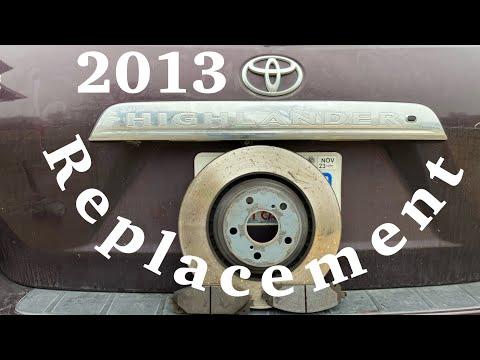




How to Replace Front Brake Pads and Rotors on a 2008-2019 Toyota Highlander (Engine: V6 3.5L)
Step-by-step DIY guide with tools, parts, torque specs, and safety tips for 2008, 2009, 2010, 2011, 2012, 2013, 2014, 2015, 2016, 2017, 2018, 2019
How to Replace Front Brake Pads and Rotors on a 2008-2019 Toyota Highlander (Engine: V6 3.5L)
Step-by-step DIY guide with tools, parts, torque specs, and safety tips for 2008, 2009, 2010, 2011, 2012, 2013, 2014, 2015, 2016, 2017, 2018, 2019


🔧 Highlander - Front Brake Pad and Rotor Replacement
This repair replaces the front brake pads and front brake rotors on your Highlander. The front brakes do most of the stopping, so worn pads or warped rotors can cause grinding, vibration, pulling, or longer stopping distance.
Difficulty Level: Beginner-Intermediate | Estimated Time: 2-3 hours
⚠️ Safety & Precautions
- ⚠️ Work on a flat, solid surface only. Never work under a vehicle supported only by a jack.
- ⚠️ Use jack stands. Jack stands are metal safety supports that hold the vehicle after lifting.
- ⚠️ Brake dust can irritate your lungs. Do not blow it off with compressed air.
- ⚠️ Brake fluid damages paint. Wipe spills immediately with water and a clean towel.
- ⚠️ Your Highlander Hybrid uses regenerative braking, but the front hydraulic brakes are serviced like normal disc brakes.
- ⚠️ Do not press the brake pedal while a caliper is removed from the rotor.
- ⚠️ No high-voltage hybrid system service is required. Do not touch orange high-voltage cables.
🔧 Required Tools
You'll need the following tools for this repair:
- 21mm lug nut socket
- 14mm socket
- 17mm socket
- Ratchet handle 3/8-inch drive
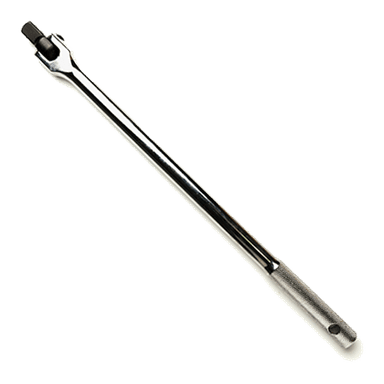
- Breaker bar 1/2-inch drive
- Torque wrench 1/2-inch drive 20-150 ft-lb range
- Torque wrench 3/8-inch drive 10-80 ft-lb range
- Floor jack rated 3-ton minimum
- Jack stands rated 3-ton minimum
- Wheel chocks
- Brake caliper piston compressor tool
- Brake hanger hook
- Flat-blade screwdriver medium
- Wire brush small
- Brake cleaner aerosol
- Shop towels
- Anti-seize brush small
- Rubber mallet 16-ounce
- M8 x 1.25 bolts 30mm length
- Nitrile gloves
- Safety glasses
- Dust mask N95
🔩 Required Parts
HowToo sells all the parts you need for this repair:
- Front brake pad set - Qty: 1
- Front brake rotors - Replace in pairs - Qty: 2
- Front brake hardware kit - Qty: 1
- Brake caliper slide pin grease - Qty: 1 packet
- Brake cleaner aerosol - Qty: 1-2 cans
- Brake fluid DOT 3 - Qty: 1 small bottle, if top-off is needed
- Anti-seize compound - Qty: 1 small packet
📋 Before You Begin
- Park your Highlander on level ground.
- Shift to Park and press the parking brake pedal fully.
- Place wheel chocks behind both rear wheels.
- Open the hood and check the brake fluid level in the reservoir.
- If the reservoir is at MAX, remove a small amount with a clean suction tool before compressing calipers.
- Keep the brake fluid cap loosely installed to reduce spills while allowing fluid to return.
- No infotainment menu or scan tool brake service mode is needed for the front brakes on your Highlander.
🔨 Step-by-Step Instructions
Follow these steps in order:
Step 1: Loosen the Front Lug Nuts
- Use a 21mm lug nut socket and breaker bar 1/2-inch drive to loosen each front lug nut about half a turn.
- Do this while the tires are still on the ground.
- Do not remove the lug nuts yet.
- Loose first, lift second.
Step 2: Lift and Support the Front of the Vehicle
- Use a floor jack rated 3-ton minimum at the front center jack point on the front subframe.
- Raise the front of your Highlander high enough to place jack stands under the front side support points.
- Place jack stands rated 3-ton minimum under the reinforced front side pinch weld areas.
- Slowly lower the vehicle onto the jack stands.
- Gently shake the vehicle by hand to confirm it is stable.
Step 3: Remove the Front Wheels
- Use a 21mm lug nut socket and ratchet handle 3/8-inch drive to remove the loosened lug nuts.
- Remove both front wheels by hand.
- Slide one wheel under the vehicle as a backup safety measure.
Step 4: Turn the Steering for Better Access
- Turn the steering wheel left to work on the right front brake.
- Turn the steering wheel right to work on the left front brake.
- This gives more room to reach the caliper bolts.
Step 5: Inspect the Brake Hose and Caliper Area
- Use safety glasses, nitrile gloves, and a dust mask N95.
- Look at the rubber brake hose for cracks, swelling, or leaks.
- Look at the caliper piston boot for tears or wet brake fluid.
- If you see fluid leaking, stop and repair that issue before continuing.
Step 6: Remove the Caliper Slide Pin Bolts
- The caliper is the clamp-shaped part that squeezes the brake pads against the rotor.
- Use a 14mm socket and ratchet handle 3/8-inch drive to remove the two caliper slide pin bolts.
- If a slide pin spins with the bolt, hold the pin flats with a suitable wrench while loosening the bolt.
- Keep the bolts clean on a shop towel.
Step 7: Remove and Support the Caliper
- Lift the caliper off the brake pads by hand.
- If it sticks, use a flat-blade screwdriver medium to gently pry between the old pad and rotor.
- Hang the caliper from the strut spring using a brake hanger hook.
- Do not let the caliper hang by the rubber brake hose.
Step 8: Remove the Old Brake Pads
- Slide the old inner and outer brake pads out of the caliper bracket by hand.
- Note the position of any wear indicator tab before removal.
- The wear indicator is a small metal tab that squeals when pads are worn low.
Step 9: Remove the Caliper Bracket
- The caliper bracket is the heavy metal frame that holds the pads around the rotor.
- Use a 17mm socket and breaker bar 1/2-inch drive to loosen the two caliper bracket bolts.
- Remove the bolts with the 17mm socket and ratchet handle 3/8-inch drive.
- Remove the caliper bracket by hand.
Step 10: Remove the Old Rotor
- Pull the rotor straight off the hub by hand.
- If the rotor is stuck, thread two M8 x 1.25 bolts 30mm length evenly into the small threaded holes on the rotor face.
- Use a ratchet handle 3/8-inch drive with a matching socket to tighten each bolt a few turns at a time until the rotor pops loose.
- If needed, tap the rotor hat with a rubber mallet 16-ounce.
- Do not hit the wheel studs.
Step 11: Clean the Hub Face
- Use a wire brush small to clean rust and dirt from the wheel hub face.
- Spray the hub lightly with brake cleaner aerosol.
- Wipe dry with shop towels.
- Apply a very thin film of anti-seize compound to the hub face using an anti-seize brush small.
- Keep anti-seize off the wheel studs and rotor braking surfaces.
Step 12: Install the New Rotor
- Clean both sides of the new rotor with brake cleaner aerosol.
- Wipe dry with shop towels.
- Slide the new rotor onto the hub by hand.
- Install one lug nut backward by hand to hold the rotor flat against the hub.
Step 13: Service the Caliper Bracket Hardware
- Remove the old pad support clips from the caliper bracket by hand or with a flat-blade screwdriver medium.
- Use a wire brush small to clean the metal areas under the clips.
- Install the new clips from the front brake hardware kit by hand.
- Apply a tiny amount of brake caliper slide pin grease only where the pad ears touch the clips.
- Do not get grease on the rotor or pad friction material.
Step 14: Check and Grease the Slide Pins
- Pull each slide pin out of the caliper bracket by hand.
- Wipe old grease off with shop towels.
- Apply a thin coat of brake caliper slide pin grease.
- Push each slide pin back into its boot by hand.
- Make sure each pin moves smoothly.
Step 15: Reinstall the Caliper Bracket
- Place the caliper bracket over the rotor by hand.
- Start both bracket bolts by hand.
- Use a 17mm socket and torque wrench 1/2-inch drive 20-150 ft-lb range to tighten the bracket bolts.
- Torque to 107 Nm (79 ft-lbs).
Step 16: Compress the Caliper Piston
- The caliper piston is the round part that pushes the inner brake pad.
- Place one old brake pad against the piston.
- Use a brake caliper piston compressor tool to slowly press the piston fully back into the caliper.
- Watch the brake fluid reservoir while compressing. Stop if fluid gets close to overflowing.
- Compress slowly to protect the ABS hydraulic system.
Step 17: Install the New Brake Pads
- Install the new inner and outer pads into the caliper bracket by hand.
- Make sure the pad friction material faces the rotor.
- If the pad set includes a wear indicator, install it in the same position as the old one.
- The pads should slide easily in the clips without being forced.
Step 18: Reinstall the Caliper
- Remove the brake hanger hook.
- Lower the caliper over the new brake pads by hand.
- Start both slide pin bolts by hand.
- Use a 14mm socket and torque wrench 3/8-inch drive 10-80 ft-lb range to tighten the slide pin bolts.
- Torque to 34 Nm (25 ft-lbs).
Step 19: Repeat on the Other Front Side
- Repeat Steps 4 through 18 on the other front brake.
- Always replace pads and rotors in left-right pairs.
- Use brake cleaner aerosol and shop towels to clean any fingerprints from both rotor faces.
Step 20: Reinstall the Front Wheels
- Remove the backward lug nut holding each rotor.
- Install each front wheel by hand.
- Thread all lug nuts by hand first.
- Use a 21mm lug nut socket and ratchet handle 3/8-inch drive to snug the lug nuts in a star pattern.
Step 21: Lower the Vehicle and Torque the Lug Nuts
- Use the floor jack rated 3-ton minimum to raise the front slightly off the jack stands.
- Remove the jack stands rated 3-ton minimum.
- Lower the vehicle until the tires just touch the ground.
- Use a 21mm lug nut socket and torque wrench 1/2-inch drive 20-150 ft-lb range to tighten the lug nuts in a star pattern.
- Torque to 103 Nm (76 ft-lbs).
- Fully lower the vehicle and remove the floor jack.
Step 22: Pump the Brake Pedal
- Before shifting out of Park, press the brake pedal slowly several times.
- The pedal will go low at first, then become firm.
- This seats the caliper pistons against the new pads.
- Do not drive until the pedal feels firm.
Step 23: Check Brake Fluid Level
- Open the hood and check the brake fluid reservoir.
- If needed, add brake fluid DOT 3 until the level is between MIN and MAX.
- Do not overfill above MAX.
- Install the reservoir cap securely by hand.
✅ After Repair
- Start your Highlander and make sure the brake pedal still feels firm.
- Check around both front calipers for leaks.
- Drive slowly in a safe area and test the brakes at low speed first.
- Bed in the new pads if the pad manufacturer recommends it. A common method is 5-8 moderate stops from about 35 mph to 10 mph, allowing cooling time between stops.
- Avoid hard braking for the first 100-200 miles unless needed for safety.
- Recheck lug nut torque after the first short drive.
💰 DIY vs Shop Cost
Shop Cost: $450-$800, parts + labor
DIY Cost: $160-$350, parts only
You Save: $250-$500 by doing it yourself!
Shop labor rates vary but typically run $100-$150/hour. This repair takes a shop approximately 1.5-2.0 hours.
🎯 Ready to get started?
HowToo makes it easy: same-day/2-day shipping on every part, plus all the tools and specialty tools you need! Check out the parts and tools sections below to add everything to your cart.