









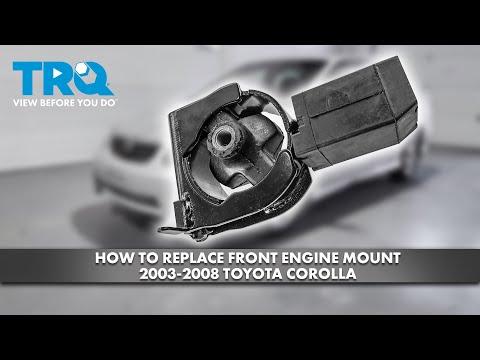






How to Replace Engine & Transmission Mounts on a 2007 Toyota Corolla
Step-by-step DIY instructions with required tools, parts list, safety tips, and proper bolt torque guidance
How to Replace Engine & Transmission Mounts on a 2007 Toyota Corolla
Step-by-step DIY instructions with required tools, parts list, safety tips, and proper bolt torque guidance


🔧 Corolla - Engine Mount Replacement
On your Corolla, the “engine mounts” are multiple mounts that hold the engine/transmission in place and control vibration. Replacing them usually requires safely supporting the engine with a jack, unbolting one mount at a time, and re-aligning everything so bolts thread in smoothly.
Difficulty Level: Intermediate | Estimated Time: 2-5 hours (one mount: ~1-2 hours)
⚠️ Safety & Precautions
- ⚠️ Support the car on jack stands on level ground; never rely on a jack alone.
- ⚠️ Support the engine with a floor jack + wood block under the oil pan (wood spreads the load so you don’t dent the pan).
- ⚠️ Keep hands clear when lifting/settling the engine; mounts can “shift” suddenly.
- ⚠️ If working near the starter/positive cable area, disconnect the battery: negative (-) terminal first.
🔧 Required Tools
You'll need the following tools for this repair:
- Floor jack (rated 2-ton minimum)
- Jack stands (rated 2-ton minimum)
- Wheel chocks
- Wood block (2x4 or similar)
- Metric socket set 10mm-19mm
- Metric wrench set 10mm-19mm
- 3/8" drive ratchet
- 1/2" drive breaker bar
- Socket extensions 3" and 6"
- Torque wrench (10-150 ft-lbs range)
- Flat pry bar
- Trim clip remover
- Phillips screwdriver
- Safety glasses
- Mechanic gloves
🔩 Required Parts
HowToo sells all the parts you need for this repair:
- Right (passenger-side) engine mount - Qty: 1
- Left (driver-side) transmission mount - Qty: 1
- Front torque strut mount - Qty: 1
- Rear torque strut mount - Qty: 1
- Replacement mount bolts/nuts (if rusted or damaged) - Qty: As needed
📋 Before You Begin
- Park on level ground, set the parking brake, and chock the rear wheels using wheel chocks.
- Open the hood and remove any loose items.
- If you’ll be working near the battery/starter wiring, use a 10mm socket to disconnect the negative (-) battery terminal.
- Plan to replace one mount at a time so the engine stays aligned.
🔨 Step-by-Step Instructions
Follow these steps in order:
Step 1: Safely raise and support the front of the car
- Use a floor jack at the front center jacking point to lift the car.
- Set the car onto jack stands at the proper pinch weld/support points.
- If you remove a front wheel for access, use a 21mm socket to remove lug nuts and later Torque to 103 Nm (76 ft-lbs).
Step 2: Support the engine (critical)
- Place a wood block on the floor jack.
- Gently jack up under the oil pan just until the wood contacts firmly and the engine’s weight is supported.
- Lift only enough to take weight off mounts.
Step 3: Choose the mount you’re replacing first
- Right (passenger-side) engine mount: upper mount near the coolant reservoir/headlight area.
- Left (driver-side) transmission mount: upper mount under/near the battery tray area.
- Front & rear torque strut mounts: lower “dogbone” style mounts that control engine rocking (usually accessed from below).
- Use a flat pry bar only gently to check for torn rubber or excessive movement.
Step 4: Remove the mount fasteners (one mount at a time)
- Use the appropriate metric sockets (typically 14mm, 17mm, 19mm) with a ratchet or breaker bar to loosen mount nuts/bolts.
- If a bolt binds, slightly raise/lower the engine using the floor jack to remove pressure from that bolt, then try again.
- For plastic covers/splash shields, remove clips with a trim clip remover and screws with a Phillips screwdriver.
Step 5: Remove the mount and compare parts
- Remove the mount from the car once all its fasteners are out (use a flat pry bar if it’s stuck in place).
- Compare the new mount to the old one: same shape, bolt holes, and orientation.
- Do not force the new mount into place; re-position the engine with the floor jack until it drops in smoothly.
Step 6: Install the new mount (start all bolts by hand)
- Position the new mount and start every bolt/nut by hand first (use your fingers, then a ratchet).
- Tighten fasteners gradually, alternating between them so the mount seats evenly.
- Finish tightening with a torque wrench: Torque all mount fasteners to Toyota factory specification for your exact mount location.
- Hand-starting prevents cross-threading.
Step 7: Repeat for remaining mounts (if replacing more than one)
- Keep the engine supported with the floor jack and wood block.
- Replace the next mount using Steps 4–6.
- Never remove multiple upper mounts at the same time.
Step 8: Reassemble and lower the car
- Reinstall splash shields and clips using a trim clip remover and Phillips screwdriver as needed.
- Reinstall any wheel(s) using a 21mm socket, then Torque to 103 Nm (76 ft-lbs).
- Lower the car using the floor jack and remove jack stands.
- If disconnected, reconnect the battery using a 10mm socket (negative terminal last tightened securely).
✅ After Repair
- Start the engine and let it idle. Listen for clunks and watch for excessive engine movement.
- With your foot on the brake, shift through gears (automatic) or lightly load the engine (manual) and check for abnormal vibration.
- Take a short test drive. Re-check that all fasteners you touched are tight and nothing is rubbing.
💰 DIY vs Shop Cost
Shop Cost: $350-$1,100 (parts + labor, depending on how many mounts)
DIY Cost: $80-$450 (parts only, depending on how many mounts)
You Save: $270-$650 by doing it yourself!
Shop labor rates vary but typically run $100-$150/hour. This repair takes a shop approximately 2-5 hours.
🎯 Ready to get started?
HowToo makes it easy: same-day/2-day shipping on every part, plus all the tools and specialty tools you need! Check out the parts and tools sections below to add everything to your cart.
Two quick questions so I can give you the exact mount order + exact torque specs for your Corolla:
- 🧰 Is your Corolla an automatic or manual?
- 🔩 Are you replacing all mounts, or which one is bad (right/passenger, left/driver, front lower, rear lower)?