









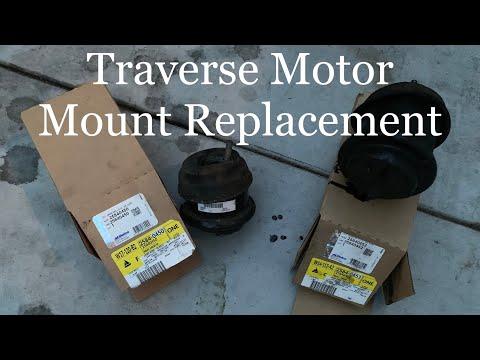







How to Replace Engine Mounts on a 2020 Chevrolet Traverse (All Mount Locations)
Step-by-step engine mount replacement guide with tools, parts list, safety tips, and torque spec notes
How to Replace Engine Mounts on a 2020 Chevrolet Traverse (All Mount Locations)
Step-by-step engine mount replacement guide with tools, parts list, safety tips, and torque spec notes


🔧 Traverse - Engine Mount Replacement
On your Traverse, “engine mounts” can mean a few different mounts (right/passenger-side, left/driver-side, front/rear torque mounts, and the transmission mount). The exact steps, tools, and torque specs change depending on which mount you’re replacing and whether your Traverse is FWD or AWD.
Difficulty Level: Advanced | Estimated Time: 2.0-6.0 hours
⚠️ Safety & Precautions
- 🛑 Never work under a vehicle supported only by a jack; use jack stands.
- 🛑 You must support the engine before removing any mount.
- 🛑 Keep hands clear when lifting/lowering the engine; it can shift suddenly.
- 🛑 Let the exhaust cool fully before starting.
🔧 Required Tools
You'll need the following tools for this repair:
- Floor jack (rated 3-ton minimum)
- Jack stands (rated 3-ton minimum)
- Wheel chocks
- Safety glasses
- Mechanic gloves
- Socket set (metric 8mm–21mm)
- Ratchet (3/8")
- Breaker bar (1/2")
- Torque wrench (10–200 ft-lbs range)
- Extensions (3", 6", 12")
- Universal joint adapter (3/8")
- Trim clip removal tool
- Flat-blade screwdriver
- Pry bar (12–18")
- Engine support bar (specialty)
- Block of wood (2x6, 12–18")
🔩 Required Parts
HowToo sells all the parts you need for this repair:
- Engine mount (correct position for your Traverse) - Qty: 1
- New engine mount bolts (if required) - Qty: 1 set
📋 Before You Begin
- 🅿️ Park on level ground, set the parking brake, and chock the rear wheels.
- Raise the front and support it securely on jack stands if you’ll be working from below.
- Plan to support the engine using an engine support bar (specialty); this spans the fenders and holds the engine from above. Safer than jacking the oil pan.
- If you must lift from below, place a block of wood (2x6) on the jack pad so you spread the load and reduce damage risk.
🔨 Step-by-Step Instructions
Follow these steps in order:
Step 1: Confirm which mount you’re replacing
- Before I give the exact OEM steps and torque specs, I need two quick details.
- Are you replacing the passenger-side (right) upper mount, driver-side (left) upper mount, front/rear torque mount, or the transmission mount?
- Is your Traverse FWD or AWD?
Step 2: Safely support the engine (common requirement for all mounts)
- Use wheel chocks and wear safety glasses and mechanic gloves.
- If using an engine support bar: install the engine support bar (specialty) across the strut towers per the tool’s instructions, then take up slack until the engine just begins to carry weight.
- If supporting from below: place the block of wood (2x6) on the floor jack, then gently lift at a strong engine support point (not a plastic cover). Lift only enough to “take the weight” off the mount.
Step 3: Remove the mount fasteners (mount-specific)
- Once you tell me which mount (and FWD vs AWD), I’ll list the exact access panels to remove and the bolt/nut sizes.
- Use the correct metric socket with a ratchet and extensions to remove the mount-to-body and mount-to-engine fasteners.
- Use a breaker bar (1/2") if bolts are tight; don’t round the bolt heads.
Step 4: Swap the mount and align it
- Remove the old mount and install the new mount in the same orientation.
- You may need a pry bar (12–18") to slightly shift alignment. Move the engine only a little at a time.
- Hand-thread all bolts/nuts first so nothing cross-threads.
Step 5: Torque fasteners (must be OEM-spec)
- Use a torque wrench (10–200 ft-lbs range) to tighten fasteners.
- Torque to XX Nm (YY ft-lbs) once I confirm which mount and drivetrain; these values differ by mount and layout.
- If your mount uses “single-use” bolts (torque-to-yield), replace them and torque in the required sequence.
Step 6: Reassemble and lower the engine
- Reinstall any shields, brackets, or liners using the correct metric sockets and a trim clip removal tool for clips.
- Slowly lower the engine support (support bar or jack) and watch the mount area to confirm it seats normally.
✅ After Repair
- Start the engine with the hood open and watch for excessive engine movement.
- With your foot on the brake, shift from Park to Reverse to Drive and listen for clunks.
- Test drive and re-check for vibration or thumping on acceleration.
- If any bolt was hard to start, re-check torque after the test drive.
💰 DIY vs Shop Cost
Shop Cost: $450-$1,300 (parts + labor)
DIY Cost: $80-$450 (parts only)
You Save: $370-$850 by doing it yourself!
Shop labor rates vary but typically run $100-$150/hour. This repair takes a shop approximately 2-5 hours.
🎯 Ready to get started?
HowToo makes it easy: same-day/2-day shipping on every part, plus all the tools and specialty tools you need! Check out the parts and tools sections below to add everything to your cart.