









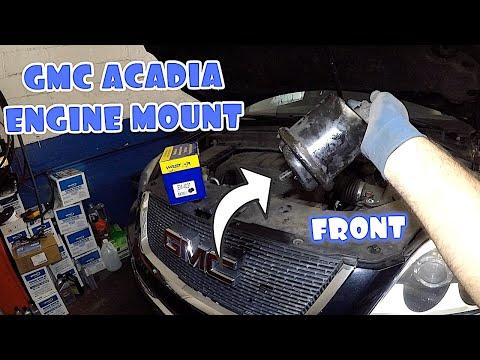






How to Replace Engine Mounts on a 2018 GMC Acadia (All Mount Locations)
Step-by-step DIY instructions, required tools/parts, safety tips, and mount-specific torque spec guidance
How to Replace Engine Mounts on a 2018 GMC Acadia (All Mount Locations)
Step-by-step DIY instructions, required tools/parts, safety tips, and mount-specific torque spec guidance


🔧 Acadia - Engine Mount Replacement
Your Acadia uses multiple mounts to hold the engine/transmission in place and control vibration. The exact steps and (critical) torque specs change depending on which mount you’re replacing and whether it’s the engine-side mount or the transmission-side mount.
Difficulty Level: Intermediate | Estimated Time: 1.5-4.0 hours (varies by mount)
⚠️ Safety & Precautions
- ⚠️ Never support the engine by the oil pan without a wide wood block; you can crack the pan.
- ⚠️ Keep hands clear when the engine is supported and bolts are removed; it can shift suddenly.
- ⚠️ Work on level ground and support the vehicle with jack stands; never rely on a floor jack alone.
- ⚠️ If you remove any mount bolts, support the powertrain first to prevent strain on axles/exhaust.
- ⚠️ Battery disconnect is usually not required, but disconnect it if you’ll be near the starter/primary wiring.
🔧 Required Tools
You'll need the following tools for this repair:
- Floor jack (rated 3-ton minimum)
- Jack stands (rated 3-ton minimum)
- Wheel chocks
- Safety glasses
- Mechanic gloves
- Socket set 8mm-21mm
- Deep socket set 13mm-21mm
- E-Torx socket set (specialty)
- Torx bit set (T20-T50)
- Breaker bar 1/2-inch
- Torque wrench 10-200 ft-lbs
- Ratchet extensions (3-inch, 6-inch, 12-inch)
- Pry bar 18-inch
- Trim clip removal tool
- Wood block 2x6 (about 12-18 inches long)
🔩 Required Parts
HowToo sells all the parts you need for this repair:
- Engine mount (specific position: RH/LH/front/rear) - Qty: 1
- Transmission mount (if replacing LH mount) - Qty: 1
- Mount-to-body bolts (if one-time-use) - Qty: as needed
- Mount-to-engine bracket bolts (if one-time-use) - Qty: as needed
📋 Before You Begin
- Park on level ground, set the parking brake, and place wheel chocks behind the rear wheels.
- Open the hood and remove any plastic engine cover by pulling upward (if equipped).
- Plan how you’ll support the powertrain: place a floor jack with a wood block under the engine to hold it up slightly.
- Tip: Lift the engine only enough to remove load.
🔨 Step-by-Step Instructions
Follow these steps in order:
Step 1: Confirm which mount you’re replacing
- Look for the failed mount location: passenger side (RH engine mount), driver side (LH/transmission mount), or lower mounts (front/rear torque struts).
- Before loosening anything, I need the exact mount position so I can give the correct disassembly path and the correct OEM torque specs.
Step 2: Safely raise and support the vehicle (if access from below is needed)
- Use a floor jack (rated 3-ton minimum) to lift the front at the correct jacking point.
- Set the vehicle onto jack stands (rated 3-ton minimum) and verify it’s stable.
Step 3: Support the engine
- Place the wood block 2x6 on the pad of the floor jack (rated 3-ton minimum).
- Raise the jack until it just contacts the underside of the engine and takes the weight off the mount.
- Tip: Don’t “lift” the SUV—just support the engine.
Step 4: Remove required covers/shields for access
- Use a trim clip removal tool and socket set 8mm-13mm to remove any splash shield/undertray fasteners blocking access.
- If a wheel-well liner section blocks access, use a Torx bit set (T20-T50) and trim clip removal tool to loosen and move it aside.
Step 5: Remove the mount fasteners
- Use the correct socket set 13mm-21mm or E-Torx socket set (specialty) to remove the mount-to-body and mount-to-bracket fasteners.
- If a bolt is tight, use a breaker bar 1/2-inch to crack it loose, then switch to a ratchet.
- Use a pry bar 18-inch only if needed to line up bolt holes during reassembly.
Step 6: Remove the mount and install the new one
- Remove the mount from the vehicle, noting orientation (some mounts only fit one way).
- Set the new mount into place and start all bolts by hand to prevent cross-threading.
Step 7: Set engine height and torque fasteners
- Use the floor jack (rated 3-ton minimum) to raise/lower the engine slightly until bolts thread in smoothly.
- Tighten bolts with a torque wrench 10-200 ft-lbs.
- Torque specs are position-specific on your Acadia and some bolts may be one-time-use. Once you tell me which mount position you’re doing, I’ll give you the exact torque sequence and values.
Step 8: Reinstall shields/liners and lower the vehicle
- Reinstall any splash shields using a socket set 8mm-13mm and Torx bit set (T20-T50).
- Lower the vehicle off the jack stands (rated 3-ton minimum) using the floor jack (rated 3-ton minimum).
✅ After Repair
- Start the engine and let it idle; confirm the engine sits level and doesn’t lift excessively when shifting from Park to Reverse/Drive with your foot on the brake.
- Test drive at low speed first; listen for clunks on acceleration/deceleration.
- Recheck for any loose shields/fasteners after the first drive.
💰 DIY vs Shop Cost
Shop Cost: $450-$1,200 (parts + labor; varies by mount/location)
DIY Cost: $80-$350 (parts only; varies by mount brand/location)
You Save: $250-$850 by doing it yourself!
Shop labor rates vary but typically run $100-$150/hour. This repair takes a shop approximately 1.5-4.0 hours.
🎯 Ready to get started?
HowToo makes it easy: same-day/2-day shipping on every part, plus all the tools and specialty tools you need! Check out the parts and tools sections below to add everything to your cart.
I only need 2 quick details to give you the exact mount-by-mount steps and OEM torque specs:
- Which mount are you replacing on your Acadia: passenger-side (RH engine mount), driver-side (LH/transmission mount), or lower front/rear torque mount?
- Are you replacing one mount or doing all mounts?