









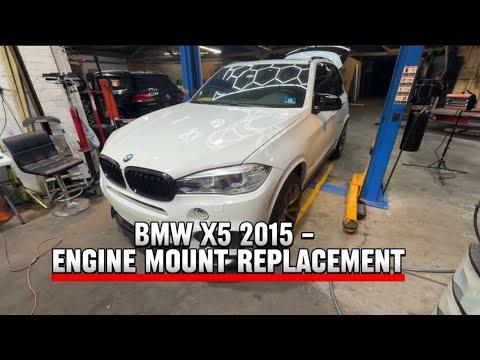







How to Replace Engine Mounts on a 2016 BMW X5 (Step-by-Step DIY Guide)
Tools, parts list, safety tips, and torque specs to eliminate vibration and clunking for 2010, 2011, 2012, 2013, 2015, 2016, 2017, 2018
How to Replace Engine Mounts on a 2016 BMW X5 (Step-by-Step DIY Guide)
Tools, parts list, safety tips, and torque specs to eliminate vibration and clunking for 2010, 2011, 2012, 2013, 2015, 2016, 2017, 2018


🔧 X5 - Engine Mount Replacement
Your X5 uses rubber/hydraulic engine mounts to isolate vibration and keep the engine positioned correctly. When mounts wear out, you’ll often feel extra vibration at idle, clunks on takeoff, or see the engine sit slightly lower on one side.
Difficulty Level: Advanced | Estimated Time: 3-6 hours
Assumption: OEM-style mounts; verify torque specs with service info.
⚠️ Safety & Precautions
- ⚠️ Support the engine before unbolting mounts; it can drop suddenly.
- ⚠️ Never get under a vehicle supported only by a jack—use jack stands.
- ⚠️ Keep hands clear when raising/lowering the engine support/jack.
- ⚠️ Let the exhaust and turbo area cool fully before starting.
- ⚠️ Don’t lift by the oil pan directly without a wood block to spread load.
🔧 Required Tools
You'll need the following tools for this repair:
- Floor jack (rated 3-ton minimum)
- Jack stands (rated 3-ton minimum)
- Wheel chocks
- Safety glasses
- Mechanic gloves
- Engine support bar (specialty)
- Wood block 2x6 in
- Socket set 8mm-18mm
- Deep socket 16mm
- Deep socket 18mm
- Ratchet 3/8 in
- Ratchet 1/2 in
- Extension set 3 in-12 in
- Universal swivel joint 3/8 in
- Torx bit set T20-T30
- E-Torx socket set E10-E14
- Trim clip remover
- Torque wrench 10-100 Nm
- Torque wrench 40-200 Nm
- Flashlight
- Paint marker
🔩 Required Parts
HowToo sells all the parts you need for this repair:
- Engine mount (left) - Qty: 1
- Engine mount (right) - Qty: 1
- Self-locking engine mount nuts - Qty: 4
- Underbody shield fastener kit - Qty: 1
📋 Before You Begin
- Park on level ground, set the parking brake, and chock the rear wheels.
- Open the hood so you can use an engine support bar (a crossbar that holds the engine from above).
- Raise the front of the vehicle with a floor jack and support with jack stands at the proper jack points.
- Remove any loose items from the engine bay; you’ll be gently lifting the engine.
🔨 Step-by-Step Instructions
Follow these steps in order:
Step 1: Remove the lower underbody panels
- Use a Torx T25-T30 bit and 8mm socket to remove the fasteners for the front splash shield and any center undertray panels.
- Use a trim clip remover for plastic push-clips so they don’t snap.
- Set panels and hardware aside in groups. Take a quick photo for reassembly.
Step 2: Support the engine
- Install the engine support bar (specialty) across the strut towers and attach it to the engine lift point(s) per the tool instructions.
- Take up the slack until the chains are snug—do not lift hard yet.
- If you don’t have an engine support bar, you can support from below using a floor jack with a wood block 2x6 in under the engine, lifting very gently.
Step 3: Locate the engine mounts and mark positions
- From underneath, use a flashlight to find both mounts between the engine bracket and the front subframe.
- Use a paint marker to mark the mount and bracket orientation. Helps prevent misalignment.
Step 4: Remove the lower mount-to-subframe nuts
- Use a deep socket 16mm or deep socket 18mm with a ratchet, extensions, and a universal swivel joint as needed to remove the lower nut on each mount.
- If access is tight, use an E-Torx socket set E10-E14 to remove any small brackets blocking access (varies by layout).
Step 5: Remove the upper mount-to-engine bracket nuts
- Use a deep socket 16mm or deep socket 18mm with extensions to remove the upper nut on each mount.
- Raise the engine slightly using the engine support bar (specialty) (or floor jack + wood block) until the studs clear the brackets.
- Lift only enough to free the mounts. Small movements make a big difference.
Step 6: Remove the old mounts
- Work one side at a time.
- Wiggle the mount out downward; if it’s trapped, slightly adjust engine height using the engine support bar (specialty).
- Do not pry against aluminum parts. Use hand pressure and repositioning instead.
Step 7: Install the new mounts
- Place the new mount in the same orientation as the original (use your paint marker marks as a guide).
- Start the upper and lower nuts by hand to avoid cross-threading.
- Lower/raise the engine slightly until studs sit centered in the holes—then snug the nuts with a ratchet.
Step 8: Torque the engine mount fasteners
- Use a torque wrench 10-100 Nm to torque the mount nuts evenly.
- Mount-to-subframe nuts: Torque to 55 Nm (41 ft-lbs)
- Mount-to-engine bracket nuts: Torque to 47 Nm (35 ft-lbs)
- Replace any self-locking nuts you removed with new ones.
Step 9: Reinstall any brackets and undertrays
- Reinstall any removed brackets using the correct E-Torx socket or socket set, then snug securely.
- Reinstall underbody panels using a Torx T25-T30 bit and 8mm socket.
- Make sure no wiring or hoses are pinched before final tightening.
Step 10: Lower the vehicle
- Remove the engine support load (back off the engine support bar (specialty) slowly).
- Raise slightly with the floor jack, remove jack stands, and lower to the ground.
✅ After Repair
- Start the engine and let it idle. Expect a smoother idle with less vibration.
- With the hood open, lightly blip the throttle and watch for abnormal engine movement.
- Test drive and listen for clunks on acceleration/braking transitions.
- Recheck underneath for any loose undertray fasteners after the test drive.
💰 DIY vs Shop Cost
Shop Cost: $900-$1,600 (parts + labor)
DIY Cost: $250-$600 (parts only)
You Save: $650-$1,000 by doing it yourself!
Shop labor rates vary but typically run $100-$150/hour. This repair takes a shop approximately 3-6 hours.
🎯 Ready to get started?
HowToo makes it easy: same-day/2-day shipping on every part, plus all the tools and specialty tools you need! Check out the parts and tools sections below to add everything to your cart.