









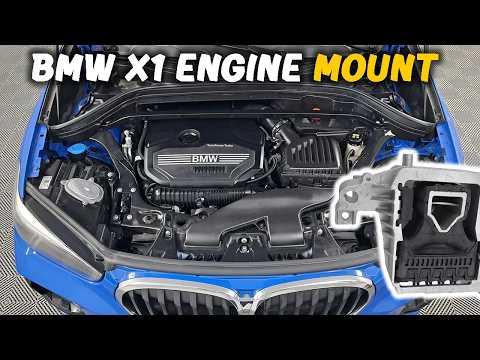







How to Replace Engine Mounts on a 2016 BMW X1 (Step-by-Step DIY Guide)
Tools, parts list, safety tips, and torque specs to fix vibration, clunks, and harsh shifting
How to Replace Engine Mounts on a 2016 BMW X1 (Step-by-Step DIY Guide)
Tools, parts list, safety tips, and torque specs to fix vibration, clunks, and harsh shifting


🔧 X1 - Engine Mount Replacement
Worn engine mounts let the engine shift too much, which can cause clunks on acceleration, extra vibration at idle, and harsh shifting feel. On your X1, the job is mainly about safely supporting the engine, unbolting the mounts, and installing new mounts with the engine sitting in a “neutral” position.
Difficulty Level: Advanced | Estimated Time: 3-5 hours
Assumption: Typical X1 2.0T mount layout; bolt torques can vary by bolt type—verify with BMW service info if possible.
⚠️ Safety & Precautions
- ⚠️ Never get under the X1 supported only by a jack; use jack stands on solid ground.
- ⚠️ You must support the engine before removing any mount bolts, or parts can drop and pinch fingers.
- ⚠️ Keep the jack pad off oil pans and plastic covers; always use a wood block to spread the load.
- ⚠️ Let the engine cool; turbo/charge piping can be hot.
- ⚠️ If you remove any electrical connectors near the mounts, disconnect the battery negative cable with a 10mm socket.
🔧 Required Tools
You'll need the following tools for this repair:
- Floor jack (rated 3-ton minimum)
- Jack stands (rated 3-ton minimum)
- Wheel chocks
- Safety glasses
- Mechanic gloves
- Work light
- Torque wrench (10–200 Nm range)
- Socket set 8mm–18mm
- 10mm socket
- 13mm socket
- 16mm socket
- 18mm socket
- E-Torx socket set (E10–E14)
- Torx bit set (T25–T30)
- Ratchet (3/8")
- Breaker bar (3/8" or 1/2")
- Extensions (3", 6", 12")
- Universal joint adapter (wobble)
- Trim clip removal tool
- Flathead screwdriver
- Pry bar (small)
- Wood block (2x4 or similar)
- Engine support bar (specialty)
🔩 Required Parts
HowToo sells all the parts you need for this repair:
- Engine mount (right) - Qty: 1
- Engine mount (left) - Qty: 1
- Engine mount bolts (single-use) - Qty: 1 set
- Subframe/bracket bolts (single-use, if removed) - Qty: 1 set
📋 Before You Begin
- Park on level ground, set the parking brake, and place wheel chocks behind the rear wheels.
- Open the hood and remove the top engine cover (it typically pulls up; use a trim clip tool if needed).
- Raise the front and support it securely on jack stands; remove the lower splash shield using Torx T25/T30.
- Set up your engine support bar across the strut towers. (An engine support bar is a crossbar that holds the engine from above so mounts can be removed safely.)
- If you’ll unplug sensors or move wiring harnesses, disconnect the battery negative cable using a 10mm socket.
🔨 Step-by-Step Instructions
Follow these steps in order:
Step 1: Remove the lower undertray and get access
- Use a Torx T25/T30 and trim clip removal tool to remove the fasteners holding the front undertray/splash shield.
- Lower the panel and set it aside.
Step 2: Remove the air intake ducting (top-side clearance)
- Use a flathead screwdriver or 8mm socket to loosen intake hose clamps.
- Use a 10mm socket to remove the airbox/duct mounting bolts (if equipped), then lift the ducting/airbox out for working room.
- Tip: Take a quick photo before removing hoses.
Step 3: Support the engine safely
- From above, tension the engine support bar (specialty) until it just begins to carry the engine’s weight.
- From below, position the floor jack with a wood block under a sturdy engine/transmission support area (not on plastic covers).
- Raise the jack slightly so the engine is supported from below too. You want it stable, not lifted high.
Step 4: Replace the right engine mount (passenger-side mount)
- Locate the right mount between the engine bracket and subframe.
- Use an E-Torx socket (commonly E12/E14), ratchet, and extensions to remove the upper mount-to-engine bracket fasteners.
- Use a 16mm socket or 18mm socket (varies by hardware) to remove the lower mount-to-subframe nut/bolt.
- Use the floor jack (tiny adjustments) to raise/lower the engine just enough to slide the mount out.
- Install the new mount in the same orientation (don’t force it; adjust engine height with the jack).
- Start all fasteners by hand first to prevent cross-threading.
- Tighten fasteners with a torque wrench: Torque to 56 Nm (41 ft-lbs) + 90° for typical torque-to-yield mount fasteners (use new bolts).
Step 5: Replace the left engine/transmission-side mount (driver-side mount)
- Locate the left mount on the transmission side (often tighter access).
- Move any small brackets/heat shields out of the way using a 10mm socket and Torx T25/T30.
- Use an E-Torx socket (commonly E12/E14), extensions, and a universal joint adapter to remove the upper fasteners.
- Use a 16mm socket or 18mm socket to remove the lower mount-to-subframe fastener.
- Adjust engine height slightly with the floor jack and remove the mount.
- Install the new mount, hand-start all fasteners, then torque with a torque wrench: Torque to 56 Nm (41 ft-lbs) + 90° for typical torque-to-yield mount fasteners (use new bolts).
Step 6: “Neutral-set” the mounts before final tightening
- Lower the floor jack slightly so the engine rests naturally on the new mounts (still keep light support from the engine support bar).
- Loosen (do not remove) the lower mount fasteners with a ratchet, then re-tighten to spec with a torque wrench so the mounts aren’t preloaded.
- Tip: Preload can cause vibration at idle.
Step 7: Reinstall intake parts and undertray
- Reinstall the air ducting/airbox using a 10mm socket.
- Tighten hose clamps with an 8mm socket or flathead screwdriver.
- Reinstall the undertray using Torx T25/T30.
Step 8: Remove supports and lower the vehicle
- Slowly release the engine support bar (specialty).
- Use the floor jack to lift slightly, remove jack stands, then lower the X1.
- If disconnected, reconnect the battery negative cable using a 10mm socket.
✅ After Repair
- Start the engine and let it idle. Listen for new clunks or metallic contact.
- With your foot on the brake, shift through R/N/D (automatic). Excessive engine movement should be reduced.
- Test drive gently first. Recheck for any loose intake clamps (hissing/boost leak sounds).
- After the drive, recheck mount fasteners visually for anything obviously out of place.
💰 DIY vs Shop Cost
Shop Cost: $900-$1,600 (parts + labor)
DIY Cost: $250-$650 (parts only)
You Save: $650-$950 by doing it yourself!
Shop labor rates vary but typically run $100-$150/hour. This repair takes a shop approximately 3-5 hours.
🎯 Ready to get started?
HowToo makes it easy: same-day/2-day shipping on every part, plus all the tools and specialty tools you need! Check out the parts and tools sections below to add everything to your cart.