









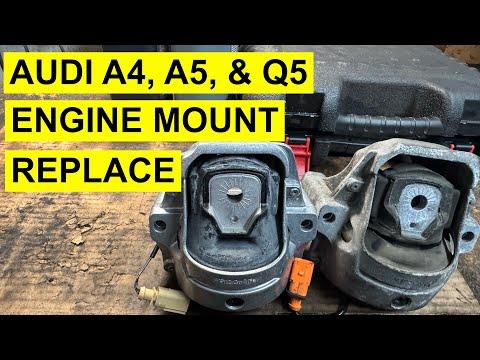







How to Replace Engine Mounts on a 2016 Audi Q3 (Right, Trans Mount & Dogbone)
Step-by-step DIY instructions with required tools, parts, safety tips, and torque-spec guidance for 2015, 2016, 2017, 2018
How to Replace Engine Mounts on a 2016 Audi Q3 (Right, Trans Mount & Dogbone)
Step-by-step DIY instructions with required tools, parts, safety tips, and torque-spec guidance for 2015, 2016, 2017, 2018


🔧 Q3 - Engine Mount Replacement
Worn engine mounts let the engine shift too much, which can cause clunks, vibration at idle, and harsh shifting. On your Q3, you’ll typically replace the right (passenger-side) engine mount, the left (driver-side) transmission mount, and the lower “pendulum/dogbone” mount one at a time while the engine is safely supported.
Difficulty Level: Advanced | Estimated Time: 3-6 hours
Assumption: common Q3 2.0T mount layout; torque specs vary—verify with a factory spec source when possible.
⚠️ Safety & Precautions
- 🛑 Never get under the vehicle supported only by a jack; use jack stands.
- 🛑 The engine must be supported before any mount bolts are removed; the engine can drop/shift suddenly.
- 🛑 Keep hands clear between the mount and bracket while raising/lowering the engine.
- 🛑 If removing the battery/battery tray, disconnect the negative terminal first to prevent shorts.
- 🛑 Replace any “stretch bolts” (torque-to-yield) removed from mounts; reusing them can cause loosening.
🔧 Required Tools
You'll need the following tools for this repair:
- Floor jack (rated 3-ton minimum)
- Jack stands (rated 3-ton minimum)
- Wheel chocks
- Safety glasses
- Mechanic gloves
- Engine support bar (specialty)
- Jack pad block of wood (2x6 in)
- Metric socket set 10mm-21mm
- 16mm socket
- 18mm socket
- 21mm socket
- Torx T25 screwdriver
- Torx T30 screwdriver
- Triple-square M10 bit socket
- Triple-square M12 bit socket
- Ratchet 3/8"
- Breaker bar 1/2"
- Torque wrench 10-200 Nm
- Trim clip removal tool
- Flat-blade screwdriver
- Paint marker
- Work light
🔩 Required Parts
HowToo sells all the parts you need for this repair:
- Right engine mount - Qty: 1
- Left transmission mount - Qty: 1
- Lower pendulum/dogbone mount - Qty: 1
- Engine mount bolt kit (stretch bolts) - Qty: 1
- Transmission mount bolt kit (stretch bolts) - Qty: 1
- Pendulum/dogbone mount bolt kit (stretch bolts) - Qty: 1
📋 Before You Begin
- Park on level ground, set the parking brake, and place wheel chocks behind the rear wheels.
- Open the hood and remove the engine cover (pull up by hand).
- Plan to replace one mount at a time so the drivetrain stays aligned.
- Set up an engine support bar (a crossbar that holds the engine from above) or be ready to lightly support the engine from below using a floor jack and a wood block.
- If you’ll remove the battery/battery tray for access: use a 10mm socket to disconnect the negative battery terminal first.
🔨 Step-by-Step Instructions
Follow these steps in order:
Step 1: Raise and secure the Q3
- Use a floor jack to lift the front, then support with jack stands at the approved front lift points.
- Give the vehicle a firm shake to confirm it’s stable before working underneath.
Step 2: Remove the lower splash shield
- Use a Torx T25 screwdriver and trim clip removal tool to remove the belly pan fasteners.
- Set all screws/clips aside in a tray so nothing is lost.
Step 3: Support the engine
- Preferred: install the engine support bar (specialty) across the fenders and take up light tension on the lifting eye.
- Alternative: place a wood block on the floor jack and lightly support the engine at the oil pan area (do not jack hard on the pan).
- Support it—don’t lift the car.
Step 4: Replace the lower pendulum/dogbone mount
- Locate the lower mount under the car (between the subframe and transmission).
- Use a paint marker to mark the mount’s position for reference.
- Use an 18mm socket and breaker bar to remove the main bolt(s).
- Use a triple-square M10 bit socket for any smaller mount bolts (varies by mount style).
- Install the new mount and start all bolts by hand first.
- Torque commonly-used fasteners as follows (verify for your exact bolt kit):
- Large pendulum bolt(s): Torque to 40 Nm (30 ft-lbs) + 90°
- Small pendulum bracket bolt(s): Torque to 20 Nm (15 ft-lbs) + 90°
Step 5: Replace the right (passenger-side) engine mount
- From above, remove access components as needed (often intake ducting/airbox area).
- Use a flat-blade screwdriver for hose clamps and a Torx T30 screwdriver for airbox fasteners (as equipped).
- With the engine still supported, use a 16mm socket and 18mm socket to remove the mount-to-body and mount-to-bracket bolts (bolt heads vary).
- Lift the mount out; you may need to slightly raise/lower the engine using the engine support bar or floor jack to relieve pressure.
- Install the new mount and hand-start all bolts.
- Torque commonly-used fasteners as follows (verify for your exact bolt kit):
- Mount-to-body bolts: Torque to 60 Nm (44 ft-lbs) + 90°
- Mount-to-engine bracket bolts: Torque to 40 Nm (30 ft-lbs) + 90°
Step 6: Replace the left (driver-side) transmission mount
- This side often requires removing the battery and battery tray for access.
- Use a 10mm socket to disconnect the negative battery terminal, then remove the battery hold-down (commonly 13mm socket).
- Remove the battery tray fasteners using a 10mm socket and 13mm socket (as equipped).
- With the drivetrain supported, use an 18mm socket and 21mm socket to remove the mount bolts.
- Install the new mount and hand-start all bolts.
- Torque commonly-used fasteners as follows (verify for your exact bolt kit):
- Mount-to-body bolts: Torque to 60 Nm (44 ft-lbs) + 90°
- Mount-to-transmission bracket bolts: Torque to 40 Nm (30 ft-lbs) + 90°
Step 7: Reassemble removed components
- Reinstall the battery tray using a 10mm socket and 13mm socket.
- Reinstall the battery and tighten the terminal with a 10mm socket.
- Reinstall intake/airbox pieces using a Torx T30 screwdriver and flat-blade screwdriver.
- Reinstall the belly pan using a Torx T25 screwdriver.
Step 8: Lower the vehicle
- Use the floor jack to lift slightly, remove the jack stands, and lower the Q3 to the ground.
- Remove the wheel chocks.
✅ After Repair
- Start the engine and let it idle in Park; listen for clunks and watch for excessive engine movement.
- With your foot on the brake, shift through R and D briefly; movement should be controlled and smooth.
- Test drive gently and recheck for new noises over bumps and during light acceleration.
- Recheck all accessible mount bolts for tightness after the first short drive.
💰 DIY vs Shop Cost
Shop Cost: $900-$1,800 (parts + labor)
DIY Cost: $250-$700 (parts only)
You Save: $650-$1,100 by doing it yourself!
Shop labor rates vary but typically run $100-$150/hour. This repair takes a shop approximately 3-5 hours.
🎯 Ready to get started?
HowToo makes it easy: same-day/2-day shipping on every part, plus all the tools and specialty tools you need! Check out the parts and tools sections below to add everything to your cart.