









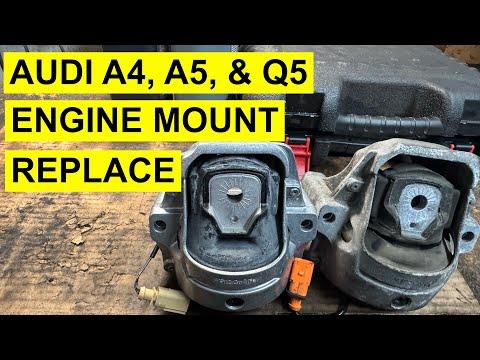







How to Replace Engine Mounts on a 2016 Audi A4 (2.0T)
Step-by-step DIY guide with required tools, parts, safety tips, and OEM torque + angle notes
How to Replace Engine Mounts on a 2016 Audi A4 (2.0T)
Step-by-step DIY guide with required tools, parts, safety tips, and OEM torque + angle notes


🔧 A4 - Engine Mount Replacement
Replacing the engine mounts restores proper support for the engine and reduces vibration, clunks, and drivetrain “thumps” when accelerating or shifting. On your A4, the mounts sit low on each side of the engine and must be swapped with the engine safely supported.
Difficulty Level: Advanced | Estimated Time: 3-6 hours
Assumption: stock 2.0T with factory hydraulic engine mounts.
⚠️ Safety & Precautions
- ⚠️ Support the engine before removing any mount bolts.
- ⚠️ Never get under the car supported only by a jack; use jack stands.
- ⚠️ Do not jack directly on the oil pan; it can crack.
- ⚠️ Many Audi mount bolts are one-time-use “stretch bolts” (torque + angle). Replace them.
- ⚠️ Let the exhaust/turbo cool fully before working near it.
🔧 Required Tools
You'll need the following tools for this repair:
- Floor jack (rated 3-ton minimum)
- Jack stands (rated 3-ton minimum)
- Wheel chocks
- Safety glasses
- Mechanic gloves
- Engine support bar (specialty)
- Block of wood (2x6 in.)
- Metric socket set 8mm-18mm
- Metric wrench set 13mm-18mm
- Torx bit set T25-T30
- Triple-square bit set M10-M12
- 3/8 in. ratchet
- 1/2 in. breaker bar
- Long extensions (6 in. and 12 in.)
- Swivel/universal joint adapter
- Torque wrench (10-200 Nm range)
- Angle gauge (specialty)
- Trim clip tool
- Flashlight
- Paint marker
🔩 Required Parts
HowToo sells all the parts you need for this repair:
- Engine mount (left) - Qty: 1
- Engine mount (right) - Qty: 1
- Engine mount bolt kit (one-time-use stretch bolts) - Qty: 1
- Subframe shield fastener/clips (as needed) - Qty: 1
📋 Before You Begin
- Park on level ground, set the parking brake, and chock the rear wheels.
- Raise the front of the car and place it securely on jack stands at the factory lift points.
- Remove the lower engine splash shield (belly pan) so you can see the mounts.
- Set up the engine support bar across the top of the engine bay; this holds the engine from above while mounts are removed.
- If you must support from below, use a floor jack with a wood block under a sturdy area of the engine (never the oil pan).
🔨 Step-by-Step Instructions
Follow these steps in order:
Step 1: Remove the lower splash shield
- Use a Torx T25-T30 bit with a 3/8 in. ratchet to remove the belly pan screws.
- Use a trim clip tool to pop any push-clips without breaking them.
Step 2: Support the engine safely
- Install the engine support bar (specialty) across the strut towers.
- Attach the support hooks/chain to the factory lift points and take up slack until the engine just begins to “hold” (do not lift aggressively).
- Tip: You only need slight tension.
Step 3: Locate both engine mounts
- Use a flashlight to find the mount on each side where the engine bracket meets the subframe.
- Use a paint marker to mark mount orientation and bracket positions for reassembly.
Step 4: Remove the right-side engine mount fasteners
- Use the correct metric socket (typically 16mm-18mm) and long extensions to loosen the mount-to-subframe bolts.
- Use a swivel/universal joint adapter if the access angle is tight.
- Loosen (do not fully remove yet) the mount-to-engine-bracket fasteners using the appropriate socket or triple-square bit (M10-M12).
- Once all are loose, fully remove the mount fasteners and lift the mount out.
- Torque to OEM spec (torque + angle may apply)
Step 5: Install the new right-side engine mount
- Set the new mount into place in the same orientation (use your paint marks).
- Start all new bolts by hand using a socket to avoid cross-threading.
- Snug bolts evenly with a 3/8 in. ratchet but do not final-torque yet.
- Torque to OEM spec (use new stretch bolts; torque + angle)
Step 6: Remove the left-side engine mount fasteners
- Repeat the same process on the left mount using a metric socket (typically 16mm-18mm), extensions, and the correct triple-square bit (M10-M12) if equipped.
- If bolts bind, slightly adjust engine height with the engine support bar to relieve tension.
- Torque to OEM spec (torque + angle may apply)
Step 7: Install the new left-side engine mount
- Place the new mount and hand-start all bolts using the correct socket or triple-square bit.
- Snug evenly with a ratchet before final tightening.
- Torque to OEM spec (use angle gauge if torque + angle)
Step 8: Final-torque with the engine at “rest” position
- Slowly release tension on the engine support bar until the engine sits naturally on the new mounts.
- Now perform final torque/angle using a torque wrench and angle gauge (specialty).
- Tip: Tightening while “preloaded” can cause vibration.
- Torque to OEM spec (verify all mount and bracket fasteners)
Step 9: Reinstall the splash shield
- Reinstall the belly pan using a Torx T25-T30 bit and ratchet.
- Snug fasteners evenly (do not over-tighten into plastic).
✅ After Repair
- Start the engine and let it idle; listen for any knocking or metal contact.
- With the brake pedal held, shift through P-R-N-D briefly and feel for abnormal clunks.
- Road test at low speed; recheck for new vibrations.
- Recheck for any loose hardware or missing underbody fasteners after the test drive.
💰 DIY vs Shop Cost
Shop Cost: $900-$1,800 (parts + labor)
DIY Cost: $250-$650 (parts only)
You Save: $650-$1,150 by doing it yourself!
Shop labor rates vary but typically run $100-$150/hour. This repair takes a shop approximately 3-6 hours.
🎯 Ready to get started?
HowToo makes it easy: same-day/2-day shipping on every part, plus all the tools and specialty tools you need! Check out the parts and tools sections below to add everything to your cart.