









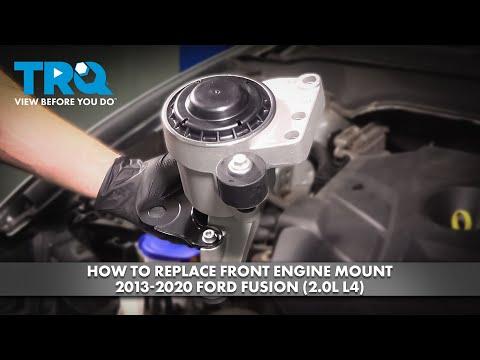







How to Replace Engine Mounts on a 2015 Ford Fusion (All Mounts, Step-by-Step)
Tools, parts list, safety tips, and torque-spec guidance to eliminate vibration and clunking
How to Replace Engine Mounts on a 2015 Ford Fusion (All Mounts, Step-by-Step)
Tools, parts list, safety tips, and torque-spec guidance to eliminate vibration and clunking


🔧 Fusion - Engine Mount Replacement
Replacing engine mounts on your Fusion means supporting the engine safely, removing the worn mount(s), then installing new mounts without stressing hoses, wiring, or hybrid components. Worn mounts can cause vibration, clunks on acceleration/braking, and harsh shifting feel.
Difficulty Level: Advanced | Estimated Time: 3-6 hours
Assumption: Stock mount layout (right engine mount, left trans mount, lower torque strut).
⚠️ Safety & Precautions
- ⚠️ Let the engine cool fully before working near the exhaust and radiator fan.
- ⚠️ Hybrid safety: do not touch or probe any orange high-voltage cables/connectors.
- ⚠️ Support the engine before unbolting any mount. An unsupported engine can drop suddenly.
- ⚠️ Use jack stands anytime you’re under the car; never rely on a floor jack alone.
- ⚠️ Recommended: disconnect the 12V battery negative cable to prevent the engine starting unexpectedly.
🔧 Required Tools
You'll need the following tools for this repair:
- Safety glasses
- Mechanic gloves
- Wheel chocks
- Floor jack (rated 3-ton minimum)
- Jack stands (rated 3-ton minimum)
- Wood block (2x6 inch, 12-18 inch long)
- Socket set 8mm-21mm
- Deep socket set 13mm-21mm
- Wrench set 8mm-21mm
- Breaker bar 1/2-inch drive
- Torque wrench 10-200 Nm (7-150 ft-lbs)
- Extensions set 3-inch, 6-inch, 12-inch
- Universal joint adapter 3/8-inch drive
- Trim clip removal tool
- Flathead screwdriver
- Fender cover
- Work light
🔩 Required Parts
HowToo sells all the parts you need for this repair:
- Right side engine mount (passenger-side) - Qty: 1
- Left side transmission mount (driver-side) - Qty: 1
- Lower torque strut mount - Qty: 1
- Engine mount fastener kit - Qty: 1
📋 Before You Begin
- Park on level ground, put the shifter in Park, and set the parking brake.
- Chock the rear wheels using wheel chocks.
- Open the hood and remove the key/fob from the vehicle (keep it 10+ feet away).
- Disconnect the 12V battery negative cable using a 10mm socket. (Negative is the “-” terminal.)
- Plan your support point: you’ll gently support the engine from underneath with a floor jack and wood block. The wood spreads the load so you don’t dent the oil pan.
🔨 Step-by-Step Instructions
Follow these steps in order:
Step 1: Raise and secure the car
- Use a floor jack (rated 3-ton minimum) to lift the front of the car at the approved front center jacking point.
- Set the vehicle down onto jack stands (rated 3-ton minimum) at the proper pinch weld/support points.
- Give the car a gentle shake to confirm it’s stable before going underneath.
Step 2: Support the engine safely
- Position the floor jack (rated 3-ton minimum) under the engine with the wood block (2x6 inch) between the jack pad and the engine’s lower aluminum area.
- Jack up only until snug (just enough to hold the engine). Do not lift the car off the stands.
- Tip: Watch hoses/wires while you lift.
Step 3: Remove the lower splash shield (if equipped)
- Use a trim clip removal tool and flathead screwdriver to remove plastic push-clips.
- Use an 8mm socket (common) to remove any small bolts.
- Set the shield and hardware aside in a tray so nothing gets lost.
Step 4: Replace the lower torque strut mount (usually the easiest)
- Locate the lower torque strut (“dogbone” mount). It limits engine rocking during acceleration/braking.
- Use a socket set 13mm-21mm and breaker bar 1/2-inch drive to loosen and remove the torque strut bolts.
- Remove the torque strut and install the new one in the same orientation.
- Hand-start all bolts first to prevent cross-threading.
- Tighten with a torque wrench 10-200 Nm (7-150 ft-lbs) and socket set 13mm-21mm: Torque to OEM specification.
Step 5: Access the right (passenger-side) engine mount
- From the top of the engine bay, remove any intake ducting or covers blocking access using a socket set 8mm-10mm and flathead screwdriver (hose clamps).
- Use a work light to clearly see the mount, bracket, and bolts.
- Tip: Take a quick photo before disassembly.
Step 6: Unbolt the right engine mount
- Confirm the engine is supported by the floor jack and wood block.
- Use a socket set 13mm-21mm, extensions set, and universal joint adapter to remove the mount-to-body fasteners.
- Use a socket set 13mm-21mm to remove the mount-to-engine bracket fasteners.
- If bolts feel “spring-loaded,” slightly raise or lower the engine with the jack to relieve tension, then continue.
Step 7: Install the new right engine mount
- Place the new mount into position.
- Hand-thread all fasteners first using your fingers and a socket set 13mm-21mm (no power tools).
- Snug bolts evenly with a ratchet, then final tighten using a torque wrench 10-200 Nm (7-150 ft-lbs): Torque to OEM specification.
- Reinstall any intake pieces removed earlier using a socket set 8mm-10mm and flathead screwdriver.
Step 8: Replace the left (driver-side) transmission mount (if doing all mounts)
- Support the transmission/engine assembly as needed with the floor jack and wood block (keep it gently loaded).
- Access may require removing a bracket/airbox area; remove fasteners with a socket set 8mm-10mm and trim clip removal tool.
- Use a socket set 13mm-21mm, extensions set, and breaker bar 1/2-inch drive to remove mount fasteners.
- Install the new mount, hand-start bolts, then tighten with a torque wrench 10-200 Nm (7-150 ft-lbs): Torque to OEM specification.
Step 9: Reinstall splash shield and lower the vehicle
- Reinstall the splash shield using the trim clip removal tool, flathead screwdriver, and 8mm socket.
- Raise the vehicle slightly with the floor jack, remove the jack stands, and lower to the ground.
Step 10: Reconnect 12V power
- Reconnect the battery negative terminal using a 10mm socket.
- Make sure the terminal is fully seated and snug.
✅ After Repair
- Start the car and let it idle. Listen for abnormal knocking or rubbing.
- With your foot on the brake, shift Park → Reverse → Drive, pausing 2 seconds each. Feel for excessive clunking.
- Test drive gently. Recheck for new vibrations during acceleration and braking.
- Visually recheck mount areas for any pinched hoses/wiring and any missing fasteners.
- If you removed any air intake tubes, confirm there are no air leaks (hissing) and the engine runs smoothly.
💰 DIY vs Shop Cost
Shop Cost: $700-$1,500 (parts + labor)
DIY Cost: $180-$500 (parts only)
You Save: $520-$1,000 by doing it yourself!
Shop labor rates vary but typically run $100-$150/hour. This repair takes a shop approximately 3-6 hours.
🎯 Ready to get started?
HowToo makes it easy: same-day/2-day shipping on every part, plus all the tools and specialty tools you need! Check out the parts and tools sections below to add everything to your cart.