









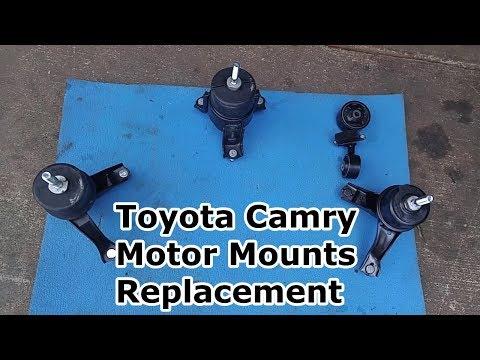







How to Replace Engine Mounts on a 2014 Toyota Camry (All Mounts Step-by-Step)
Tools, parts list, safety tips, and torque-spec guidance for right/left and front/rear mounts
How to Replace Engine Mounts on a 2014 Toyota Camry (All Mounts Step-by-Step)
Tools, parts list, safety tips, and torque-spec guidance for right/left and front/rear mounts


🔧 Camry - Engine Mount Replacement
Engine mounts are the rubber-and-metal supports that hold the engine/transaxle and absorb vibration. When they crack or collapse, you’ll feel extra shaking at idle, clunks on shifting, or thumps on acceleration/braking. You’ll support the engine safely, then replace mounts one at a time so nothing shifts.
Difficulty Level: Advanced | Estimated Time: 3-6 hours
Assumption: Stock mount layout (right/left + front/rear torque mounts).
⚠️ Safety & Precautions
- ⚠️ Never get under the car supported only by a jack—use jack stands (rated 3-ton minimum).
- ⚠️ Hybrid safety: keep the car OFF, key/fob away, and do not touch any orange high-voltage cables.
- ⚠️ Disconnect the 12V battery negative terminal before working near the engine wiring and mounts.
- ⚠️ Support the engine before removing any mount. Do not let the engine “hang” by hoses/wiring.
- ⚠️ Do not jack directly on the oil pan. Always use a wood block on the jack saddle to spread the load.
🔧 Required Tools
You'll need the following tools for this repair:
- Floor jack (rated 3-ton minimum)
- Jack stands (rated 3-ton minimum)
- Wheel chocks
- Safety glasses
- Mechanic gloves
- Wood block (2x4 or 2x6, 12-18 in long)
- Socket set (10mm, 12mm, 14mm, 17mm, 19mm)
- Deep socket set (14mm, 17mm, 19mm)
- Ratchet (3/8 in drive)
- Breaker bar (1/2 in drive)
- Torque wrench (10-200 Nm / 7-150 ft-lbs)
- Extensions (3 in, 6 in, 12 in)
- Universal joint adapter (3/8 in drive)
- Trim clip removal tool
- Flathead screwdriver
- Paint marker
- Engine support bar (specialty)
🔩 Required Parts
HowToo sells all the parts you need for this repair:
- Right (passenger-side) engine mount - Qty: 1
- Left (driver-side) transaxle mount - Qty: 1
- Front torque mount (front “dogbone”) - Qty: 1
- Rear torque mount (rear “dogbone”) - Qty: 1
- Engine mount hardware kit (nuts/bolts) - Qty: 1
📋 Before You Begin
- Park on level ground. Set the parking brake. Place wheel chocks behind the rear tires.
- Open the hood and make sure the hybrid system is fully OFF (no “READY” light).
- Disconnect the 12V battery negative terminal using a 10mm socket. Move the cable aside so it can’t spring back.
- Plan to replace one mount at a time. This keeps alignment close and reduces stress on hoses.
- Engine support options: use an engine support bar (specialty) from above, or a floor jack + wood block from below (most DIY-friendly).
🔨 Step-by-Step Instructions
Follow these steps in order:
Step 1: Remove lower covers and safely raise the front
- Use a floor jack (rated 3-ton minimum) to lift at the correct front jack point.
- Set the car onto jack stands (rated 3-ton minimum) at the pinch weld/support points.
- Remove the engine under cover/splash shield using a trim clip removal tool and 10mm socket.
Step 2: Support the engine
- Place a wood block (2x4 or 2x6, 12-18 in long) on the floor jack saddle.
- Jack up gently until the wood block just contacts the engine’s lower support area. You want support, not lifting the car.
- Tip: Watch hoses and wiring as you lift.
Step 3: Replace the right (passenger-side) engine mount
- This mount is typically near the passenger-side frame rail. Remove any small brackets/air ducting in the way using a 10mm socket and 12mm socket.
- Use a paint marker to mark the mount position relative to the body bracket. This helps alignment on install.
- Loosen (do not fully remove yet) the mount-to-engine bracket fasteners using a 14mm socket and 17mm socket.
- Loosen the mount-to-body/frame fasteners using a 14mm socket and 17mm socket.
- Adjust engine height slightly with the floor jack until the bolts come out without binding.
- Remove the fasteners and lift the mount out. Use extensions (6 in, 12 in) and a universal joint adapter if access is tight.
- Install the new mount in the same orientation. Start all bolts/nuts by hand first.
- Tighten fasteners evenly. Torque to Toyota factory specification for the right mount fasteners using a torque wrench (10-200 Nm / 7-150 ft-lbs).
Step 4: Replace the left (driver-side) transaxle mount
- This mount supports the transaxle side. Access is usually from above/side and sometimes from below.
- Keep the engine supported with the floor jack and wood block.
- Remove any obstructing brackets/wiring retainers using a 10mm socket and trim clip removal tool. (A retainer is a clip that holds wiring in place.)
- Loosen mount fasteners using a 14mm socket, 17mm socket, and breaker bar (1/2 in drive) if needed.
- Adjust engine height slightly to remove the mount without forcing it.
- Install the new mount and hand-start all hardware.
- Torque to Toyota factory specification for the left mount fasteners using a torque wrench (10-200 Nm / 7-150 ft-lbs).
Step 5: Replace the front torque mount (“dogbone”)
- The torque mount limits engine rocking. It’s often accessed from underneath near the front subframe.
- Use a 14mm socket or 17mm socket (varies by fastener) with a ratchet (3/8 in drive) and extensions (6 in) to remove the bolts.
- Install the new torque mount, hand-start bolts, then snug.
- Torque to Toyota factory specification for the front torque mount fasteners using a torque wrench (10-200 Nm / 7-150 ft-lbs).
Step 6: Replace the rear torque mount
- The rear torque mount is usually harder to reach. Use extensions (12 in) and a universal joint adapter.
- Remove the mount bolts using a 14mm socket and 17mm socket. Use a breaker bar (1/2 in drive) if the bolt is tight.
- Install the new mount, hand-start hardware, then tighten.
- Torque to Toyota factory specification for the rear torque mount fasteners using a torque wrench (10-200 Nm / 7-150 ft-lbs).
Step 7: Settle the mounts before final check
- Lower the engine support slightly with the floor jack so the engine’s weight sits naturally on the mounts.
- Re-check that all mount fasteners are tightened and torqued to Toyota factory specification with a torque wrench (10-200 Nm / 7-150 ft-lbs).
- Tip: If a bolt won’t start, adjust jack height.
Step 8: Reinstall covers and lower the car
- Reinstall the splash shield using a 10mm socket and trim clip removal tool.
- Raise slightly with the floor jack, remove jack stands (rated 3-ton minimum), then lower fully.
✅ After Repair
- Reconnect the 12V battery negative terminal using a 10mm socket.
- Start the car and confirm it goes to “READY.” Listen for any clunks at idle.
- With your foot on the brake, shift from Park to Reverse to Drive. Check for abnormal movement or banging.
- Test drive at low speed. Do a few gentle starts/stops and one moderate acceleration to confirm the clunk is gone.
- Recheck for any loose wiring clips or under-cover fasteners.
💰 DIY vs Shop Cost
Shop Cost: ₹18,000-₹45,000 (parts + labor, depending on how many mounts)
DIY Cost: ₹6,000-₹22,000 (parts only, depending on how many mounts)
You Save: ₹12,000-₹23,000 by doing it yourself!
Shop labor rates vary but typically run ₹1,200-₹2,500/hour. This repair takes a shop approximately 3-6 hours.
🎯 Ready to get started?
HowToo makes it easy: same-day/2-day shipping on every part, plus all the tools and specialty tools you need! Check out the parts and tools sections below to add everything to your cart.