









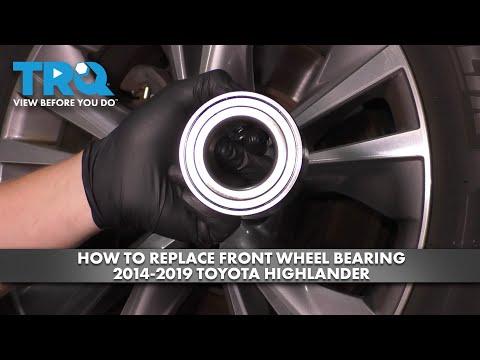



How to Replace Both Front Wheel Bearings on a 2015 Toyota Highlander
Step-by-step hub assembly guide with tools, parts, torque specs, and safety tips for 2010, 2011, 2012, 2013, 2014, 2015, 2016, 2017, 2018
How to Replace Both Front Wheel Bearings on a 2015 Toyota Highlander
Step-by-step hub assembly guide with tools, parts, torque specs, and safety tips for 2010, 2011, 2012, 2013, 2014, 2015, 2016, 2017, 2018


🔧 Highlander - Front Wheel Bearing Replacement
This guide covers replacing both front wheel bearing/hub assemblies on your Highlander. The front wheel bearing is built into a bolt-on hub assembly, so the repair is easier than press-in bearing designs, but it still requires safely lifting the vehicle and removing brake and axle-related hardware.
Difficulty Level: Intermediate | Estimated Time: 3-5 hours
⚠️ Safety & Precautions
- ⚠️ Work on a flat, solid surface and support your Highlander with jack stands before removing any wheel.
- ⚠️ Never rely on a jack alone. A jack lifts the vehicle; jack stands safely hold it up.
- ⚠️ The axle nut is very tight. Loosen it before raising the vehicle.
- ⚠️ Do not let the brake caliper hang by the rubber brake hose. Support it with wire or a bungee cord.
- ⚠️ Avoid pulling the CV axle outward too far. The CV axle is the shaft that transfers power from the transmission to the wheel.
- ⚠️ If equipped with ABS wiring at the hub, handle the sensor wire gently and route it exactly like the original.
- ⚠️ Battery disconnect is not required for this repair.
🔧 Required Tools
You'll need the following tools for this repair:
- 21mm lug nut socket
- 30mm axle nut socket
- 17mm socket
- 14mm socket
- 10mm socket
- 3/8-inch ratchet
- 1/2-inch breaker bar
- 1/2-inch torque wrench rated to 220 ft-lbs
- 3/8-inch torque wrench rated to 100 ft-lbs
- Flathead screwdriver
- Needle-nose pliers
- Hammer
- Brass punch
- Hub puller kit (specialty)
- Wire brush
- Bungee cord
- Floor jack rated 3-ton minimum
- Jack stands rated 3-ton minimum
- Wheel chocks
- Nitrile gloves
- Safety glasses
🔩 Required Parts
HowToo sells all the parts you need for this repair:
- Front wheel bearing and hub assembly - Qty: 2
- Front axle nut - Qty: 2
- Brake cleaner - Qty: 1 can
- Anti-seize compound - Qty: 1 small tube
📋 Before You Begin
- Park your Highlander on level ground and shift to Park.
- Set the parking brake and place wheel chocks behind the rear wheels.
- Plan to replace both front hub assemblies as a pair for even wear and noise prevention.
- Keep the left and right brake parts separated so everything goes back on the same side.
- No infotainment menu or scan-tool setup is needed for this repair.
🔨 Step-by-Step Instructions
Follow these steps in order:
Step 1: Loosen the Front Wheel Lug Nuts
- Use the 21mm lug nut socket and 1/2-inch breaker bar to loosen each front lug nut about one turn.
- Do not remove the lug nuts yet.
- Loosen first, lift second.
Step 2: Loosen the Axle Nuts
- Use the flathead screwdriver to remove the center cap if it blocks access to the axle nut.
- If the axle nut is staked, use the flathead screwdriver and hammer to lift the staked edge out of the axle groove. “Staked” means the nut is dented into a groove to keep it from backing off.
- Use the 30mm axle nut socket and 1/2-inch breaker bar to loosen the axle nut on each front wheel.
- Do not fully remove the axle nuts until the vehicle is safely supported.
Step 3: Raise and Support the Front of the Vehicle
- Use the floor jack rated 3-ton minimum at the front center jacking point.
- Place jack stands rated 3-ton minimum under the proper front support points.
- Lower your Highlander gently onto the jack stands.
- Use the floor jack rated 3-ton minimum as a light backup support, but do not rely on it alone.
Step 4: Remove Both Front Wheels
- Use the 21mm lug nut socket and 3/8-inch ratchet to remove the loosened lug nuts.
- Remove both front wheels and set them flat on the ground.
Step 5: Remove the Brake Caliper on One Side
- Start on one side only so the other side can be used as a visual reference.
- Use the 14mm socket and 3/8-inch ratchet to remove the two brake caliper slide pin bolts.
- Lift the caliper off the bracket.
- Use the bungee cord to hang the caliper from the strut spring.
- Do not stretch or twist the brake hose.
Step 6: Remove the Brake Caliper Bracket
- Use the 17mm socket and 1/2-inch breaker bar to remove the two caliper bracket bolts.
- Remove the caliper bracket and set it aside.
- During installation, tighten the caliper bracket bolts to Torque to 79 Nm (58 ft-lbs).
Step 7: Remove the Brake Rotor
- Pull the rotor straight off by hand.
- If it is stuck, tap around the rotor hat with the hammer.
- Do not hit the wheel studs directly.
- Rust may hold it tight.
Step 8: Remove the Axle Nut
- Use the 30mm axle nut socket and 1/2-inch breaker bar to remove the axle nut fully.
- Discard the old axle nut. It should not be reused.
Step 9: Free the CV Axle from the Hub
- Thread the old axle nut back on a few turns by hand to protect the axle threads.
- Use the brass punch and hammer to tap the axle inward until it moves freely in the hub splines.
- A spline is a set of small ridges that lock the axle and hub together.
- Remove the old axle nut again once the axle moves.
Step 10: Disconnect the ABS Wire if Attached to the Hub
- Use the 10mm socket and 3/8-inch ratchet to remove any ABS wire bracket bolts attached near the hub.
- Use the needle-nose pliers to release wire clips carefully.
- Do not pull on the wire itself.
- Match the original routing during reassembly.
Step 11: Remove the Hub Assembly Bolts
- From the back side of the steering knuckle, use the 17mm socket and 1/2-inch breaker bar to remove the four hub mounting bolts.
- The steering knuckle is the metal suspension part the hub bolts into.
- Support the hub with one hand as the last bolt comes out.
Step 12: Remove the Old Hub Assembly
- Pull the hub assembly straight out of the steering knuckle.
- If it is stuck from rust, install the hub puller kit (specialty) and tighten it evenly until the hub breaks free.
- Use the hammer only on the old hub, not on the steering knuckle.
- Patience prevents broken parts.
Step 13: Clean the Mounting Surface
- Use the wire brush to clean rust and debris from the steering knuckle bore and flat mounting surface.
- Use brake cleaner to rinse away loose debris.
- Apply a very thin layer of anti-seize compound to the outer hub mounting surface.
- Keep anti-seize off the wheel studs, brake rotor face, and axle threads.
Step 14: Install the New Hub Assembly
- Slide the new front wheel bearing and hub assembly into the steering knuckle by hand.
- Make sure the CV axle splines pass cleanly through the center of the hub.
- Start all four hub mounting bolts by hand first to avoid cross-threading.
- Use the 17mm socket and 3/8-inch torque wrench to tighten the hub mounting bolts evenly in a crisscross pattern.
- Torque to 80 Nm (59 ft-lbs).
Step 15: Reconnect the ABS Wire
- Use the needle-nose pliers to clip the ABS wire back into its original retainers.
- Use the 10mm socket and 3/8-inch torque wrench to reinstall any ABS wire bracket bolts.
- Torque to 8 Nm (71 in-lbs).
- Check that the wire cannot rub the tire, rotor, or axle.
Step 16: Install the New Axle Nut
- Thread the new front axle nut on by hand.
- Use the 30mm axle nut socket and 1/2-inch torque wrench rated to 220 ft-lbs to tighten the axle nut.
- Torque to 294 Nm (217 ft-lbs).
- Use the flathead screwdriver and hammer to stake the nut into the axle groove if the replacement nut is a staked design.
Step 17: Reinstall the Brake Rotor
- Slide the rotor back onto the hub by hand.
- Use brake cleaner to clean fingerprints from the rotor braking surface.
- Hold the rotor flush against the hub while installing the caliper bracket.
Step 18: Reinstall the Caliper Bracket
- Position the caliper bracket over the rotor.
- Start both bracket bolts by hand.
- Use the 17mm socket and 3/8-inch torque wrench to tighten the bolts.
- Torque to 79 Nm (58 ft-lbs).
Step 19: Reinstall the Brake Caliper
- Remove the bungee cord and slide the caliper back over the brake pads and bracket.
- Start the two slide pin bolts by hand.
- Use the 14mm socket and 3/8-inch torque wrench to tighten the bolts.
- Torque to 34 Nm (25 ft-lbs).
Step 20: Repeat on the Other Front Side
- Repeat Steps 5 through 19 on the opposite front wheel bearing and hub assembly.
- Use the same tools and torque specs for the second side.
- Compare routing and part position with the completed side if needed.
Step 21: Reinstall the Front Wheels
- Place each wheel back onto the hub.
- Install the lug nuts by hand first.
- Use the 21mm lug nut socket and 3/8-inch ratchet to snug the lug nuts in a star pattern.
Step 22: Lower and Torque the Wheels
- Use the floor jack rated 3-ton minimum to lift your Highlander slightly off the jack stands.
- Remove the jack stands rated 3-ton minimum.
- Lower the vehicle until the tires touch the ground.
- Use the 21mm lug nut socket and 1/2-inch torque wrench rated to 220 ft-lbs to tighten the lug nuts in a star pattern.
- Torque to 103 Nm (76 ft-lbs).
✅ After Repair
- ✅ Pump the brake pedal several times before driving. This seats the brake calipers back into position.
- ✅ Start slowly and listen for grinding, clicking, or scraping.
- ✅ Check that the ABS warning light stays off after the vehicle moves.
- ✅ Recheck the lug nut torque after 25-50 miles.
- ✅ If the steering wheel shakes, the vehicle pulls, or a humming noise remains, inspect tires, rear bearings, and alignment next.
💰 DIY vs Shop Cost
Shop Cost: $650-$1,050 (parts + labor)
DIY Cost: $220-$420 (parts only)
You Save: $430-$630 by doing it yourself!
Shop labor rates vary but typically run $100-$150/hour. This repair takes a shop approximately 2.5-4.0 hours.
🎯 Ready to get started?
HowToo makes it easy: same-day/2-day shipping on every part, plus all the tools and specialty tools you need! Check out the parts and tools sections below to add everything to your cart.