









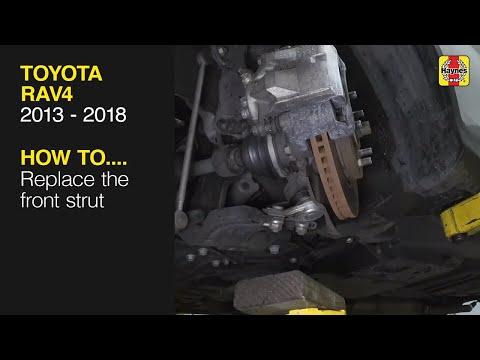






How to Replace All Struts on a 2018 Toyota RAV4 (Front & Rear DIY Guide)
Step-by-step 2018 RAV4 strut replacement with tools, parts list, torque specs, safety tips, and cost savings for 2013, 2014, 2015, 2016, 2017, 2018
How to Replace All Struts on a 2018 Toyota RAV4 (Front & Rear DIY Guide)
Step-by-step 2018 RAV4 strut replacement with tools, parts list, torque specs, safety tips, and cost savings for 2013, 2014, 2015, 2016, 2017, 2018


🔧 RAV4 - Strut Replacement Overview
You can replace the struts at home, but on your RAV4 this is a fairly involved job because the front struts are part of the steering and the springs are under high tension. We’ll walk through it step by step in simple language.
Difficulty Level: Advanced (for a first-timer) | Estimated Time: 4–6 hours for all fronts or all rears
⚠️ Safety & Precautions
- ⚠️ Springs are dangerous: The coil spring on the strut is under high tension. Always use a proper coil spring compressor and follow its instructions.
- ⚠️ Support the RAV4 with jack stands. Never work under a vehicle held only by a jack.
- ⚠️ Front struts affect steering and alignment. Plan for a professional wheel alignment after front strut replacement.
- ⚠️ Keep hands clear of pinch points around the knuckle, control arm, and spring.
- ⚠️ Turn ignition off and remove key. Battery disconnection is not required unless you feel safer doing so.
🔧 Required Tools
You'll need the following tools for this repair:
- 🛠️ Floor jack (rated 3-ton)
- 🛠️ Jack stands (rated 3-ton, set of 2 or 4)
- 🛠️ Wheel chocks
- 🛠️ Lug wrench 21mm
- 🛠️ Socket set 10–22mm
- 🛠️ Metric combination wrench set 10–22mm
- 🛠️ Breaker bar 1/2"
- 🛠️ Torque wrench 10–200 Nm range
- 🛠️ Coil spring compressor (specialty)
- 🛠️ Allen key set metric
- 🛠️ Flathead screwdriver medium
- 🛠️ Needle-nose pliers
- 🛠️ Pry bar 12–18"
- 🛠️ Rubber mallet
- 🛠️ Penetrating oil spray
- 🛠️ Paint marker or white correction pen
- 🛠️ Safety glasses
- 🛠️ Mechanic gloves
- 🛠️ Shop rags
🔩 Required Parts
HowToo sells all the parts you need for this repair:
- 🔩 Front strut assembly, left - Qty: 1
- 🔩 Front strut assembly, right - Qty: 1
- 🔩 Front strut mount with bearing - Qty: 2
- 🔩 Front coil spring insulators - Qty: 2
- 🔩 Front bump stop and dust boot kit - Qty: 2
- 🔩 Front stabilizer link nut kit - Qty: 2
- 🔩 Rear shock/strut assembly, left - Qty: 1
- 🔩 Rear shock/strut assembly, right - Qty: 1
- 🔩 Rear upper mount and rubber insulators - Qty: 2
- 🔩 Replacement strut bolts/nuts set - Qty: 1
- 🔩 Anti-seize compound - Qty: 1
- 🔩 Penetrating oil - Qty: 1
📋 Before You Begin
- 🧰 Park the RAV4 on level ground, set the parking brake, and place wheel chocks behind the wheels that stay on the ground.
- 🧰 Loosen (do not remove) the wheel lug nuts one turn with the 21mm lug wrench before lifting.
- 🧰 Decide: front struts, rear shocks/struts, or all four. The process below covers fronts first, then rears.
- 🧰 If you are reusing the original springs, have the coil spring compressor ready and read its instructions fully.
🔨 Step-by-Step Instructions
Follow these steps in order:
Step 1: Lift and support the RAV4
- Use the floor jack at the front center jacking point (under the subframe) to lift the front of the RAV4.
- Place jack stands under the factory pinch welds or frame points on both sides, then slowly lower the jack so the RAV4 rests securely on the stands.
- Remove the front wheels using the 21mm lug wrench.
- Shake the vehicle gently to confirm stability.
Step 2: Identify the front strut components
- Look inside the wheel well: the strut is the big tube with a spring wrapped around it.
- Note where it bolts to the steering knuckle at the bottom and to the body at the top under the hood.
- Spray all visible strut bolts and nuts with penetrating oil and let them soak for a few minutes.
Step 3: Disconnect brake hose and ABS wire brackets
- Use a 12mm socket to remove the small bolt that holds the brake hose bracket to the strut body; move the hose gently aside.
- Use a 10mm socket or needle-nose pliers to release any ABS sensor wire clips from the strut.
- Do not stretch or pull on the hoses or wires.
Step 4: Disconnect the sway bar (stabilizer) link from the strut
- The stabilizer link is the short rod that connects the sway bar to the strut.
- Use a 17mm wrench on the nut, and an Allen key in the end of the stud (if required) to keep it from spinning.
- Remove the nut and push the link free from the strut. Use a rubber mallet if lightly stuck.
Step 5: Loosen the lower strut-to-knuckle bolts
- Use a paint marker to mark the relationship between the strut and the knuckle (around the bolt holes). This helps keep alignment closer.
- Use a 19mm socket and breaker bar to loosen the two large bolts at the bottom of the strut that clamp it to the steering knuckle, but do not remove them yet.
- They will be tight; use steady force, not jerks.
Step 6: Remove the top strut mount nuts
- Open the hood. Locate the three small nuts holding the top of the strut mount to the strut tower.
- Use a 14mm socket and ratchet to loosen and remove two of the three nuts, leaving one loosely threaded to support the strut.
- Do not remove the center nut at this time.
Step 7: Separate the strut from the steering knuckle
- Back at the wheel well, remove the two lower 19mm bolts and nuts fully using the socket and wrench.
- If the knuckle is stuck to the strut, gently tap the side of the knuckle with a rubber mallet while supporting it with your hand.
- Once free, support the knuckle so the brake hose is not stretched (you can rest it on a small box or use a short bungee, not hanging from hose).
Step 8: Remove the front strut assembly
- Hold the strut from below with one hand.
- Under the hood, remove the last top mount nut with the 14mm socket.
- Carefully lower the strut assembly out of the wheel well and set it on the ground.
Step 9: Compress the spring on the old strut
- Attach the coil spring compressor on opposite sides of the spring, as the tool instructions show.
- Using the appropriate wrench or socket, tighten each side evenly, a few turns at a time, until the spring is clearly loose from the top and bottom seats.
- Never point your face over the spring while tightening.
Step 10: Remove the old strut mount and spring
- With the spring compressed, use a 17mm socket on the top center nut and an Allen key in the rod end (if needed) to remove the nut.
- Lift off the top mount, bearing, dust boot, and bump stop.
- Carefully slide the spring off and set it aside while still in the compressor.
Step 11: Transfer spring to the new strut
- Install the compressed spring onto the new strut, aligning the end of the coil with the stop in the lower spring seat.
- Install new bump stop, dust boot, and top mount/bearing onto the new strut.
- Thread the new center nut by hand, then tighten with a 17mm socket and torque wrench to 54 Nm (40 ft-lbs) while holding the rod with an Allen key if needed.
- Slowly loosen the coil spring compressor evenly on both sides until the spring is seated and fully supporting itself.
Step 12: Reinstall the front strut assembly
- Guide the new strut up into the strut tower from the wheel well.
- From under the hood, start the three top mount nuts by hand using the 14mm socket, but do not fully tighten yet.
- Align the bottom of the strut with the steering knuckle. Insert the two lower bolts by hand.
- Use a 19mm socket and wrench to snug the lower bolts, then torque to 177 Nm (131 ft-lbs).
- Torque the three upper nuts to 59 Nm (44 ft-lbs) with the torque wrench and 14mm socket.
Step 13: Reattach sway bar link, brake hose, and ABS wire
- Insert the stabilizer link stud into the bracket on the strut and install the nut. Tighten with a 17mm wrench and Allen key as needed, then torque to 74 Nm (55 ft-lbs).
- Reinstall the brake hose bracket bolt with a 12mm socket and torque to 29 Nm (21 ft-lbs).
- Clip the ABS wire back into all holders using your fingers or needle-nose pliers.
Step 14: Repeat for the other front side
- Repeat Steps 2–13 on the other front corner.
- Do one side at a time to use it as reference.
Step 15: Rear strut/shock removal (one side)
- Move the floor jack and lift the rear of the RAV4 at the rear jacking point, then support with jack stands and remove rear wheels with the 21mm lug wrench.
- On your RAV4, the rear damper is a shock/strut unit without a front-style steering knuckle connection.
- Support the rear lower control arm with the floor jack lightly so it does not drop when you remove bolts.
- Use a 17mm socket and wrench to remove the lower shock bolt.
- Inside the cargo area, behind the trim near the wheel well, locate the top shock/strut mount and remove the two nuts with a 14mm socket.
- Lower the jack a bit and remove the rear shock/strut assembly.
Step 16: Install rear strut/shock assembly
- If your new rear unit is complete (spring already installed), position it and start the top nuts by hand with the 14mm socket.
- Raise the lower control arm slightly with the floor jack until the lower bolt hole lines up, then insert the bolt by hand.
- Tighten the lower bolt with a 17mm socket and wrench and torque to 103 Nm (76 ft-lbs).
- Torque the upper mount nuts to 39 Nm (29 ft-lbs) using the torque wrench and 14mm socket.
Step 17: Repeat rear on other side and reinstall wheels
- Repeat Steps 15–16 on the opposite rear side.
- Reinstall all wheels and snug the lug nuts with the 21mm lug wrench.
- Remove jack stands and lower the RAV4 fully to the ground using the floor jack.
- Torque all wheel lug nuts to 103 Nm (76 ft-lbs) in a star pattern with the torque wrench and 21mm socket.
✅ After Repair
- 🧪 Bounce each corner of the RAV4 by hand; it should settle quickly without extra bounces.
- 🧪 Take a short, slow test drive. Listen for clunks, rattles, or rubbing noises over bumps and during turns.
- 🧪 Recheck all visible fasteners after the test drive with the proper sockets and verify torque if something seems loose.
- 🧪 Schedule a professional wheel alignment as soon as possible, especially after front strut replacement.
💰 DIY vs Shop Cost
Shop Cost: $900–$1,400 for all four corners (parts + labor)
DIY Cost: $350–$700 (parts only, depending on brand and if assemblies are pre-loaded)
You Save: $550–$700 by doing it yourself!
Shop labor rates vary but typically run $100–$150/hour. This repair takes a shop approximately 3–4 hours.
🎯 Ready to get started?
HowToo makes it easy: same-day/2-day shipping on every part, plus all the tools and specialty tools you need! Check out the parts and tools sections above to add everything to your cart.