








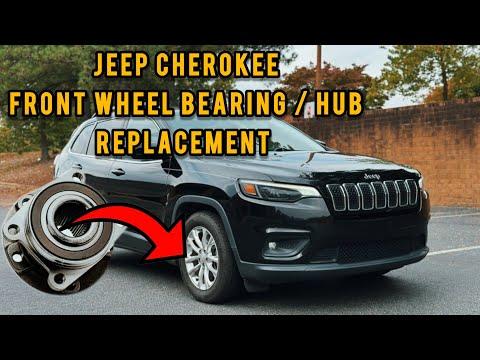







How to Replace a Wheel Bearing/Hub Assembly on a 2018 Jeep Cherokee
Step-by-step front or rear hub replacement with tools/parts list, ABS tips, and torque specs
How to Replace a Wheel Bearing/Hub Assembly on a 2018 Jeep Cherokee
Step-by-step front or rear hub replacement with tools/parts list, ABS tips, and torque specs


🔧 Cherokee - Wheel Bearing Replacement
On your Cherokee, the wheel bearing is part of the wheel hub assembly. Replacing it means removing the brake parts and the hub from the steering knuckle (front) or rear knuckle, then bolting in the new hub so the wheel spins quietly and smoothly again.
Difficulty Level: Intermediate | Estimated Time: 1.5-3.0 hours per side
⚠️ Safety & Precautions
- ⚠️ Support the vehicle with jack stands; never rely on a jack.
- ⚠️ Wear safety glasses and gloves; rust and debris fall straight down.
- ⚠️ Do not let the brake caliper hang by the hose; support it with a hook/strap.
- ⚠️ If your hub has an ABS wire/sensor lead, disconnect it carefully; don’t pull on the wire.
- ⚠️ If working on the front, do not push/pull hard on the axle (CV) joint; it can damage the joint.
🔧 Required Tools
You'll need the following tools for this repair:
- Floor jack (rated 3-ton minimum)
- Jack stands (rated 3-ton minimum)
- Wheel chocks
- Safety glasses
- Nitrile gloves
- Breaker bar 1/2-inch drive
- Torque wrench 1/2-inch drive (20-250 ft-lbs range)
- Socket set 1/2-inch drive (10mm-24mm)
- Ratchet 3/8-inch drive
- Socket set 3/8-inch drive (8mm-18mm)
- Torx bit set (T30-T50)
- Pry bar 12-inch
- Dead-blow hammer 2 lb
- Wire brush
- Bungee cord or mechanics hook
- Penetrating oil
- Slide hammer hub puller (specialty)
🔩 Required Parts
HowToo sells all the parts you need for this repair:
- Wheel hub & bearing assembly (with ABS tone ring/sensor provision) - Qty: 1
- Axle nut (one-time-use recommended) - Qty: 1
- Brake caliper bracket bolts (if specified as one-time-use) - Qty: 2
- Brake cleaner - Qty: 1
- Medium-strength threadlocker (blue) - Qty: 1
- Anti-seize compound - Qty: 1
📋 Before You Begin
- Park on level ground, shift to Park, and set the parking brake.
- Chock the wheels on the opposite end you’re lifting.
- Loosen the lug nuts slightly with the vehicle on the ground using a breaker bar.
- Spray penetrating oil on the hub-to-knuckle seam and hub bolts now; let it soak.
🔨 Step-by-Step Instructions
Follow these steps in order:
Step 1: Lift and remove the wheel
- Use a floor jack (rated 3-ton minimum) to lift at the proper jacking point.
- Set the vehicle onto jack stands (rated 3-ton minimum).
- Remove the lug nuts using a socket set 1/2-inch drive (10mm-24mm) and take the wheel off.
Step 2: Remove the brake caliper and bracket
- Remove the caliper bolts using a socket set 3/8-inch drive (8mm-18mm) and ratchet 3/8-inch drive.
- Lift the caliper off and support it with a bungee cord or mechanics hook.
- Remove the caliper bracket bolts using a socket set 1/2-inch drive (10mm-24mm) and breaker bar 1/2-inch drive.
- Caliper bracket bolts are usually very tight.
Step 3: Remove the brake rotor
- If there is a rotor retaining screw, remove it using a Torx bit set (T30-T50).
- Pull the rotor off. If stuck, tap the rotor hat with a dead-blow hammer 2 lb to break rust free.
Step 4: Disconnect the ABS wheel speed sensor wiring
- Locate the ABS wire at the back of the knuckle/hub area.
- Unclip the wiring from its retainers using a pry bar 12-inch gently.
- Disconnect the electrical connector by hand.
- Never pull the ABS wire to unplug it.
Step 5: Remove the axle nut (front only)
- If you are doing a front hub: remove the axle nut using a socket set 1/2-inch drive (10mm-24mm) and breaker bar 1/2-inch drive.
- If the nut is staked (dented into a groove), straighten the staked area first using a pry bar 12-inch and dead-blow hammer 2 lb.
- Loosen the axle nut before fully pushing the axle inward.
Step 6: Unbolt the hub assembly from the knuckle
- From the back side of the knuckle, remove the hub bolts using a socket set 1/2-inch drive (10mm-24mm) and ratchet 3/8-inch drive (use the drive that fits best).
- Clean exposed bolt heads with a wire brush so the socket seats fully.
Step 7: Separate the hub from the knuckle
- Spray the seam again with penetrating oil.
- Use a slide hammer hub puller (specialty) to pull the hub out if it’s rust-seized.
- If needed, tap around the hub flange with a dead-blow hammer 2 lb to help it break free.
- Rust can make this the hardest part.
Step 8: Prep the mounting surface
- Use a wire brush to clean the knuckle’s hub mating surface until it’s smooth and shiny.
- Spray with brake cleaner and wipe clean.
- Apply a very thin film of anti-seize compound to the mating surface to prevent future seizure.
Step 9: Install the new hub assembly
- Slide the new hub into place by hand, lining up bolt holes and the ABS routing.
- Install the hub bolts and snug them using a ratchet 3/8-inch drive.
- Apply medium-strength threadlocker (blue) to hub bolt threads if your replacement hardware/service info calls for it.
- Tighten hub bolts evenly in a crisscross pattern using a torque wrench 1/2-inch drive (20-250 ft-lbs range).
- Torque to the exact spec for your axle (front vs rear) (I’ll provide the exact numbers once you answer the question below).
Step 10: Reinstall the axle nut (front only)
- Install the new axle nut by hand first to avoid cross-threading.
- Tighten using a socket set 1/2-inch drive (10mm-24mm) and torque wrench 1/2-inch drive (20-250 ft-lbs range).
- Torque to the exact spec (I’ll provide the exact number once you confirm front or rear).
- If the nut must be staked, stake it using a dead-blow hammer 2 lb and pry bar 12-inch.
Step 11: Reinstall rotor, bracket, and caliper
- Reinstall the rotor (and rotor screw if equipped) using a Torx bit set (T30-T50).
- Reinstall the caliper bracket bolts using a socket set 1/2-inch drive (10mm-24mm) and torque wrench 1/2-inch drive (20-250 ft-lbs range).
- Torque to the exact spec (I’ll provide the exact number once you confirm axle).
- Reinstall the caliper bolts using a socket set 3/8-inch drive (8mm-18mm) and torque wrench 1/2-inch drive (20-250 ft-lbs range) (use an adapter if needed).
- Torque to the exact spec (I’ll provide the exact number once you confirm axle).
Step 12: Reconnect ABS wiring and reinstall wheel
- Reconnect the ABS connector by hand and re-clip the wire into its retainers.
- Install the wheel and hand-tighten lug nuts.
- Lower the vehicle using a floor jack (rated 3-ton minimum), then torque lug nuts using a torque wrench 1/2-inch drive (20-250 ft-lbs range).
- Torque to 135 Nm (100 ft-lbs)
✅ After Repair
- Pump the brake pedal 5-10 times until it feels firm (this seats the pads back against the rotor).
- Start the engine and verify no ABS warning light stays on.
- Road test at low speed first; listen for humming/grinding and check for vibration.
- Recheck lug nut torque after 25-50 miles using a torque wrench 1/2-inch drive (20-250 ft-lbs range).
💰 DIY vs Shop Cost
Shop Cost: $450-$900 (parts + labor)
DIY Cost: $120-$350 (parts only)
You Save: $330-$550 by doing it yourself!
Shop labor rates vary but typically run $100-$150/hour. This repair takes a shop approximately 1.5-3.0 hours.
🎯 Ready to get started?
Quick question so I can give you the exact factory torque specs (hub bolts, axle nut, caliper bracket bolts): are you replacing the front wheel bearing/hub or the rear?
HowToo makes it easy: same-day/2-day shipping on every part, plus all the tools and specialty tools you need! Check out the parts and tools sections below to add everything to your cart.