









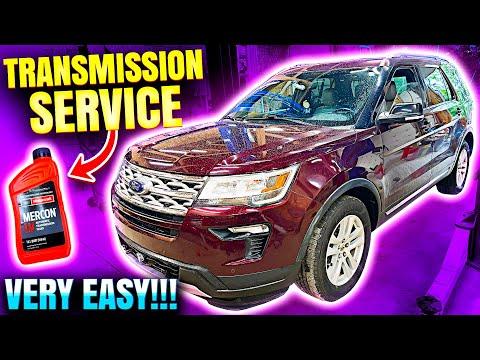







How to Change Transmission Fluid on a 2018 Ford Explorer (Drain & Refill MERCON LV)
Step-by-step DIY instructions with required tools, parts, safety tips, and proper fluid-level check at temperature
How to Change Transmission Fluid on a 2018 Ford Explorer (Drain & Refill MERCON LV)
Step-by-step DIY instructions with required tools, parts, safety tips, and proper fluid-level check at temperature


🔧 Explorer - Transmission Fluid Change
On your Explorer, the safest DIY way is usually a drain-and-refill (sometimes repeated) to refresh fluid without forcing debris through the valve body. The critical part is setting the fluid level at the correct transmission fluid temperature, because level changes as the fluid warms up.
Difficulty Level: Intermediate | Estimated Time: 1.5-3.0 hours
⚠️ Safety & Precautions
- ⚠️ Support the SUV on jack stands on level ground; never rely on a jack.
- ⚠️ Transmission fluid can be hot; wear gloves and safety glasses.
- ⚠️ Keep the vehicle level during the final level check, or you can over/under-fill.
- ⚠️ Engine may need to run during level checking; keep hands/clothes away from moving parts.
- ⚠️ Battery disconnect is not normally required for a drain-and-refill.
🔧 Required Tools
You'll need the following tools for this repair:
- Floor jack (rated 3-ton minimum)
- Jack stands (rated 3-ton minimum)
- Wheel chocks
- Safety glasses
- Nitrile gloves
- Drain pan (8-quart minimum)
- Socket set (metric)
- Ratchet
- Torque wrench (10–100 ft-lbs range)
- Trim clip removal tool
- Flat-head screwdriver
- Fluid transfer pump (specialty)
- Funnel
- OBD2 scan tool that reads transmission fluid temperature (specialty)
- Infrared thermometer
- Shop rags
🔩 Required Parts
HowToo sells all the parts you need for this repair:
- Automatic transmission fluid (MERCON LV) - Qty: 6–12 quarts
- Transmission drain/fill plug seal or O-ring - Qty: 1
- Brake cleaner - Qty: 1
📋 Before You Begin
- Park on level ground, set the parking brake, and chock the rear wheels.
- Plan to check/set fluid level at a specific temperature using an OBD2 scan tool (it shows live data like transmission temp).
- Quick questions so I give the exact correct procedure:
- Are you doing a simple drain-and-refill or a full fluid exchange (cooler-line method/machine)?
- Do you have an OBD2 scanner that can read Transmission Fluid Temp (TFT)?
🔨 Step-by-Step Instructions
Follow these steps in order:
Step 1: Warm the transmission slightly
- Drive 10–15 minutes so the fluid is warm (not scorching hot).
- Use your OBD2 scan tool that reads transmission fluid temperature (specialty) to confirm it’s responding. Temp reading is key later.
Step 2: Raise and level the vehicle
- Use a floor jack (rated 3-ton minimum) to lift the front at the proper jacking point.
- Set the front on jack stands (rated 3-ton minimum).
- If needed to keep it level, lift the rear with the floor jack (rated 3-ton minimum) and support with jack stands (rated 3-ton minimum).
- Shake-test the vehicle gently before going underneath.
Step 3: Remove the splash shield (if equipped)
- Use a trim clip removal tool and flat-head screwdriver to remove push clips.
- Use a socket set (metric) and ratchet to remove any bolts holding the shield.
- Set fasteners aside in a tray so you don’t lose them.
Step 4: Identify the correct drain and fill/check points
- Place a drain pan (8-quart minimum) under the transmission pan area.
- Use a flashlight (from your phone is fine) to locate:
- The drain plug (usually at/near the transmission pan).
- The fill plug/port (often on the side of the case) or the method your transmission uses to fill.
- The level check plug if your unit uses an overflow/standpipe style check.
- Stop here if you can’t clearly identify the fill point. Draining before confirming the fill method can leave you stuck.
Step 5: Drain the old fluid
- Use the correct-size tool from your socket set (metric) with a ratchet to remove the drain plug.
- Let it drain fully into the drain pan (8-quart minimum).
- Clean the plug area with shop rags and brake cleaner.
- Replace the drain/fill plug seal or O-ring if applicable.
- Reinstall the drain plug and tighten using a torque wrench (10–100 ft-lbs range).
- Torque: I’ll give the exact plug torque once you confirm drain-and-fill vs exchange (and your fill/check style), because it varies by transmission version.
Step 6: Measure what came out
- Pour drained fluid into a container with markings (or measure it) so you know roughly how much to add back.
- This does not replace the final level check—just prevents big over/under filling.
Step 7: Refill with MERCON LV
- Use a fluid transfer pump (specialty) and/or funnel to add Automatic transmission fluid (MERCON LV) through the correct fill port.
- Add approximately the same amount you drained out to start.
- Clean any spills with shop rags and brake cleaner.
Step 8: Set the final fluid level at temperature
- Start the engine and keep the vehicle safely supported and level.
- With your foot on the brake, move the shifter slowly through P-R-N-D and back to P, pausing 2–3 seconds in each gear.
- Use the OBD2 scan tool that reads transmission fluid temperature (specialty) to watch TFT.
- Critical: The exact temperature window and level-check method (overflow/check plug vs dipstick-style) must match your transmission version. I’ll give the exact TFT range and “what you should see” once you answer the two questions above.
Step 9: Reinstall the splash shield
- Reinstall the shield using the socket set (metric) and ratchet.
- Reinstall push clips using the trim clip removal tool.
Step 10: Lower the vehicle
- Use the floor jack (rated 3-ton minimum) to lift slightly, remove jack stands (rated 3-ton minimum), then lower slowly.
- Remove wheel chocks last.
✅ After Repair
- Test drive 10–15 minutes and verify smooth shifts and no slipping.
- Park on a clean surface and check underneath for leaks.
- Recheck the level again (same temperature method) if your transmission uses an overflow-style check.
💰 DIY vs Shop Cost
Shop Cost: $250-$550 (parts + labor)
DIY Cost: $60-$160 (parts only)
You Save: $190-$390 by doing it yourself!
Shop labor rates vary but typically run $100-$150/hour. This repair takes a shop approximately 1.5-3.0 hours.
🎯 Ready to get started?
HowToo makes it easy: same-day/2-day shipping on every part, plus all the tools and specialty tools you need! Check out the parts and tools sections below to add everything to your cart.