
















How to Change Transmission Fluid on a 2012 Chevy Silverado 1500
Step-by-step DIY ATF and filter service with tools, parts list, torque specs, and safety tips for 2006, 2007, 2008, 2009, 2010, 2011, 2012, 2013, 2014, 2015, 2016, 2017, 2018, 2019, 2020, 2021, 2022, 2023, 2024
How to Change Transmission Fluid on a 2012 Chevy Silverado 1500
Step-by-step DIY ATF and filter service with tools, parts list, torque specs, and safety tips for 2006, 2007, 2008, 2009, 2010, 2011, 2012, 2013, 2014, 2015, 2016, 2017, 2018, 2019, 2020, 2021, 2022, 2023, 2024


🔧 Silverado 1500 - Automatic Transmission Fluid & Filter Change
You’ll be draining the old automatic transmission fluid, removing the pan, changing the filter and gasket, then refilling with fresh ATF. This is the safe “service” method (not a machine flush) and is appropriate for the hybrid transmission in your Silverado.
Difficulty Level: Intermediate | Estimated Time: 2–3 hours
⚠️ Safety & Precautions
- ⚠️ Hybrid safety: Do not touch or damage any orange high-voltage cables or connectors under the truck; those are part of the hybrid system.
- ⚠️ Work on a flat, solid surface, use a floor jack only to lift, and always support the truck with jack stands under the frame.
- ⚠️ Transmission fluid and the exhaust can be very hot; let the truck cool until you can touch the pan comfortably.
- ⚠️ Wear safety glasses and gloves; old ATF is irritating and will drip unexpectedly as the pan comes down.
- ⚠️ Set the parking brake and use wheel chocks behind the rear wheels so the truck cannot roll.
- ⚠️ Disconnect the negative battery cable with a 10mm wrench before working underneath to avoid accidental starter engagement.
🔧 Required Tools
You'll need the following tools for this repair:
- 🛠️ Floor jack (rated 3-ton minimum)
- 🛠️ Jack stands (rated 3-ton minimum, set of 2–4)
- 🛠️ Wheel chocks
- 🛠️ Safety glasses
- 🛠️ Nitrile or mechanic’s gloves
- 🛠️ Drain pan (at least 10-quart capacity)
- 🛠️ 3/8" drive ratchet
- 🛠️ 13mm socket
- 🛠️ 10mm socket
- 🛠️ 6" socket extension
- 🛠️ 3/8" drive torque wrench (5–80 ft-lbs range)
- 🛠️ Inch-pound torque wrench (50–150 in-lbs range)
- 🛠️ Flathead screwdriver (medium size)
- 🛠️ Plastic scraper
- 🛠️ Pick tool or small hook tool
- 🛠️ Long-neck fluid funnel
- 🛠️ Shop rags or paper towels
- 🛠️ Brake cleaner spray
- 🛠️ Torque bit set (if your skid plate uses Torx fasteners)
- 🛠️ 10mm combination wrench
🔩 Required Parts
HowToo sells all the parts you need for this repair:
- 🔩 DEXRON-VI automatic transmission fluid - Qty: 6–7 quarts (pan drop & refill)
- 🔩 Automatic transmission filter kit with pan gasket - Qty: 1
- 🔩 Transmission pan bolts (optional refresh set) - Qty: 1 set
- 🔩 Drain plug sealing washer (if your pan has a drain plug) - Qty: 1
- 🔩 Brake cleaner - Qty: 1–2 cans
- 🔩 Shop towels - Qty: 1 pack
📋 Before You Begin
- Park your Silverado on level ground, set the parking brake, and place it in P (Park).
- Let the engine run for about 5–10 minutes to warm the transmission slightly, then switch the engine off. Warm fluid drains better, but don’t work with it too hot.
- Open the hood and locate the transmission dipstick (toward the rear of engine bay on passenger side). This is where you’ll refill later.
- Disconnect the negative battery cable with a 10mm wrench and secure it away from the terminal.
- Gather all tools and parts so you don’t have to crawl out from under the truck halfway through.
🔨 Step-by-Step Instructions
Follow these steps in order:
Step 1: Raise and Support the Truck
- Use the floor jack (3-ton) to lift the front of your Silverado at the front crossmember (strong metal bar under the engine).
- Place jack stands (3-ton) under the frame rails on both sides and slowly lower the truck onto them with the floor jack.
- Leave the jack lightly touching the frame as a backup.
- Place wheel chocks behind the rear wheels.
- Give the truck a firm push to confirm it’s stable.
Step 2: Remove Any Skid Plate or Shield
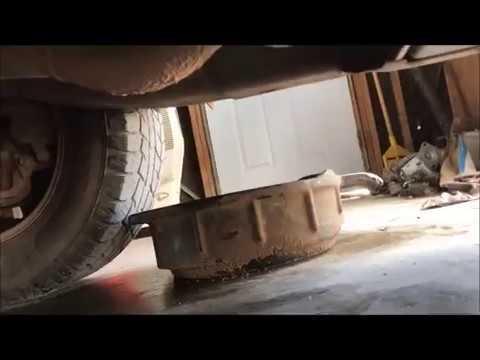
- Slide the drain pan under the transmission area so it’s ready for any drips.
- If your Silverado has a metal skid plate under the transmission, use a 10mm socket (or Torx bit if Torx fasteners) with a 3/8" ratchet to remove the bolts.
- Support the plate with one hand while removing the last bolts, then lower it and set it aside.
Step 3: Loosen the Transmission Pan and Start Draining
- Identify the transmission pan — a rectangular metal pan near the middle of the truck, behind the engine oil pan.
- If your pan has a drain plug, place the drain pan directly under it and use a 13mm socket to loosen and remove the plug. Let it drain fully.
- Torque when reinstalling drain plug later: 27 Nm (20 ft-lbs).
- If there is no drain plug, move the drain pan under a rear corner of the pan and use a 13mm socket to loosen (but not remove) all the pan bolts.
- Remove more bolts from the rear and sides, leaving a few at the front to “hinge” the pan. Fluid will start to pour out from the loosened corner into your drain pan.
- Go slowly; lots of small drips are normal.
Step 4: Remove the Transmission Pan
- Once most fluid has drained, support the pan with one hand while you remove the remaining bolts using the 13mm socket and 3/8" ratchet.
- Lower the pan carefully. It will still have some fluid inside, so keep it level and pour the remaining fluid into your drain pan.
- Set the pan on the ground on some shop rags.
Step 5: Clean the Pan and Magnet
- Inside the pan you’ll see a small magnet that collects metal particles. Remove it and wipe it clean with shop rags.
- Spray the inside of the pan with brake cleaner and wipe it clean until it’s completely free of sludge and old gasket material.
- Use a plastic scraper to gently scrape off any old gasket stuck to the pan lip. Do not use a metal scraper that can gouge the metal.
- Reinstall the cleaned magnet in its original location.
Step 6: Remove the Old Filter and Seal
- Look up at the exposed transmission valve body. You’ll see the transmission filter (a flat plastic/metal piece) mounted into the transmission.
- Most 4L70E filters on your Silverado pull straight out. Grip the filter and pull down gently but firmly. Let it drip into the drain pan.
- There is a rubber seal in the transmission where the filter neck plugged in. Use a pick tool carefully to pry out this old seal.
- Do not scratch the aluminum bore where the seal sits.
Step 7: Install the New Filter
- Lightly coat the new filter’s rubber seal with a bit of fresh DEXRON-VI ATF.
- Push the new seal into the transmission bore by hand, making sure it sits square and fully seated.
- Insert the neck of the new filter into the seal and push up firmly until it clicks or feels solidly seated.
- If your new filter has a small retaining bolt, install it with the appropriate socket (often 10mm socket) and snug it with the 3/8" ratchet to about 8–10 Nm (70–90 in-lbs) using the inch-pound torque wrench.
Step 8: Install the New Pan Gasket
- Lay the cleaned transmission pan on the bench.
- Place the new pan gasket onto the pan, lining up the bolt holes. Most kits use a reusable rubber gasket; no extra sealant is needed.
- If the gasket keeps slipping, use a couple of bolts through holes to hold it in place.
Step 9: Reinstall the Transmission Pan
- Hold the pan with gasket up to the transmission and start a couple of bolts by hand at opposite corners to keep the gasket aligned.
- Install all remaining bolts finger-tight first, using the 13mm socket.
- Using the inch-pound torque wrench and 13mm socket, tighten pan bolts in a crisscross pattern to 12 Nm (106 in-lbs ≈ 9 ft-lbs).
- Do not overtighten; crushing the gasket causes leaks.
- If you removed a drain plug earlier, reinstall it with a new washer (if used) and torque to 27 Nm (20 ft-lbs) using the 3/8" torque wrench and 13mm socket.
Step 10: Reinstall Skid Plate or Shield
- Lift the skid plate back into position under the transmission.
- Start all bolts by hand, then tighten them using the 10mm socket or appropriate Torx bit and 3/8" ratchet.
- Snug them evenly; typical torque for these is around 20–25 Nm (15–18 ft-lbs) unless otherwise marked.
Step 11: Lower the Truck
- Use the floor jack to slightly lift the front of the truck off the jack stands.
- Remove the jack stands and slowly lower the truck back to the ground.
- Remove the wheel chocks.
Step 12: Add New Transmission Fluid
- Under the hood, pull out the transmission dipstick and set it aside.
- Place the long-neck funnel into the dipstick tube.
- Pour in about 4 quarts of DEXRON-VI ATF to start.
- Reconnect the negative battery cable with the 10mm wrench.
- Start the engine and with your foot on the brake, slowly move the shifter through all gears (P–R–N–D–M–L) pausing 2–3 seconds in each, then back to Park. This fills the circuits with fluid.
- With engine idling in Park on level ground, add fluid in 0.5-quart steps, checking the dipstick each time.
Step 13: Check Fluid Level Correctly
- With the engine idling, transmission in P, and the truck on level ground, wipe the dipstick with a shop rag, reinsert fully, then pull it again to read.
- The fluid should be in the “HOT” range once the transmission is at operating temperature (after a 15–20 minute drive). Initially, just get it into the safe range; do final adjustment after a short drive.
- Do not overfill. The correct level is between the upper and lower notches in the “HOT” zone when the trans is hot.
Step 14: Final Road Test and Recheck
- Take the truck for a 10–15 minute drive to warm the transmission fully. Use all gears (including highway speeds if possible).
- Park on level ground, leave the engine idling in Park, and check the fluid level again with the dipstick.
- Add small amounts of DEXRON-VI ATF as needed until the level is right in the “HOT” range.
- Look underneath for any signs of leaks around the pan or drain plug.
✅ After Repair
- 🧪 Check for leaks after the first drive and again the next day; look at the transmission pan edges and drain plug area.
- 🚗 Pay attention to how the transmission shifts. It should feel smooth and consistent; any harsh or slipping shifts should be checked further.
- 📝 Note the mileage and date of this service; a typical interval for fluid and filter on these is about every 50,000–60,000 miles in real-world use.
- ♻️ Dispose of the old ATF properly at a recycling center or auto parts store that accepts used fluids.
💰 DIY vs Shop Cost
Shop Cost: $250–$400 (parts + labor)
DIY Cost: $80–$140 (parts only)
You Save: $170–$260 by doing it yourself!
Shop labor rates typically run $100–$150/hour. This repair takes a shop about 1.5–2.0 hours.
🎯 Ready to get started?
HowToo makes it easy: same-day/2-day shipping on every part, plus all the tools and specialty tools you need! Check out the parts and tools sections above to add everything to your cart.