









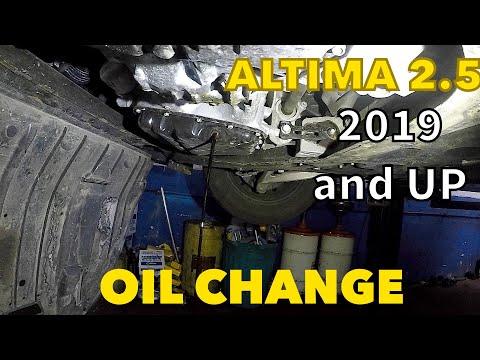






How to Change Engine Oil and Oil Filter on a 2014-2023 Nissan Altima 2.5L (Trim: SV)
Step-by-step DIY oil service with tools, parts list, torque specs, safety tips, and maintenance reset instructions
How to Change Engine Oil and Oil Filter on a 2014-2023 Nissan Altima 2.5L (Trim: SV)
Step-by-step DIY oil service with tools, parts list, torque specs, safety tips, and maintenance reset instructions for 2014, 2016, 2017, 2018, 2019, 2020, 2021, 2022, 2023


🔧 Altima - Engine Oil & Filter Change
You’ll drain the old engine oil, replace the oil filter, then refill with fresh oil to the correct level. This keeps the engine lubricated, cool, and clean, which greatly extends its life.
Difficulty Level: Beginner | Estimated Time: 1–1.5 hours
⚠️ Safety & Precautions
- 🧯 Always work on solid, level ground and keep the transmission in Park with the parking brake fully applied.
- 🛠️ Support the front of the car with jack stands under the correct points; never rely only on a floor jack.
- 🔥 Let the engine cool 20–30 minutes; hot oil and exhaust parts can burn skin.
- 🧤 Wear gloves and safety glasses; used oil is dirty and can irritate skin and eyes.
- 🛢️ Keep oil away from belts and the exhaust; wipe any spills right away.
- 🌎 Used oil and filters are hazardous waste; recycle them at a proper collection center (most service stations or parts stores).
- 🔌 Battery disconnect is not required for this job.
🔧 Required Tools
You'll need the following tools for this repair:
- 🧰 Floor jack (rated 2-ton or higher)
- 🧰 Jack stands (2-ton or higher, pair)
- 🧰 Wheel chocks
- 🧰 10mm socket
- 🧰 14mm socket
- 🧰 Socket wrench (3/8" drive)
- 🧰 Socket extension 75–100mm (3–4")
- 🧰 Torque wrench 5–75 Nm (5–55 ft-lbs)
- 🧰 Oil filter wrench (strap or cup type, specialty)
- 🧰 Drain pan (at least 7-liter capacity)
- 🧰 Funnel (medium size)
- 🧰 Flathead screwdriver (medium)
- 🧰 Shop towels or rags
- 🧰 Nitrile or mechanic gloves
- 🧰 Safety glasses
- 🧰 Plastic trim clip tool (specialty)
🔩 Required Parts
HowToo sells all the parts you need for this repair:
- 🛢️ Engine oil 0W-20 full synthetic (API SN or better) - Qty: 5 quarts
- 🛢️ Engine oil filter (for 2.5L QR25 engine) - Qty: 1
- 🛢️ Aluminum drain plug crush washer (14mm Nissan type) - Qty: 1
- 🧽 Brake cleaner or parts cleaner spray - Qty: 1 can
- 🧻 Absorbent pads or cardboard (for floor protection) - Qty: as needed
📋 Before You Begin
- Park the Altima on a flat surface, select Park, set the parking brake, and chock the rear wheels.
- Run the engine for 3–5 minutes, then shut it off to slightly warm the oil so it drains easier.
- Gather all tools and parts so you’re not crawling in and out from under the car repeatedly.
- Place the drain pan, funnel, new oil, filter, and rags within arm’s reach of the front of the car.
- On the dash later you’ll reset the oil reminder using Settings > Maintenance > Oil and Filter.
🔨 Step-by-Step Instructions
Follow these steps in order:
Step 1: Raise and support the front of the Altima
- Use the floor jack to lift the front center jacking point (under the front subframe area; consult your owner’s manual picture to confirm).
- Place jack stands under the left and right front pinch welds or frame points, then slowly lower the car onto them with the floor jack.
- Give the car a gentle shake to confirm it is stable on the jack stands.
- Keep wheels chocked for extra safety.
Step 2: Remove the lower engine cover (splash shield)
- Slide the drain pan (empty for now) under the engine to catch any small drips from removing the cover.
- Use a 10mm socket and socket wrench to remove the bolts holding the front part of the plastic shield.
- Use the plastic trim clip tool or flathead screwdriver to carefully pop out any plastic clips.
- Lower the shield and set it aside where you won’t step on it.
Step 3: Locate the drain plug and oil filter
- Slide under the car and find the oil pan at the bottom of the engine; it’s a shallow metal pan.
- The drain plug is a single hex-headed bolt at the rear or bottom of the pan that fits a 14mm socket.
- The oil filter is a small cylindrical canister (usually white or blue/black) screwed into the engine block, visible from underneath.
- Make sure you do not confuse the transmission drain plug.
Step 4: Drain the old engine oil
- Place the drain pan under the drain plug, slightly rearward so the oil stream lands in the center.
- Use a 14mm socket and socket wrench to loosen the drain plug, then finish removing it by hand while pushing inward until the last threads, then pull it away quickly.
- Allow the oil to drain completely; this may take 5–10 minutes.
- Inspect the old drain plug and crush washer; you will replace the washer with a new one.
Step 5: Reinstall the drain plug with new washer
- Wipe the drain plug hole and surrounding area with a rag.
- Slide a new crush washer onto the drain plug.
- Thread the drain plug in by hand first to avoid cross-threading.
- Use a 14mm socket and torque wrench to tighten the plug to 34 Nm (25 ft-lbs).
- Never overtighten; the oil pan threads are soft metal.
Step 6: Remove the old oil filter
- Move the drain pan under the oil filter area; more oil will come out here.
- Use the oil filter wrench and socket wrench (or its own handle) to loosen the filter by turning counterclockwise.
- Once loosened, spin it off by hand, keeping it upright as much as possible to reduce spills, and place it open-side up in the drain pan.
- Wipe the mating surface on the engine where the filter seals; make sure the old rubber gasket is not stuck to the engine.
Step 7: Install the new oil filter
- Pour a little fresh engine oil into the new filter (about 1/3 full) to pre-wet it; this is optional but helpful.
- Use a gloved finger to lightly coat the rubber gasket on the new filter with fresh oil.
- Thread the new filter onto the engine by hand, turning clockwise until the gasket makes contact with the engine surface.
- Tighten the filter a further 2/3 to 3/4 turn by hand, or use the oil filter wrench with a torque wrench to tighten to about 17 Nm (13 ft-lbs).
- Hand-tight plus 2/3 turn is usually enough.
Step 8: Clean up underneath and reinstall the splash shield
- Spray a little brake cleaner on a rag and wipe around the drain plug and filter to remove oil residue.
- Check that there is no fresh dripping from the drain plug or filter.
- Reposition the lower engine cover and reinstall the bolts with a 10mm socket and clips with the plastic trim clip tool or fingers.
- Snug the 10mm bolts gently; they do not need heavy torque.
Step 9: Lower the Altima
- Use the floor jack to raise the car slightly off the jack stands.
- Remove the jack stands, then slowly lower the car to the ground.
- Remove the wheel chocks only after the car is fully lowered.
Step 10: Add new engine oil
- Open the hood and locate the oil filler cap on top of the engine; it will be marked “Engine Oil” or “0W-20”.
- Remove the cap by hand and place a funnel in the opening.
- Pour in about 4.25 quarts (4.0 liters) of 0W-20 full synthetic oil to start.
- Wait a minute for oil to settle, then remove the funnel and reinstall the filler cap by hand.
Step 11: Start engine and check for leaks
- Start the engine and let it idle for 30–60 seconds.
- Look underneath the front of the car for any oil dripping from the drain plug or filter area.
- If you see leaks, shut off immediately and carefully tighten the leaking part slightly with the appropriate tool (14mm socket for plug, oil filter wrench for filter).
- If no leaks, shut the engine off and wait about 5 minutes to let the oil drain back into the pan.
Step 12: Check and adjust oil level
- Pull out the engine oil dipstick, wipe it clean with a rag, then reinsert it fully and pull it back out to read.
- The level should be between the “L” (low) and “H” (high) marks, ideally close to “H”.
- If the level is low, add oil through the filler cap in small amounts (about 0.1–0.2 quart at a time) using the funnel, then recheck.
- Total capacity with filter change for your 2.5L engine is about 4.5 liters (4.75 quarts), but always trust the dipstick.
Step 13: Reset the maintenance reminder
- Turn the ignition to ON (engine can be running or off, but electronics on).
- Use the steering wheel controls to open the menu on the instrument cluster.
- Navigate to Settings > Maintenance > Oil and Filter.
- Select Reset or set the interval (for example, 8,000–10,000 km depending on your local schedule).
- This clears the “oil change” message.
✅ After Repair
- 🧪 Recheck for leaks under the car after a short 5–10 minute drive.
- 🧪 Let the car sit a few minutes after driving and verify the oil level again on the dipstick, topping up if needed.
- 🧪 Make sure there are no warning lights on the dash related to oil pressure.
- 🧪 Place the used oil and filter into sealed containers and take them to a recycling or service center for proper disposal.
💰 DIY vs Shop Cost
Shop Cost: $80–$140 (parts + labor)
DIY Cost: $40–$70 (parts only)
You Save: $40–$70 by doing it yourself!
Shop labor rates typically run $100–$150/hour. This repair takes a shop about 0.5–0.7 hours.
🎯 Ready to get started?
HowToo makes it easy: same-day/2-day shipping on every part, plus all the tools and specialty tools you need! Check out the parts and tools sections above to add everything to your cart.
Guide for Engine Oil replace for these Nissan vehicles
| Year Make Model | Sub Model | Engine | Body Style |
|---|---|---|---|
| 2023 Nissan Altima | S | - | - |
| 2023 Nissan Altima | SL | - | - |
| 2023 Nissan Altima | SV | - | - |
| 2023 Nissan Altima | SR | - | - |
| 2022 Nissan Altima | S | - | - |
| 2022 Nissan Altima | SL | - | - |
| 2022 Nissan Altima | SV | - | - |
| 2022 Nissan Altima | SR | - | - |
| 2022 Nissan Altima | Platinum | - | - |
| 2021 Nissan Altima | S | - | - |
| 2021 Nissan Altima | SL | - | - |
| 2021 Nissan Altima | SV | - | - |
| 2021 Nissan Altima | SR | - | - |
| 2021 Nissan Altima | Platinum | - | - |
| 2020 Nissan Altima | S | - | - |
| 2020 Nissan Altima | SL | - | - |
| 2020 Nissan Altima | SV | - | - |
| 2020 Nissan Altima | SR | - | - |
| 2020 Nissan Altima | Platinum | - | - |
| 2019 Nissan Altima | S | - | - |
| 2019 Nissan Altima | SL | - | - |
| 2019 Nissan Altima | SV | - | - |
| 2019 Nissan Altima | SR | - | - |
| 2019 Nissan Altima | Edition ONE | - | - |
| 2019 Nissan Altima | Platinum | - | - |
| 2018 Nissan Altima | S | - | - |
| 2018 Nissan Altima | SL | - | - |
| 2018 Nissan Altima | SV | - | - |
| 2018 Nissan Altima | SR | - | - |
| 2017 Nissan Altima | S | - | - |
| 2017 Nissan Altima | SL | - | - |
| 2017 Nissan Altima | SV | - | - |
| 2017 Nissan Altima | SR | - | - |
| 2016 Nissan Altima | S | - | - |
| 2016 Nissan Altima | SL | - | - |
| 2016 Nissan Altima | SV | - | - |
| 2016 Nissan Altima | SR | - | - |
| 2014 Nissan Altima | S | - | - |
| 2014 Nissan Altima | SL | - | - |
| 2014 Nissan Altima | SV | - | - |