









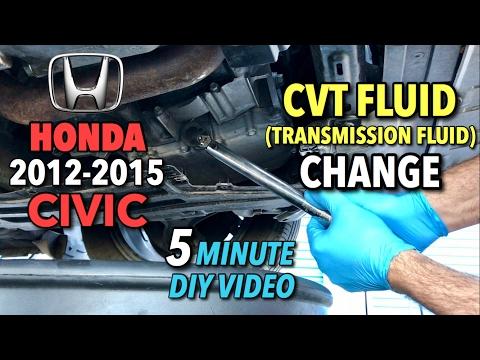


How to Change CVT Transmission Fluid on a 2015 Honda Civic (HCF-2 Service)
Step-by-step drain-and-fill guide with tools, parts list, drain plug torque spec, and safety tips
How to Change CVT Transmission Fluid on a 2015 Honda Civic (HCF-2 Service)
Step-by-step drain-and-fill guide with tools, parts list, drain plug torque spec, and safety tips


🔧 Civic - CVT Transmission Fluid Change
This service drains the old CVT fluid and refills with fresh Honda-spec fluid to protect the belt and pulleys inside the CVT. Fresh fluid helps prevent shudder, slipping, and premature transmission wear.
Difficulty Level: Beginner | Estimated Time: 1.0-1.5 hours
⚠️ Safety & Precautions
- Work on a level surface and support your Civic with jack stands before going underneath.
- Transmission fluid can be hot—let the car cool if it was just driven.
- Keep dirt out of the fill area; CVTs are sensitive to contamination.
- Use only Honda CVT fluid (HCF-2); using “universal” ATF can cause shudder/damage.
- Battery disconnect is not required for this service.
🔧 Required Tools
You'll need the following tools for this repair:
- Floor jack (rated 2-ton minimum)
- Jack stands (rated 2-ton minimum)
- Wheel chocks
- Safety glasses
- Nitrile gloves
- Drain pan (6-quart minimum)
- 17mm socket
- 3/8" drive ratchet
- 3/8" drive torque wrench (10-100 Nm range)
- Long-neck funnel
- Trim clip tool
- Flathead screwdriver
- Shop towels
- Measuring container (quart/liter marked)
🔩 Required Parts
HowToo sells all the parts you need for this repair:
- Honda CVT fluid (HCF-2) - Qty: 4 quarts
- Transmission drain plug crush washer - Qty: 1
📋 Before You Begin
- Park on level ground, set the parking brake, and place wheel chocks behind the rear tires.
- Gather a measuring container so you can refill the same amount you drain (this helps avoid over/under-filling).
- Assumption: Your Civic uses a CVT with a dipstick-tube fill (most common setup).
🔨 Step-by-Step Instructions
Follow these steps in order:
Step 1: Warm the CVT fluid slightly
- Drive 5–10 minutes so the fluid flows easier, then park on a level surface.
- Turn the engine off and let it sit 5 minutes so it’s warm, not scorching hot.
Step 2: Raise and support the front of the car
- Use a floor jack to lift the front of your Civic at the proper front jack point.
- Set the car down onto jack stands and gently shake the car to confirm it’s stable.
Step 3: Remove the lower splash shield (if equipped)
- Use a trim clip tool and flathead screwdriver to remove the plastic clips/screws.
- Set the shield and clips aside in a small pile so nothing gets lost.
Step 4: Locate the CVT drain plug and drain the fluid
- Place a drain pan (6-quart minimum) under the transmission drain plug.
- Use a 17mm socket with a 3/8" drive ratchet to loosen and remove the drain plug.
- Let the fluid drain completely (usually 5–10 minutes).
- Pour the drained fluid into your measuring container so you know how much came out.
Step 5: Replace the crush washer and reinstall the drain plug
- Remove the old washer from the drain plug and install the new crush washer (it’s a soft sealing ring that prevents leaks).
- Thread the drain plug in by hand first to avoid cross-threading.
- Use a 3/8" drive torque wrench (a tool that tightens to an exact setting) with a 17mm socket to tighten the drain plug: Torque to 49 Nm (36 ft-lbs).
- Wipe the area clean with shop towels.
Step 6: Refill the CVT with Honda HCF-2 fluid
- Open the hood and locate the CVT dipstick and dipstick tube.
- Remove the dipstick, then insert a long-neck funnel into the dipstick tube.
- Pour in the same amount you measured out, using Honda CVT fluid (HCF-2).
- Tip: Pour slowly to prevent burps/overflow.
Step 7: Circulate fluid and set the level
- Start the engine and keep your foot on the brake.
- Move the shifter slowly through P-R-N-D-S-L (if equipped), pausing 2 seconds in each position, then return to P.
- With the engine idling, remove and wipe the dipstick with a shop towel, reinsert fully, then remove again to check level.
- Add small amounts through the funnel if needed until it reads in the correct range on the dipstick.
- Reinstall the dipstick fully.
Step 8: Reinstall the splash shield and lower the car
- Reinstall the splash shield using the trim clip tool and flathead screwdriver.
- Use the floor jack to lift slightly, remove the jack stands, then lower the car to the ground.
✅ After Repair
- With the engine running, look underneath for leaks around the drain plug.
- Take a 10–15 minute test drive and confirm smooth takeoff and no shudder.
- Park on level ground and recheck the dipstick level; top off if needed.
- Dispose of used CVT fluid at a recycling center/auto parts store—do not dump it.
💰 DIY vs Shop Cost
Shop Cost: $180-$320 (parts + labor)
DIY Cost: $45-$90 (parts only)
You Save: $135-$230 by doing it yourself!
Shop labor rates vary but typically run $100-$150/hour. This repair takes a shop approximately 1.0-1.5 hours.
🎯 Ready to get started?
HowToo makes it easy: same-day/2-day shipping on every part, plus all the tools and specialty tools you need! Check out the parts and tools sections below to add everything to your cart.