









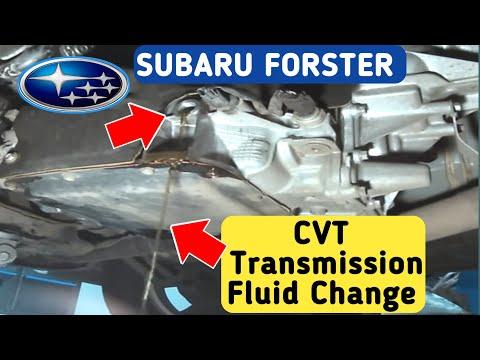







How to Change CVT Transmission Fluid on a 2014 Subaru Forester (Drain & Refill Guide)
Step-by-step drain, refill, and fluid level check with tools, correct Subaru CVT fluid, temps, and torque specs for 2014, 2015, 2016, 2017, 2018, 2019, 2020, 2021, 2022, 2023, 2024, 2025, 2026
How to Change CVT Transmission Fluid on a 2014 Subaru Forester (Drain & Refill Guide)
Step-by-step drain, refill, and fluid level check with tools, correct Subaru CVT fluid, temps, and torque specs for 2014, 2015, 2016, 2017, 2018, 2019, 2020, 2021, 2022, 2023, 2024, 2025, 2026


🔧 Forester - CVT Transmission Fluid Drain & Refill
On your Forester (CVT), a fluid change is usually done as a drain-and-refill (not a full machine flush). The key is refilling with the correct Subaru CVT fluid and setting the level at the correct fluid temperature.
Difficulty Level: Intermediate | Estimated Time: 1.5-3.0 hours
Quick questions (optional, so I tailor the steps): (1) Do you have a CVT fluid dipstick under the hood? (2) Are you doing a simple drain/refill or trying to exchange most of the fluid?
⚠️ Safety & Precautions
- ⚠️ Work on a level surface and support the SUV with jack stands before getting underneath.
- ⚠️ CVT fluid can be hot. Let it cool if you can’t touch the pan area comfortably.
- ⚠️ Keep the vehicle level while checking/finalizing fluid level, or the level will be wrong.
- ⚠️ Do not mix fluids: use Subaru CVT fluid only (wrong fluid can damage the CVT).
- ⚠️ Battery disconnect is not required for this service.
🔧 Required Tools
You'll need the following tools for this repair:
- Floor jack (rated 3-ton minimum)
- Jack stands (rated 3-ton minimum)
- Wheel chocks
- Safety glasses
- Nitrile gloves
- Drain pan (at least 10-quart capacity)
- Socket set (8mm-19mm)
- 17mm socket
- Ratchet (3/8" drive)
- Torque wrench (10-100 ft-lbs range)
- Trim clip remover
- Flathead screwdriver
- 8mm hex bit socket
- Fluid transfer pump (specialty)
- Long neck funnel
- OBD-II scan tool that can read CVT fluid temperature (specialty)
- Infrared thermometer (specialty)
- Shop rags
🔩 Required Parts
HowToo sells all the parts you need for this repair:
- Subaru CVT fluid (CVTF-II equivalent) - Qty: 6-8 quarts
- CVT drain plug crush washer - Qty: 1
- CVT fill/inspection plug crush washer - Qty: 1
📋 Before You Begin
- Park on a flat surface, set the parking brake, and place wheel chocks behind the rear wheels.
- Warm the CVT fluid with a short 10-minute drive so it drains better.
- Plan how you’ll set the final level: either via dipstick (if equipped) or via the level-check/overflow method.
- Set up your OBD-II scan tool to read CVT fluid temperature (this matters for accurate level checking).
- “Crush washer” = soft sealing washer; replace it.
- “Fluid transfer pump” = hand pump to push fluid in.
🔨 Step-by-Step Instructions
Follow these steps in order:
Step 1: Lift and level the vehicle
- Use a floor jack to lift the front, then set the front on jack stands.
- If needed to keep the SUV level, lift the rear with the floor jack and support with jack stands.
- Shake the vehicle gently to confirm it’s stable before going underneath.
Step 2: Remove the lower splash shield (if equipped)
- Use a trim clip remover and flathead screwdriver to remove plastic clips.
- Use your socket set to remove any bolts holding the under-cover.
- Set hardware aside so nothing gets lost.
Step 3: Identify the CVT drain plug and (separately) the fill/level plug
- Place a drain pan under the CVT drain plug.
- Important: Before draining, make sure you can open the fill point (fill plug or dipstick tube). Use an 8mm hex bit socket or appropriate socket to “crack” it loose.
- If you can’t fill it, don’t drain it.
Step 4: Drain the old CVT fluid
- Use a 17mm socket and ratchet to remove the drain plug.
- Let the fluid drain until it slows to a drip (typically 10-20 minutes).
- Inspect the drain plug for metal fuzz; a light paste is normal, chunks are not.
Step 5: Reinstall the drain plug with a new crush washer
- Install a new CVT drain plug crush washer on the drain plug by hand.
- Thread the drain plug in by hand to avoid cross-threading.
- Use a torque wrench and 17mm socket to tighten: Torque to 50 Nm (37 ft-lbs).
Step 6: Refill with the correct CVT fluid
- If filling through a plug: use an 8mm hex bit socket to remove the fill plug, then use a fluid transfer pump to pump in fresh fluid.
- If filling through a dipstick tube: remove the dipstick and use a long neck funnel to add fluid.
- Add back approximately what you drained (most drain-and-refills land around 4-6 quarts).
- Measure what drains; refill that amount first.
Step 7: Start the engine and circulate the fluid
- With the vehicle still level on jack stands, start the engine.
- Hold the brake pedal and slowly shift with the shifter through P-R-N-D and back, pausing 2-3 seconds in each position.
- Keep the engine idling.
Step 8: Set the final fluid level (choose the method you have)
- Method A (if your Forester has a CVT dipstick):
- Use the OBD-II scan tool to confirm fluid temperature is in the warm check range (target 35–45°C (95–113°F)).
- With engine idling, use a shop rag to pull and wipe the dipstick, reinsert fully, then read the level.
- Add small amounts using the funnel until it reaches the correct range.
- Method B (overflow/level-check style, common on CVTs without a usable dipstick):
- Use the OBD-II scan tool to confirm CVT fluid temp is 35–45°C (95–113°F).
- With engine idling, carefully remove the level-check/inspection plug using an 8mm hex bit socket (keep the drain pan under it).
- If fluid barely drips, pump in more CVT fluid using the fluid transfer pump until it becomes a steady thin stream.
- Let it slow to a drip, then reinstall the plug with a new crush washer.
- Use a torque wrench to tighten: Torque to 25 Nm (18 ft-lbs).
Step 9: Reinstall the splash shield and lower the vehicle
- Reinstall the under-cover using the trim clip remover and socket set.
- Use the floor jack to lift slightly, remove jack stands, and set the SUV back on the ground.
✅ After Repair
- Start the engine and check underneath for leaks with a flashlight (use shop rags to wipe and re-check).
- Take a short 10-minute test drive. Verify smooth takeoff and no shuddering.
- Recheck for leaks and recheck the level again once the CVT is at the same temperature range you used earlier.
- If you have a scan tool, check for stored transmission codes after the drive.
💰 DIY vs Shop Cost
Shop Cost: $250-$450 (parts + labor)
DIY Cost: $80-$180 (parts only)
You Save: $170-$270 by doing it yourself!
Shop labor rates vary but typically run $100-$150/hour. This repair takes a shop approximately 1.5-2.5 hours.
🎯 Ready to get started?
HowToo makes it easy: same-day/2-day shipping on every part, plus all the tools and specialty tools you need! Check out the parts and tools sections below to add everything to your cart.