









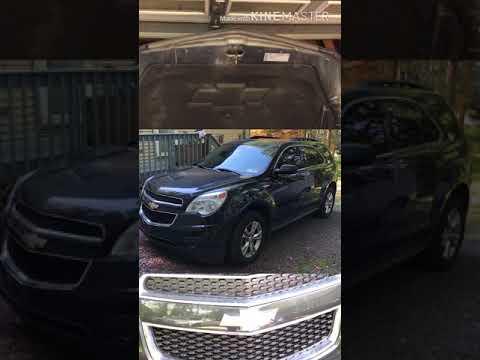






How to Change Automatic Transmission Fluid on a 2008-2025 Chevy Equinox (Engine: Inline 4 2.4L)
Step-by-step DIY drain-and-fill guide with tools, parts list, torque specs, safety tips, and cost comparison
How to Change Automatic Transmission Fluid on a 2008-2025 Chevy Equinox (Engine: Inline 4 2.4L)
Step-by-step DIY drain-and-fill guide with tools, parts list, torque specs, safety tips, and cost comparison for 2008, 2009, 2013, 2014, 2015, 2016, 2017


🔧 Equinox - Automatic Transmission Fluid Change
You’ll be doing a drain-and-fill on the automatic transmission, not a full flush. This refreshes a good portion of the old fluid and helps protect the transmission from wear and overheating.
Difficulty Level: Intermediate | Estimated Time: 2–3 hours (first time)
⚠️ Safety & Precautions
- ⚠️ Always support the vehicle on jack stands, never work under a car held up only by a jack.
- ⚠️ Transmission fluid can be very hot; let the engine and transmission cool so parts are warm, not burning.
- ⚠️ Keep the car in Park with the parking brake firmly set and wheels chocked.
- ⚠️ ATF (automatic transmission fluid) is slippery—clean spills immediately to avoid falls.
- ⚠️ Work in a well‑ventilated area and keep fluid away from eyes and skin; wear safety glasses and gloves.
- ⚠️ This transmission uses a temperature-based level check; you’ll need a way to check fluid temperature (scan tool or infrared thermometer).
- ⚠️ Do not remove any large cooler lines with the engine running; that’s part of a flush machine process, not DIY.
🔧 Required Tools
You'll need the following tools for this repair:
- 🛠️ Floor jack (rated 3-ton minimum)
- 🛠️ Jack stands (rated 3-ton minimum, set of 4)
- 🛠️ Wheel chocks
- 🛠️ 10mm socket
- 🛠️ 13mm socket
- 🛠️ 15mm socket
- 🛠️ Socket wrench (3/8" drive)
- 🛠️ Torque wrench (5–80 ft-lbs range)
- 🛠️ Torx T30 screwdriver
- 🛠️ Hex/Allen bit set (metric, 6–10mm)
- 🛠️ Drain pan (at least 10-liter capacity)
- 🛠️ Funnel with long flexible hose
- 🛠️ Hand fluid transfer pump (specialty)
- 🛠️ Flathead screwdriver (medium)
- 🛠️ Plastic trim tool
- 🛠️ OBD2 scan tool with live data (specialty)
- 🛠️ Infrared thermometer (specialty)
- 🛠️ Shop rags
- 🛠️ Brake cleaner spray
- 🛠️ Nitrile gloves
- 🛠️ Safety glasses
🔩 Required Parts
HowToo sells all the parts you need for this repair:
- 🔩 DEXRON-VI automatic transmission fluid - Qty: 6 quarts (drain and fill)
- 🔩 Transmission drain plug sealing washer - Qty: 1
- 🔩 Transmission level plug sealing washer - Qty: 1
- 🔩 Transmission pan gasket - Qty: 1 (only if removing pan)
- 🔩 Shop towels - Qty: 1 pack
- 🔩 Brake cleaner (aerosol) - Qty: 1–2 cans
📋 Before You Begin
- Park the Equinox on a flat, level surface, engage the parking brake, and place the shifter in Park.
- Loosen, but do not remove, the engine under-cover fasteners if equipped so you can access the transmission area.
- You do not need to disconnect the battery for this job.
- Make sure your OBD2 scan tool can read transmission fluid temperature (TFT), or have an infrared thermometer to measure the transmission case temperature.
- Have a clean area ready to set bolts and parts so you don’t mix them up.
🔨 Step-by-Step Instructions
Follow these steps in order:
Step 1: Safely lift and support the Equinox
- Use the floor jack to lift the front of the vehicle at the front jacking point (center of the front subframe area).
- Place jack stands under the left and right front pinch welds or frame points, then slowly lower the vehicle onto the stands.
- Repeat for the rear if you want the vehicle level; use the rear center jacking point and set two more jack stands.
- Place wheel chocks behind at least one rear wheel if only the front is lifted.
- Car must sit level to get correct fluid level.
Step 2: Remove any plastic splash shield (if equipped)
- Use a 10mm socket and a Torx T30 screwdriver to remove the bolts or screws holding the lower engine splash shield.
- Use a plastic trim tool to gently pop out any plastic clips.
- Lower the shield and set it aside.
Step 3: Locate the transmission drain and level/fill points
- The automatic transmission is on the driver’s side of the engine bay, underneath the vehicle.
- Look for the drain plug on the bottom of the transmission pan (usually a small hex or regular bolt head).
- Locate the level/check plug on the side of the transmission case or in the pan (it’s a smaller plug, often an internal hex/Allen).
- If your transmission has a separate fill plug higher on the case, locate that as well. If not, you will fill through the level plug or the vent using a hose and funnel.
- Confirm you can loosen the fill/level plug before draining.
Step 4: Loosen the fill/level plug first
- Use the correct hex/Allen bit or socket (commonly 8mm or 10mm) with your socket wrench to carefully crack loose the level/fill plug.
- Do not remove it fully yet—just confirm it will unscrew. Then snug it back lightly.
- If this plug is stuck, do not drain fluid yet.
Step 5: Drain the old transmission fluid
- Position the drain pan directly under the transmission drain plug.
- Use the correct socket (usually 13mm or 15mm) and the socket wrench to loosen and remove the drain plug.
- Allow the fluid to drain completely; this may take 10–15 minutes.
- Inspect the drain plug for metal shavings. A light “paste” on the magnet is normal, chunks are not.
- Install a new drain plug washer onto the plug.
- Reinstall the drain plug by hand, then tighten with a torque wrench and correct socket to 25 Nm (18 ft-lbs).
- Do not overtighten; pan threads strip easily.
Step 6: Optional – Remove pan and clean (if pan is serviceable)
- If you want extra cleaning and your pan has a removable gasket, you can take the pan off.
- Use a 10mm socket on the socket wrench to remove all pan bolts, leaving two bolts at opposite corners threaded in a few turns.
- Support the pan with one hand and remove the last two bolts, then lower the pan carefully into the drain pan.
- Clean the pan with brake cleaner and shop rags, paying attention to the magnet.
- Install a new pan gasket if required, position the pan, and start all bolts by hand.
- Tighten pan bolts in a crisscross pattern with a 10mm socket to 10 Nm (89 in-lbs) using the torque wrench.
- Your internal filter is not normally user-serviceable on this unit.
Step 7: Add new transmission fluid (engine off, cold trans)
- Remove the fill plug or level plug fully using the correct hex/Allen bit or socket and socket wrench.
- If filling through the side, connect the hand fluid transfer pump to your DEXRON-VI fluid bottles.
- Pump new fluid into the transmission until it just starts to trickle out of the level opening (this is a rough initial fill).
- Expect to add about 4–5 quarts on a typical drain and fill.
- Install a new washer on the level/fill plug, then reinstall the plug finger tight with the socket wrench—you will be removing it again shortly for final level check.
Step 8: Warm the transmission to level-check temperature
- Lower the vehicle just enough so you can safely run the engine while it stays as level as possible, or leave it on all four stands if already level.
- Start the engine with your foot on the brake.
- With the engine idling, move the shifter slowly through all gears (P-R-N-D-M, then back to P), pausing 2–3 seconds in each position to circulate fluid.
- Connect your OBD2 scan tool to the diagnostic port under the dash and pull up transmission fluid temperature (TFT).
- Let the engine idle until the TFT reads about 30–40°C (86–104°F). If using an infrared thermometer, measure the transmission case and aim for the same temperature range.
- Correct level depends on fluid at this warm range.
Step 9: Set the final fluid level (engine running)
- With the engine idling, parking brake on, and transmission in Park, raise the vehicle on the floor jack back onto level jack stands if needed (do this carefully and only if confident).
- Place the drain pan under the level/check plug.
- Using the correct hex/Allen bit and socket wrench, carefully remove the level/check plug while the engine is still running.
- Observe the fluid coming from the level hole:
- If fluid flows out as a steady stream, allow it to drain until it becomes a slow drip.
- If no fluid comes out, use the hand pump to add more DEXRON-VI through the fill point until it just starts to run out, then wait until it slows to a drip.
- Once it is dripping slowly and TFT is still around 30–40°C (86–104°F), install a new washer on the level plug and reinstall it with the socket wrench.
- Tighten the level plug with a torque wrench and correct bit to 9 Nm (80 in-lbs).
- Keep hands and tools clear of moving parts and hot exhaust.
Step 10: Clean up and reassemble
- Turn off the engine.
- Spray any spilled ATF on the transmission and nearby parts with brake cleaner and wipe with shop rags.
- Reinstall the plastic splash shield using the 10mm socket, Torx T30 screwdriver, and plastic trim tool for clips.
- Carefully raise the vehicle slightly with the floor jack, remove the jack stands, and lower the vehicle fully to the ground.
Step 11: Final checks and road test
- Start the engine again, shift slowly through all gears, then drive for 10–15 minutes with normal, gentle acceleration.
- Park on a level surface, set the parking brake, and check under the vehicle for any leaks in the transmission area.
- If you see drips, let it cool and carefully snug the corresponding plug to its torque spec again with the torque wrench.
- Consider another drain-and-fill after a few thousand km for extra refresh.
✅ After Repair
- Check for any warning lights on the dash; normal driving should not trigger any transmission codes from this service.
- After the first longer drive, inspect the transmission area again for leaks.
- Note your mileage; many owners repeat a drain-and-fill every 40,000–60,000 km in harsh conditions.
- Dispose of the old ATF at a proper recycling center—do not pour it on the ground or into drains.
💰 DIY vs Shop Cost
Shop Cost: $220–$380 (parts + labor)
DIY Cost: $70–$110 (parts only)
You Save: $150–$270 by doing it yourself!
Shop labor rates vary but typically run $100–$150/hour. This repair takes a shop approximately 1.5–2.0 hours.
🎯 Ready to get started?
HowToo makes it easy: same-day/2-day shipping on every part, plus all the tools and specialty tools you need! Check out the parts and tools sections above to add everything to your cart.
Guide for Automatic Transmission Fluid replace for these Chevrolet vehicles
| Year Make Model | Sub Model | Engine | Body Style |
|---|---|---|---|
| 2025 Chevrolet Equinox | - | Inline 4 1.5L | - |
| 2024 Chevrolet Equinox | - | Inline 4 1.5L | - |
| 2023 Chevrolet Equinox | - | Inline 4 1.5L | - |
| 2022 Chevrolet Equinox | - | Inline 4 1.5L | - |
| 2021 Chevrolet Equinox | - | Inline 4 1.5L | - |
| 2020 Chevrolet Equinox | - | Inline 4 1.5L | - |
| 2020 Chevrolet Equinox | - | Inline 4 2.0L | - |
| 2019 Chevrolet Equinox | - | Inline 4 1.5L | - |
| 2019 Chevrolet Equinox | - | Inline 4 1.6L | - |
| 2019 Chevrolet Equinox | - | Inline 4 2.0L | - |
| 2018 Chevrolet Equinox | - | Inline 4 1.5L | - |
| 2018 Chevrolet Equinox | - | Inline 4 1.6L | - |
| 2018 Chevrolet Equinox | - | Inline 4 2.0L | - |
| 2017 Chevrolet Equinox | - | V6 3.6L | - |
| 2017 Chevrolet Equinox | - | Inline 4 2.4L | - |
| 2016 Chevrolet Equinox | - | V6 3.6L | - |
| 2016 Chevrolet Equinox | - | Inline 4 2.4L | - |
| 2015 Chevrolet Equinox | - | V6 3.6L | - |
| 2015 Chevrolet Equinox | - | Inline 4 2.4L | - |
| 2014 Chevrolet Equinox | - | V6 3.6L | - |
| 2014 Chevrolet Equinox | - | Inline 4 2.4L | - |
| 2013 Chevrolet Equinox | - | V6 3.6L | - |
| 2013 Chevrolet Equinox | - | Inline 4 2.4L | - |
| 2012 Chevrolet Equinox | - | Inline 4 2.4L | - |
| 2012 Chevrolet Equinox | - | V6 3.0L | - |
| 2011 Chevrolet Equinox | - | Inline 4 2.4L | - |
| 2011 Chevrolet Equinox | - | V6 3.0L | - |
| 2010 Chevrolet Equinox | - | Inline 4 2.4L | - |
| 2010 Chevrolet Equinox | - | V6 3.0L | - |
| 2009 Chevrolet Equinox | - | V6 3.6L | - |
| 2008 Chevrolet Equinox | - | V6 3.6L | - |