









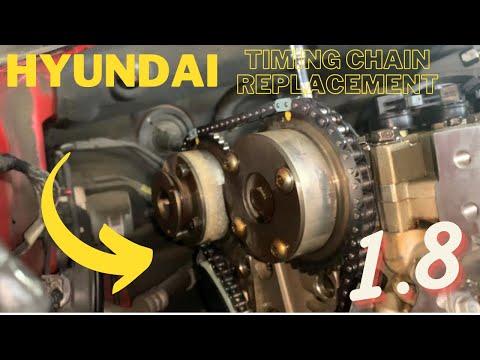







2014-2016 Hyundai Elantra Timing Chain Replacement Guide (No Timing Belt on 1.8L) (Engine: Inline 4 1.8L)
Step-by-step timing chain service with required tools/parts, TDC timing mark tips, and safety checks
2014-2016 Hyundai Elantra Timing Chain Replacement Guide (No Timing Belt on 1.8L) (Engine: Inline 4 1.8L)
Step-by-step timing chain service with required tools/parts, TDC timing mark tips, and safety checks for 2014, 2015, 2016


🔧 Elantra - Timing Chain Replacement (No Timing Belt)
Your Elantra’s 1.8L engine uses a timing chain, not a timing belt, so there isn’t a belt to replace as routine maintenance. The chain is oil-lubricated and usually only gets replaced if it’s noisy, stretched, or setting timing-related fault codes.
Difficulty Level: Advanced | Estimated Time: 6-10 hours
Assumption: Stock 1.8L engine; procedure is best-effort OEM-style.
⚠️ Safety & Precautions
- ⚠️ Support the engine before removing the passenger-side engine mount; the engine can drop suddenly.
- ⚠️ Work on a cold engine; hot coolant/oil can burn you.
- ⚠️ Disconnect the negative battery cable to prevent accidental cranking.
- ⚠️ Keep fingers/tools clear when rotating the crankshaft by hand.
- ⚠️ Cleanliness matters: dirt in the timing area can damage the engine.
🔧 Required Tools
You'll need the following tools for this repair:
- Floor jack (rated 3-ton minimum)
- Jack stands (rated 3-ton minimum)
- Wheel chocks
- Safety glasses
- Nitrile gloves
- Metric socket set (8mm-22mm)
- Metric combination wrench set (8mm-22mm)
- 3/8" drive torque wrench
- 1/2" drive breaker bar
- Torque angle gauge
- Ratchet extensions (3", 6", 12")
- Universal joint socket adapter
- Screwdriver set (flathead and Phillips)
- Pliers set (needle-nose and hose clamp)
- Trim clip removal tool
- Drain pan (at least 10-quart)
- Gasket scraper
- Plastic razor blade scraper
- Brake cleaner spray
- Shop towels
- Engine support bar (specialty)
- Harmonic balancer puller kit (specialty)
- Crank pulley holding tool (specialty)
🔩 Required Parts
HowToo sells all the parts you need for this repair:
- Timing chain - Qty: 1
- Timing chain tensioner - Qty: 1
- Timing chain guides - Qty: 1 set
- Timing cover gasket set - Qty: 1
- Front crankshaft seal - Qty: 1
- Valve cover gasket - Qty: 1
- RTV silicone sealant (OEM-compatible) - Qty: 1
- Engine oil (OEM grade) - Qty: 5 quarts
- Oil filter - Qty: 1
- Engine coolant (OEM-compatible) - Qty: 1-2 gallons
- Accessory drive belt - Qty: 1
- Crankshaft pulley bolt (single-use if specified) - Qty: 1
📋 Before You Begin
- Park on level ground, set the parking brake, and use wheel chocks.
- Disconnect the battery: use a 10mm socket to remove the negative terminal and isolate it.
- Raise and support the front: use a floor jack and jack stands under proper lift points.
- Remove the right-front wheel and splash shield: use a lug wrench (from your car) and a trim clip removal tool.
- Pro tip: Bag bolts by “area” to stay organized.
🔨 Step-by-Step Instructions
Follow these steps in order:
Step 1: Drain fluids (as needed)
- Place a drain pan under the radiator drain, open it carefully, and drain coolant.
- If you plan to reseal the timing cover, drain engine oil using the appropriate metric socket.
Step 2: Remove the accessory drive belt
- Relieve tension with the correct metric socket on the belt tensioner, then slide the belt off.
- Pro tip: Take a quick belt routing photo.
Step 3: Support the engine
- Install the engine support bar (specialty) across the fender rails and tension it to hold the engine safely.
- Engine support bar = a top brace that holds the engine up while mounts are removed.
Step 4: Remove the passenger-side engine mount
- Remove mount fasteners using a metric socket set (14mm-19mm range) and a ratchet extension.
- Torque to OEM specification during reassembly (mount fasteners are critical).
Step 5: Remove the crankshaft pulley (harmonic balancer)
- Hold the pulley with a crank pulley holding tool (specialty).
- Remove the crank bolt with a 1/2" drive breaker bar and correct metric socket.
- If the pulley is stuck, use a harmonic balancer puller kit (specialty) to pull it straight off.
- Torque to OEM specification and use torque angle gauge if the crank bolt uses an angle step.
- Torque angle gauge = a tool that measures degrees of rotation after initial torque.
Step 6: Remove the valve cover
- Disconnect any hoses/connectors in the way using pliers and a screwdriver.
- Remove valve cover bolts using an 8mm or 10mm socket (varies by fastener).
- Lift the cover off; clean gasket surfaces with a plastic razor blade scraper and brake cleaner spray.
- Torque to OEM specification on reassembly (valve cover bolts strip easily).
Step 7: Remove the front timing cover
- Remove all timing cover bolts using the correct metric socket and ratchet extensions.
- Carefully break the RTV seal using a plastic razor blade scraper; do not gouge aluminum surfaces.
- Clean both mating surfaces with gasket scraper, shop towels, and brake cleaner spray.
Step 8: Set cylinder #1 to Top Dead Center (TDC)
- Rotate the crankshaft clockwise using a ratchet and correct metric socket on the crank.
- Align the timing marks on the crank sprocket and cam sprockets to their reference marks.
- TDC = piston at the top of its travel on the compression stroke.
- Pro tip: Paint-mark the chain and sprockets.
Step 9: Remove the timing chain tensioner and guides
- Remove the tensioner bolts using a metric socket.
- Remove the chain guides using a metric socket.
- Keep parts in order so you don’t mix guide locations.
- Torque to OEM specification on reassembly (small bolts can snap).
Step 10: Remove and install the timing chain
- Lift the chain off the sprockets carefully.
- Install the new chain so the colored links (if provided) line up with the sprocket timing marks.
- Reinstall new guides using a metric socket, then install the new tensioner using a metric socket.
- Release/activate the tensioner per the part design (some are pinned; remove the pin after installation).
Step 11: Verify timing before closing it up
- Rotate the engine by hand clockwise two full revolutions using a ratchet and metric socket.
- Re-check that timing marks realign correctly.
- If marks don’t align, do not start the engine—re-time it.
Step 12: Reseal and reinstall the timing cover
- Install a new front crankshaft seal if removed; tap it in evenly using an appropriately sized socket as a driver.
- Apply RTV silicone sealant only where the manual specifies (typically seams/corners).
- Install the timing cover bolts using a torque wrench.
- Torque to OEM specification in the correct sequence.
Step 13: Reinstall crank pulley, mount, and belt
- Reinstall the crank pulley and crank bolt using a crank pulley holding tool (specialty) and torque wrench.
- Torque to OEM specification and add angle torque using a torque angle gauge if required.
- Reinstall the passenger-side engine mount using a metric socket and torque wrench.
- Install the accessory belt using a metric socket on the tensioner.
Step 14: Refill fluids and reconnect battery
- Refill engine oil and install a new filter using the correct metric socket (filter tool if needed).
- Refill coolant and bleed air per Hyundai procedure (fill slowly; run heater on HOT later).
- Reconnect the negative battery cable using a 10mm socket.
✅ After Repair
- Start the engine and let it idle; listen for abnormal rattling from the timing cover area.
- Check for oil leaks around the timing cover and crank seal.
- Verify coolant level after the engine warms up and cools back down; top off as needed.
- Road-test gently, then recheck for leaks.
- If you have a scan tool, check for pending/active timing-related codes and clear only after the repair is confirmed.
💰 DIY vs Shop Cost
Shop Cost: $1,200-$2,300 (parts + labor)
DIY Cost: $250-$650 (parts only)
You Save: $550-$2,050 by doing it yourself!
Shop labor rates vary but typically run $100-$150/hour. This repair takes a shop approximately 6-10 hours.
🎯 Ready to get started?
HowToo makes it easy: same-day/2-day shipping on every part, plus all the tools and specialty tools you need! Check out the parts and tools sections below to add everything to your cart.
Guide for Engine Timing Chain replace for these Hyundai vehicles
| Year Make Model | Sub Model | Engine | Body Style |
|---|---|---|---|
| 2016 Hyundai Elantra | - | Inline 4 1.8L | - |
| 2016 Hyundai Elantra | - | Inline 4 2.0L | - |
| 2015 Hyundai Elantra | - | Inline 4 1.8L | - |
| 2015 Hyundai Elantra | - | Inline 4 2.0L | - |
| 2014 Hyundai Elantra | - | Inline 4 1.8L | - |
| 2014 Hyundai Elantra | - | Inline 4 2.0L | - |