









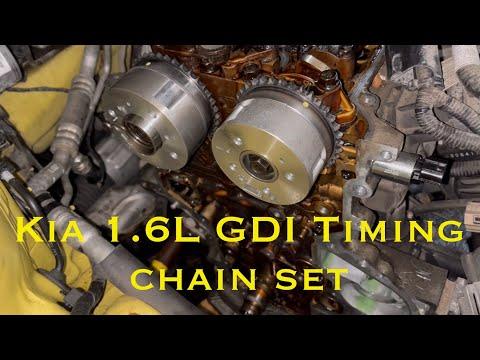







2012-2017 Kia Rio Timing Belt vs Timing Chain: How to Confirm & Replace the Timing Chain (Engine: Inline 4 1.6L)
Step-by-step timing chain service guide with tools/parts list, TDC timing marks, and safety tips
2012-2017 Kia Rio Timing Belt vs Timing Chain: How to Confirm & Replace the Timing Chain (Engine: Inline 4 1.6L)
Step-by-step timing chain service guide with tools/parts list, TDC timing marks, and safety tips for 2012, 2013, 2014, 2015, 2016, 2017


🔧 Rio - Timing Belt Replacement
Your Rio’s 1.6L engine uses a timing chain (not a timing belt). That means there isn’t a scheduled “timing belt replacement” like on older engines—chain service is only needed if there’s a problem (rattle on cold start, timing correlation codes, poor running) or confirmed chain stretch.
Difficulty Level: Advanced | Estimated Time: 6-10 hours
Assumption: Stock 1.6L timing chain engine (no belt fitted).
⚠️ Safety & Precautions
- 🛑 Let the engine cool fully before draining coolant or working near the exhaust.
- 🛑 Disconnect the negative battery cable to prevent accidental cranking.
- 🛑 Support the engine before removing the right-side engine mount.
- 🛑 Do not rotate the crank/cams with the chain removed; valve-to-piston contact can occur.
- 🛑 Keep the work area clean—dirt in the timing cover can cause leaks or wear.
🔧 Required Tools
You'll need the following tools for this repair:
- Safety glasses
- Nitrile gloves
- Floor jack (rated 3-ton minimum)
- Jack stands (rated 3-ton minimum)
- Wheel chocks
- Metric socket set 8mm-22mm
- Metric wrench set 8mm-22mm
- 3/8" drive ratchet
- 1/2" drive breaker bar
- Torque wrench 10-200 ft-lbs
- Phillips screwdriver
- Flat trim tool
- Pliers set
- Drain pan (at least 2-gallon)
- Funnel
- Serpentine belt tool 14mm
- Harmonic balancer puller kit (specialty)
- Engine support bar (specialty)
- RTV silicone gasket maker (sensor-safe)
- Plastic razor scraper
- Shop towels
- Paint marker
🔩 Required Parts
HowToo sells all the parts you need for this repair:
- Timing chain kit (chain, guides, tensioner) - Qty: 1
- Front crankshaft seal - Qty: 1
- Timing cover sealant (RTV, sensor-safe) - Qty: 1
- Engine coolant (compatible with Kia/Hyundai) - Qty: 1-2 gallons
- Accessory drive belt - Qty: 1
- Engine oil (5W-20 full synthetic) - Qty: 4 quarts
- Oil filter - Qty: 1
📋 Before You Begin
- 🧰 Park on level ground, set the parking brake, and chock the rear wheels.
- 🧰 Disconnect the negative battery terminal using a 10mm socket.
- 🧰 Raise the front and support it securely on jack stands.
- 🧰 Place an engine support bar (specialty) across the strut towers—this tool holds the engine from above when the mount is removed.
- 🧰 Put a drain pan under the radiator area to catch coolant.
🔨 Step-by-Step Instructions
Follow these steps in order:
Step 1: Remove the right-front wheel and splash shield
- Use a lug wrench to loosen lug nuts, then lift the car with a floor jack and support with jack stands.
- Remove the wheel using a lug wrench.
- Remove the inner fender/splash shield fasteners using a flat trim tool and Phillips screwdriver.
Step 2: Drain coolant
- Place a drain pan under the radiator drain area.
- Open the radiator cap (only when cool), then open the drain using pliers or the appropriate Phillips screwdriver (varies by clamp/plug style).
Step 3: Remove the accessory drive belt
- Use a serpentine belt tool 14mm on the belt tensioner and rotate to relieve tension.
- Slide the belt off and remove it from the engine bay.
- Tip: Take a photo of belt routing first.
Step 4: Support the engine and remove the right engine mount
- Take the engine’s weight with the engine support bar (specialty).
- Remove mount bolts/nuts using a metric socket set and ratchet.
- Reinstall later and torque to Kia specification.
Step 5: Remove the crank pulley (harmonic balancer)
- Use a breaker bar and correct metric socket to remove the crank bolt.
- Use a harmonic balancer puller kit (specialty) to pull the pulley off—this tool pulls the pulley evenly without damaging it.
- Reinstall later and torque the crank bolt to Kia specification (critical fastener).
Step 6: Remove the front timing cover
- Remove any remaining brackets/bolts blocking access using a metric socket set and ratchet.
- Remove timing cover bolts using a metric socket set.
- Gently separate the cover from the engine (do not gouge sealing surfaces) using a plastic razor scraper and a flat trim tool.
Step 7: Set engine to Top Dead Center (TDC) on cylinder #1
- Rotate the crankshaft by hand using a ratchet and correct metric socket until timing marks align.
- Use a paint marker to add your own alignment marks on the chain and sprockets for reference.
- Tip: Only rotate clockwise while setting timing.
Step 8: Remove the timing chain tensioner, guides, and chain
- Remove the chain tensioner bolts using a metric socket set.
- Remove chain guides using a metric socket set.
- Remove the chain carefully, keeping your timing reference marks visible.
Step 9: Install the new chain, guides, and tensioner
- Install the new chain aligned to the factory timing marks on the cam and crank sprockets.
- Install new guides using a metric socket set and ratchet, then torque to Kia specification.
- Install the new tensioner using a metric socket set, then torque to Kia specification.
- Release/activate the tensioner per the kit design (pin-release style is common).
Step 10: Verify timing alignment
- Rotate the engine by hand two full revolutions using a ratchet and correct metric socket.
- Recheck that timing marks realign correctly at TDC.
- If marks do not align, stop and correct before reassembly.
Step 11: Reseal and reinstall the timing cover
- Clean all sealing surfaces using shop towels and a plastic razor scraper.
- Apply a continuous bead of RTV silicone gasket maker (sensor-safe) per the cover’s sealing path.
- Install the cover and tighten bolts evenly using a torque wrench, then torque to Kia specification.
- Replace the front crankshaft seal if included/required before final pulley install.
Step 12: Reinstall crank pulley, engine mount, and belt
- Reinstall the crank pulley and crank bolt using a torque wrench and correct metric socket, then torque to Kia specification.
- Reinstall the right engine mount using a torque wrench, then torque to Kia specification.
- Install the new accessory belt using a serpentine belt tool 14mm.
Step 13: Refill coolant and change oil (recommended)
- Refill coolant using a funnel and the correct engine coolant.
- Top off/change engine oil and filter using a drain pan, metric socket set, and pliers as needed.
✅ After Repair
- 🧪 Reconnect the battery using a 10mm socket.
- 🧪 Start the engine and listen: no chain rattle, no ticking, smooth idle.
- 🧪 Check for oil leaks around the timing cover and crank seal area.
- 🧪 Let the engine reach operating temperature, then recheck coolant level and top off as needed.
- 🧪 Road test gently, then recheck for leaks again.
💰 DIY vs Shop Cost
Shop Cost: $900-$1,800 (parts + labor)
DIY Cost: $180-$450 (parts only)
You Save: $720-$1,350 by doing it yourself!
Shop labor rates vary but typically run $100-$150/hour. This repair takes a shop approximately 6-10 hours.
🎯 Ready to get started?
HowToo makes it easy: same-day/2-day shipping on every part, plus all the tools and specialty tools you need! Check out the parts and tools sections below to add everything to your cart.
Guide for Engine Timing Chain Kit replace for these Kia vehicles
| Year Make Model | Sub Model | Engine | Body Style |
|---|---|---|---|
| 2017 Kia Rio | - | Inline 4 1.6L | - |
| 2016 Kia Rio | - | Inline 4 1.6L | - |
| 2015 Kia Rio | - | Inline 4 1.6L | - |
| 2014 Kia Rio | - | Inline 4 1.6L | - |
| 2013 Kia Rio | - | Inline 4 1.6L | - |
| 2012 Kia Rio | - | Inline 4 1.6L | - |