









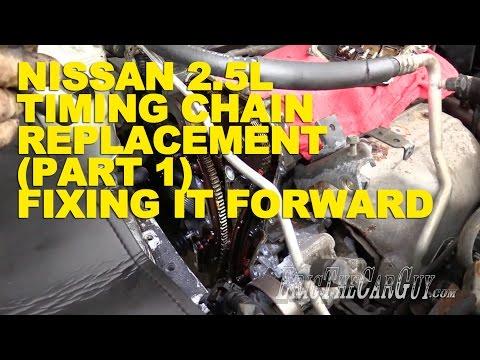







2008 Nissan Altima Timing Chain Replacement Guide (2.5L) — Fix Cold-Start Rattle & P0011/P0014
Step-by-step timing chain service with required tools, parts list, safety tips, and key checks before disassembly for 2007, 2008, 2009
2008 Nissan Altima Timing Chain Replacement Guide (2.5L) — Fix Cold-Start Rattle & P0011/P0014
Step-by-step timing chain service with required tools, parts list, safety tips, and key checks before disassembly for 2007, 2008, 2009


🔧 Altima - Timing Chain Service (Not a Timing Belt)
Your Altima’s 2.5L engine does not use a timing belt—it uses a timing chain. A timing chain normally isn’t a routine maintenance item, but it can need service if there’s chain rattle on cold start, metal debris in oil, or cam/crank timing codes.
Difficulty Level: Advanced | Estimated Time: 8-14 hours
⚠️ Safety & Precautions
- ⚠️ Support the engine before removing any engine mount hardware.
- ⚠️ Work on a cold engine; hot coolant/oil can burn you.
- ⚠️ Disconnect the negative battery terminal to prevent accidental cranking.
- ⚠️ Keep hands/tools clear of the radiator fans; they can run unexpectedly.
- ⚠️ If timing is set wrong, the engine may be damaged—follow factory marks exactly.
🔧 Required Tools
You'll need the following tools for this repair:
- Floor jack (rated 3-ton minimum)
- Jack stands (rated 3-ton minimum)
- Wheel chocks
- Safety glasses
- Nitrile gloves
- Metric socket set (8mm-19mm)
- 3/8" drive ratchet
- 1/2" drive breaker bar
- Torque wrench (10-200 ft-lbs range)
- Wrench set (10mm-19mm)
- Screwdriver set (flathead and Phillips)
- Pliers set (needle-nose and slip-joint)
- Trim clip remover
- Drain pan (at least 10-quart)
- Gasket scraper (plastic or razor type)
- RTV sealant applicator nozzle
- Engine support bar (specialty)
- Crankshaft pulley puller kit (specialty)
- Crank pulley holding tool (specialty)
- Harmonic balancer installer tool (specialty)
🔩 Required Parts
HowToo sells all the parts you need for this repair:
- Timing chain kit (chain + guides + tensioner) - Qty: 1
- Front timing cover sealant (RTV, Nissan-spec equivalent) - Qty: 1
- Front crankshaft seal - Qty: 1
- Valve cover gasket set - Qty: 1
- Accessory drive belt - Qty: 1
- Engine oil (5W-30) - Qty: 5 quarts
- Oil filter - Qty: 1
- Engine coolant (Nissan-compatible, premix) - Qty: 2-3 gallons
📋 Before You Begin
- Park on level ground, set the parking brake, and chock the rear wheels.
- Disconnect the negative battery cable using a 10mm socket.
- Plan to drain oil and coolant into a drain pan.
- Two quick questions so I can give you the correct, safe procedure:
- Is your goal to replace the timing chain due to a symptom (cold-start rattle, stretched chain, P0011/P0014), or are you doing it preventively?
- Do you have access to the factory torque specs/service info for your Altima (manual or equivalent)? I won’t guess torque values on timing components.
🔨 Step-by-Step Instructions
Follow these steps in order:
Step 1: Confirm you’re servicing the timing chain
- Open the hood and locate the engine’s front cover area (passenger side of the engine bay on your Altima).
- Understand the difference: a timing belt is rubber and lives behind plastic covers; your Altima uses a metal timing chain inside the sealed front cover.
- If you hear rattle, record a cold-start video.
Step 2: Decide if a full chain job is actually required
- If you have a check-engine light, scan codes with an OBD2 scanner (codes like P0011/P0014 can point to cam timing issues, but can also be oil/solenoid related).
- Check oil level/condition first; low/sludged oil can affect the chain tensioner and VVT operation.
Step 3: If you’re proceeding, gather factory torque specs before disassembly
- This job requires correct torques for the crank bolt, cam sprockets, tensioner, cover bolts, and engine mount fasteners.
- Set up your torque wrench (10-200 ft-lbs range) and have the torque table ready before you loosen anything.
- Have your engine support bar (specialty) ready; the right-side mount area must be supported during the job.
✅ After Repair
- Change the oil and filter and refill coolant (air pockets can cause overheating).
- Start the engine and listen for abnormal noise; verify no oil/coolant leaks at the front cover.
- Clear any stored codes and road test; recheck fluid levels after cool-down.
💰 DIY vs Shop Cost
Shop Cost: $1,200-$2,500 (parts + labor)
DIY Cost: $250-$650 (parts only)
You Save: $950-$1,850 by doing it yourself!
Shop labor rates vary but typically run $100-$150/hour. This repair takes a shop approximately 8-14 hours.
🎯 Ready to get started?
HowToo makes it easy: same-day/2-day shipping on every part, plus all the tools and specialty tools you need! Check out the parts and tools sections below to add everything to your cart.