









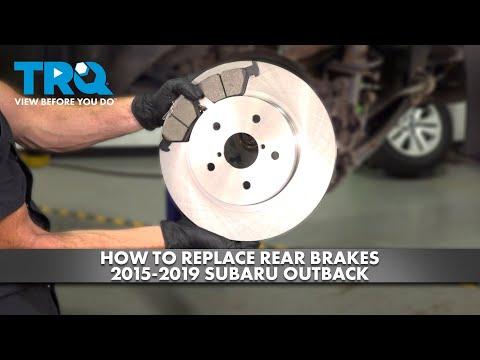






How to Replace Rear Brakes and Rotors on a 2015-2025 Subaru Outback
Step-by-step DIY guide with EPB service mode, tools, parts, and torque specs for 2015, 2016, 2017, 2018, 2019, 2020, 2021, 2022, 2023, 2024, 2025
How to Replace Rear Brakes and Rotors on a 2015-2025 Subaru Outback
Step-by-step DIY guide with EPB service mode, tools, parts, and torque specs for 2015, 2016, 2017, 2018, 2019, 2020, 2021, 2022, 2023, 2024, 2025


🔧 Outback - Rear Brake Pad & Rotor Replacement
This repair replaces the rear brake pads and rear brake rotors on your Outback. The rear electronic parking brake must be handled correctly so the caliper pistons are not damaged.
Difficulty Level: Intermediate | Estimated Time: 2-3 hours
⚠️ Safety & Precautions
- ⚠️ Your Outback uses an electronic parking brake, so do not force the rear caliper piston back unless the parking brake motor has been put into service mode or properly retracted.
- ⚠️ Work on a flat, solid surface and support the vehicle with jack stands. Never rely on a jack alone.
- ⚠️ Brake dust can be harmful. Wear safety glasses and a dust mask, and do not blow dust with compressed air.
- ⚠️ Do not press the brake pedal while a caliper is removed.
- ⚠️ Replace rear brake pads as a complete axle set, left and right together.
- ⚠️ Brake fluid can damage paint. Wipe spills immediately with clean water.
🔧 Required Tools
You'll need the following tools for this repair:
- Floor jack (rated 2-ton minimum)
- Jack stands (rated 2-ton minimum)
- Wheel chocks
- 19mm lug nut socket
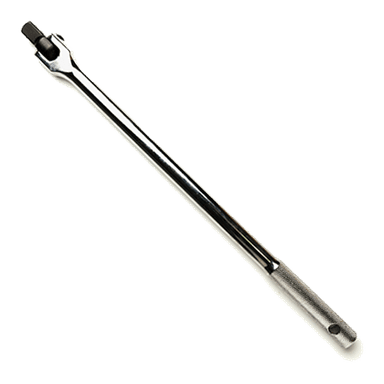
- 1/2-inch drive breaker bar
- 1/2-inch drive torque wrench
- 14mm socket
- 17mm socket
- 3/8-inch drive ratchet
- Flat blade screwdriver
- Brake caliper hanger
- Rear disc brake caliper piston tool (specialty)
- OBD bidirectional scan tool with EPB service mode (specialty)
- Brake cleaner
- Wire brush
- Small bungee cord
- Brake fluid tester or clean turkey baster
- Safety glasses
- Nitrile gloves
- Dust mask
🔩 Required Parts
HowToo sells all the parts you need for this repair:
- Rear brake pad set - Qty: 1
- Rear brake rotors - Qty: 2
- Rear brake pad hardware kit - Qty: 1
- Brake lubricant - Qty: 1
- DOT 3 brake fluid - Qty: 1 small bottle
📋 Before You Begin
- Park your Outback on level ground, shift to Park, and place wheel chocks in front of the front tires.
- Release the electronic parking brake before lifting the vehicle.
- An electronic parking brake, often called EPB, uses small electric motors on the rear calipers to apply the parking brake.
- Use an OBD bidirectional scan tool with EPB service mode to place the rear parking brake into maintenance/service mode before removing the calipers.
- A bidirectional scan tool is a diagnostic tool that can command vehicle modules to move parts, not just read codes.
- Open the hood and check the brake fluid reservoir. If it is near the MAX line, remove a small amount with a clean turkey baster so it does not overflow when the pistons are pushed back.
🔨 Step-by-Step Instructions
Follow these steps in order:
Step 1: Put the Rear Parking Brake in Service Mode
- Use the OBD bidirectional scan tool with EPB service mode and connect it to the diagnostic port under the driver side lower dash.
- Turn the ignition ON without starting the engine.
- Follow the scan tool menu for Electronic Parking Brake > Maintenance Mode > Retract/Release.
- Wait until the tool confirms the rear parking brake is fully retracted.
- Listen for both rear motors.
Step 2: Loosen the Rear Lug Nuts
- Use the 19mm lug nut socket and 1/2-inch drive breaker bar to loosen each rear wheel lug nut about half a turn.
- Do this while the tires are still touching the ground so the wheels do not spin.
Step 3: Lift and Support the Rear of the Vehicle
- Use the floor jack to lift the rear of your Outback at a safe rear lifting point.
- Place jack stands under the rear side pinch weld/jacking points.
- Lower the vehicle gently onto the jack stands.
- Lightly shake the vehicle by hand to confirm it is stable before working underneath or around the wheels.
Step 4: Remove the Rear Wheels
- Use the 19mm lug nut socket and 3/8-inch drive ratchet to remove the loosened lug nuts.
- Remove both rear wheels and place them flat under the side of the vehicle as an extra safety backup.
Step 5: Remove the Rear Caliper
- Use the 14mm socket and 3/8-inch drive ratchet to remove the two rear caliper slide pin bolts.
- Lift the caliper off the bracket carefully.
- Use the brake caliper hanger or small bungee cord to hang the caliper from the suspension.
- Do not let the caliper hang by the brake hose or EPB wiring.
- During installation, tighten the rear caliper slide pin bolts to Torque to 27 Nm (20 ft-lbs).
Step 6: Remove the Old Brake Pads and Hardware
- Use the flat blade screwdriver to gently pry the old brake pads out of the caliper bracket.
- Remove the old stainless pad clips from the bracket by hand or with the flat blade screwdriver.
- These clips are called brake hardware; they let the pads slide smoothly and should be replaced with the pads.
Step 7: Remove the Rear Caliper Bracket
- Use the 17mm socket and 1/2-inch drive breaker bar to loosen the two rear caliper bracket bolts.
- Remove the bracket bolts with the 17mm socket and 3/8-inch drive ratchet.
- Remove the caliper bracket and set it aside.
- During installation, tighten the rear caliper bracket bolts to Torque to 66 Nm (49 ft-lbs).
Step 8: Remove the Rear Rotor
- Pull the rear rotor straight off the hub by hand.
- If the rotor is stuck, use the flat blade screwdriver to make sure the parking brake is fully released and the rotor is not catching on rust.
- Use brake cleaner around the hub center and wheel studs.
- Use the wire brush to clean rust from the hub face.
- A clean hub prevents brake vibration.
Step 9: Install the New Rear Rotor
- Clean both sides of the new rotor with brake cleaner to remove protective oil.
- Slide the new rotor onto the hub by hand.
- Install one lug nut backward by hand to hold the rotor flat while you work.
Step 10: Clean and Prepare the Caliper Bracket
- Use the wire brush to clean the pad contact areas on the caliper bracket.
- Install the new pad hardware clips by hand.
- Apply a thin layer of brake lubricant to the pad contact points on the hardware.
- Do not get lubricant on the rotor or pad friction surfaces.
Step 11: Reinstall the Caliper Bracket
- Place the caliper bracket over the new rotor.
- Start both bracket bolts by hand to avoid cross-threading.
- Use the 17mm socket and 1/2-inch drive torque wrench to tighten the bolts to Torque to 66 Nm (49 ft-lbs).
Step 12: Compress the Rear Caliper Piston
- Use the rear disc brake caliper piston tool to slowly push the caliper piston back into the caliper.
- The piston is the round metal piece that presses the brake pad against the rotor.
- Go slowly and check the brake fluid reservoir often so it does not overflow.
- If the piston does not move smoothly, stop and confirm EPB service mode is active with the OBD bidirectional scan tool with EPB service mode.
Step 13: Install the New Rear Brake Pads
- Apply a thin layer of brake lubricant to the pad ears, which are the small end tabs that slide in the hardware clips.
- Install the new brake pads into the caliper bracket by hand.
- Make sure the friction material faces the rotor.
- Do not touch the friction surface with greasy gloves.
Step 14: Reinstall the Rear Caliper
- Place the caliper over the new pads and rotor.
- Start both caliper slide pin bolts by hand.
- Use the 14mm socket and 1/2-inch drive torque wrench to tighten the caliper slide pin bolts to Torque to 27 Nm (20 ft-lbs).
Step 15: Repeat on the Other Rear Side
- Repeat Steps 5 through 14 on the opposite rear wheel.
- Use the same tools and torque values on both sides.
- Brake parts should always be replaced in pairs on the same axle.
Step 16: Reinstall the Rear Wheels
- Remove the temporary backward lug nut from each rotor by hand.
- Install each rear wheel and start all lug nuts by hand.
- Use the 19mm lug nut socket and 3/8-inch drive ratchet to snug the lug nuts in a star pattern.
Step 17: Lower the Vehicle and Torque the Lug Nuts
- Use the floor jack to lift the vehicle slightly off the jack stands.
- Remove the jack stands and lower the vehicle to the ground.
- Use the 19mm lug nut socket and 1/2-inch drive torque wrench to tighten the wheel lug nuts in a star pattern to Torque to 120 Nm (89 ft-lbs).
Step 18: Exit EPB Service Mode
- Use the OBD bidirectional scan tool with EPB service mode to exit maintenance/service mode.
- Follow the scan tool menu for Electronic Parking Brake > Maintenance Mode > End/Apply.
- Cycle the electronic parking brake switch ON and OFF once after the scan tool completes the process.
✅ After Repair
- Before driving, press the brake pedal slowly several times until it feels firm. This seats the pads against the rotors.
- Check the brake fluid level and top off with DOT 3 brake fluid only if needed.
- Start the engine and confirm the brake warning light and parking brake warning light turn off normally.
- Test the electronic parking brake in a safe, flat area.
- Perform a slow test drive. Make several gentle stops from low speed before normal driving.
- Bed in the new pads with about 8-10 moderate stops from 30-35 mph, allowing light cooling time between stops.
- Avoid hard braking for the first 200 miles unless it is an emergency.
- Recheck lug nut torque after 25-50 miles using the 19mm lug nut socket and 1/2-inch drive torque wrench.
💰 DIY vs Shop Cost
Shop Cost: $450-$750 (parts + labor)
DIY Cost: $140-$280 (parts only)
You Save: $310-$470 by doing it yourself!
Shop labor rates vary but typically run $100-$150/hour. This repair takes a shop approximately 1.5-2.0 hours.
🎯 Ready to get started?
HowToo makes it easy: same-day/2-day shipping on every part, plus all the tools and specialty tools you need! Check out the parts and tools sections below to add everything to your cart.