









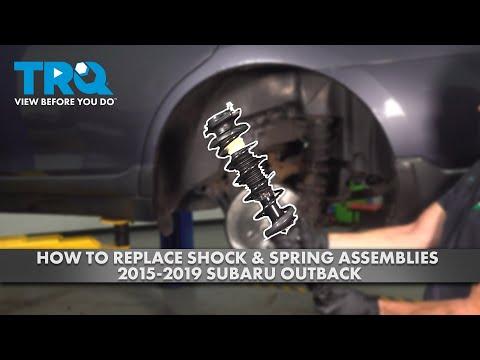







How to Replace Front Struts and Rear Shocks on a 2015-2019 Subaru Outback
Step-by-step suspension repair guide with tools, parts, torque specs, and safety tips for 2015, 2016, 2017, 2018, 2019
How to Replace Front Struts and Rear Shocks on a 2015-2019 Subaru Outback
Step-by-step suspension repair guide with tools, parts, torque specs, and safety tips for 2015, 2016, 2017, 2018, 2019


🔧 Outback - Front Strut and Rear Shock Absorber Replacement
On your Outback, the front suspension uses complete strut assemblies, while the rear uses separate shock absorbers with the coil spring mounted separately. This job restores ride control, reduces bouncing, and helps keep the tires planted on the road.
Difficulty Level: Advanced | Estimated Time: 4-6 hours
⚠️ Safety & Precautions
- ⚠️ Suspension parts are under load. Keep hands clear when removing bolts and lowering control arms.
- ⚠️ If replacing only the front strut cartridges or mounts, a spring compressor is required. A spring compressor holds the coil spring safely while the strut is disassembled.
- ⚠️ For a beginner, use complete loaded front strut assemblies when available to avoid compressing the spring.
- ⚠️ Always support your Outback with jack stands on solid ground. Never work under a vehicle supported only by a jack.
- ⚠️ Do not loosen the center nut on a front strut unless the spring is safely compressed with the correct tool.
- ⚠️ Mark front camber bolt positions before removal. Camber is the inward or outward tilt of the wheel.
- ⚠️ A wheel alignment is required after front strut replacement.
- ⚠️ No battery disconnect is normally required for this repair.
🔧 Required Tools
You'll need the following tools for this repair:
- Floor jack (rated 2-ton minimum)
- Jack stands (rated 2-ton minimum)
- Wheel chocks
- Safety glasses
- Mechanic gloves
- 1/2-inch drive breaker bar
- 1/2-inch drive torque wrench (rated to 150 ft-lbs)
- 3/8-inch drive torque wrench (rated to 50 ft-lbs)
- Ratchet set (3/8-inch drive)
- Ratchet set (1/2-inch drive)
- 19mm socket
- 17mm socket
- 14mm socket
- 12mm socket
- 19mm wrench
- 17mm wrench
- 14mm wrench
- 12mm wrench
- 6mm Allen socket
- Trim clip remover
- Flat-head screwdriver
- Needle-nose pliers
- Paint marker
- Rubber mallet
- Pry bar 18-inch
- Penetrating oil
- Spring compressor set (specialty)
🔩 Required Parts
HowToo sells all the parts you need for this repair:
- Front loaded strut assembly - Replace in pairs - Qty: 2
- Rear shock absorber - Replace in pairs - Qty: 2
- Front strut-to-knuckle bolts and nuts - Qty: 4 bolts and 4 nuts if replacing hardware
- Rear shock lower mounting bolts and nuts - Qty: 2 bolts and 2 nuts if replacing hardware
- Rear shock upper mounting nuts - Qty: 4 if replacing hardware
- Stabilizer link nuts - Qty: As needed
- Brake hose bracket clips - Qty: As needed
📋 Before You Begin
- 🅿️ Park your Outback on a flat, solid surface.
- 🅿️ Set the parking brake and place wheel chocks at the wheels that stay on the ground.
- 🔩 Loosen the wheel lug nuts slightly before lifting the vehicle.
- 🧴 Spray penetrating oil on the strut-to-knuckle bolts, sway bar link nuts, and rear shock lower bolts.
- 📌 A strut is a shock absorber that also helps support and locate the wheel assembly.
- 📌 A loaded strut assembly comes preassembled with the spring, mount, and bearing already installed.
🔨 Step-by-Step Instructions
Follow these steps in order:
Step 1: Raise and Support the Vehicle
- Use a 19mm socket and breaker bar to loosen the wheel lug nuts one turn while the tires are still on the ground.
- Use a floor jack to lift the front of your Outback at the front center jacking point.
- Place jack stands under the front side pinch weld jacking points.
- Use the floor jack to lift the rear at the rear differential support area, then place jack stands under the rear side jacking points.
- Use a 19mm socket to remove the lug nuts and remove the wheels.
- Wheel lug nut final torque: 120 Nm (89 ft-lbs)
Step 2: Remove the Front Brake Hose and ABS Wire Brackets
- Use a 12mm socket to remove the brake hose bracket bolt from the front strut.
- Use a trim clip remover or needle-nose pliers to release the ABS wire clip from the strut body.
- Move the hose and wire aside gently.
- Do not let the brake hose stretch or hang by tension.
Step 3: Disconnect the Front Stabilizer Link from the Strut
- Use a 17mm socket or 17mm wrench to remove the stabilizer link nut from the strut bracket.
- If the stud spins, hold the center of the stud with a 6mm Allen socket while turning the nut with a 17mm wrench.
- Push the stabilizer link out of the strut bracket.
- The stabilizer link connects the suspension to the sway bar, which helps reduce body roll in turns.
Step 4: Mark the Front Strut-to-Knuckle Position
- Use a paint marker to draw alignment marks across the strut bracket and steering knuckle.
- Mark the position of the upper camber bolt before removal.
- This helps you get close enough to drive safely to an alignment shop.
- Paint marks do not replace alignment.
Step 5: Remove the Front Strut Lower Bolts
- Support the lower control arm lightly with the floor jack.
- Use a 19mm socket and 19mm wrench to remove the two large strut-to-knuckle nuts and bolts.
- Use a rubber mallet to tap the bolts out if they are tight.
- Do not hit the threads directly with a steel hammer.
- Keep the knuckle from pulling outward too far to protect the axle joint.
Step 6: Remove the Front Strut Upper Nuts
- Open the hood and locate the three upper strut mount nuts at the strut tower.
- Use a 14mm socket to remove the three upper strut mount nuts.
- Hold the strut with one hand while removing the last nut.
- Lower the strut assembly out through the wheel opening.
- Do not remove the center nut on the strut mount.
- Front upper strut mount nut torque: 20 Nm (15 ft-lbs)
Step 7: Install the New Front Loaded Strut Assembly
- Guide the new loaded strut assembly into the wheel well by hand.
- Align the top studs with the holes in the strut tower.
- Use a 14mm socket to install the three upper mount nuts finger-tight.
- Line up the strut lower bracket with the steering knuckle.
- Use a pry bar 18-inch only if needed to gently align the holes.
- Install the lower bolts from the same direction they came out.
Step 8: Tighten the Front Strut Hardware
- Use a 19mm socket and 19mm wrench to snug the two lower strut-to-knuckle fasteners.
- Align your paint marks as closely as possible.
- Use a 1/2-inch drive torque wrench with a 19mm socket to tighten the strut-to-knuckle nuts.
- Front strut-to-knuckle nut torque: 155 Nm (114 ft-lbs)
- Use a 3/8-inch drive torque wrench with a 14mm socket to tighten the upper mount nuts.
- Front upper strut mount nut torque: 20 Nm (15 ft-lbs)
Step 9: Reconnect the Front Stabilizer Link, Brake Hose, and ABS Wire
- Use a 17mm socket or 17mm wrench to install the stabilizer link nut.
- If the stud spins, hold it with a 6mm Allen socket while tightening with a 17mm wrench.
- Front stabilizer link nut torque: 45 Nm (33 ft-lbs)
- Use a 12mm socket to reinstall the brake hose bracket bolt.
- Brake hose bracket bolt torque: 33 Nm (24 ft-lbs)
- Use needle-nose pliers to seat the ABS wire clip fully into the strut bracket.
Step 10: Repeat the Front Strut Replacement on the Other Side
- Use the same 12mm, 14mm, 17mm, and 19mm tools to repeat Steps 2 through 9 on the opposite front side.
- Compare left and right strut assemblies before installation so the brackets face the correct direction.
Step 11: Access the Rear Shock Upper Mounts
- Open the rear hatch.
- Use a trim clip remover to remove the rear cargo floor panels and side trim access covers as needed.
- Use a flashlight to locate the two upper shock mounting nuts on each side.
- Keep trim clips organized so they return to the same locations.
Step 12: Support the Rear Suspension Arm
- Place the floor jack under the rear lower suspension arm near the shock lower mount.
- Raise the jack just enough to support the arm without lifting your Outback off the jack stand.
- This keeps the suspension from dropping suddenly when the shock is removed.
Step 13: Remove the Rear Shock Lower Bolt
- Use a 17mm socket and 17mm wrench to remove the rear shock lower mounting bolt and nut.
- Use a rubber mallet to tap the bolt out if it is stuck.
- Move the lower shock eye away from the suspension bracket.
Step 14: Remove the Rear Shock Upper Nuts
- Inside the cargo area, use a 14mm socket to remove the two upper shock mounting nuts.
- Hold the shock from below with one hand while removing the final upper nut.
- Lower the rear shock out of the wheel well.
- Rear shock upper nut torque: 30 Nm (22 ft-lbs)
Step 15: Install the New Rear Shock
- Guide the new rear shock into place by hand from the wheel well.
- Use a 14mm socket to install the upper shock nuts finger-tight from inside the cargo area.
- Align the lower shock eye with the suspension bracket.
- Use the floor jack to raise or lower the suspension arm slightly until the bolt slides through easily.
- Install the lower bolt and nut by hand first to avoid cross-threading.
Step 16: Tighten the Rear Shock Hardware
- Use a 3/8-inch drive torque wrench with a 14mm socket to tighten the rear upper shock nuts.
- Rear shock upper nut torque: 30 Nm (22 ft-lbs)
- Use a 1/2-inch drive torque wrench with a 17mm socket and 17mm wrench to tighten the rear lower shock bolt.
- Rear shock lower bolt torque: 90 Nm (66 ft-lbs)
Step 17: Repeat the Rear Shock Replacement on the Other Side
- Use the same trim clip remover, floor jack, 14mm socket, 17mm socket, and 17mm wrench to repeat Steps 11 through 16 on the opposite rear side.
- Make sure both rear shocks are mounted with the same orientation as the originals.
Step 18: Reinstall Wheels and Lower the Vehicle
- Use a 19mm socket to reinstall the wheels and snug the lug nuts in a star pattern.
- Use the floor jack to raise your Outback slightly and remove the jack stands.
- Lower the vehicle fully to the ground.
- Use a 1/2-inch drive torque wrench with a 19mm socket to torque the lug nuts in a star pattern.
- Wheel lug nut torque: 120 Nm (89 ft-lbs)
Step 19: Bounce Check and Visual Inspection
- Press down firmly on each corner of your Outback and release.
- The body should rise and settle quickly without repeated bouncing.
- Use a flashlight to inspect all brake hoses, ABS wires, and shock mounts.
- Make sure no wires or hoses are twisted, stretched, or rubbing.
✅ After Repair
- ✅ Drive slowly around the block and listen for clunks, rattles, or rubbing.
- ✅ Recheck wheel lug nut torque after the short test drive using a 19mm socket and torque wrench.
- ✅ Schedule a four-wheel alignment after replacing the front struts.
- ✅ Avoid aggressive driving until alignment is complete.
- ✅ If the steering wheel is off-center or the vehicle pulls, do not delay the alignment.
- ✅ No scan tool or battery registration is required for this repair.
💰 DIY vs Shop Cost
Shop Cost: $1,200-$2,000 for front struts and rear shocks, including parts, labor, and alignment
DIY Cost: $450-$900 for parts, plus alignment
You Save: $500-$1,000 by doing it yourself!
Shop labor rates vary but typically run $100-$150/hour. This repair takes a shop approximately 3-5 hours plus alignment time.
🎯 Ready to get started?
HowToo makes it easy: same-day/2-day shipping on every part, plus all the tools and specialty tools you need! Check out the parts and tools sections below to add everything to your cart.