









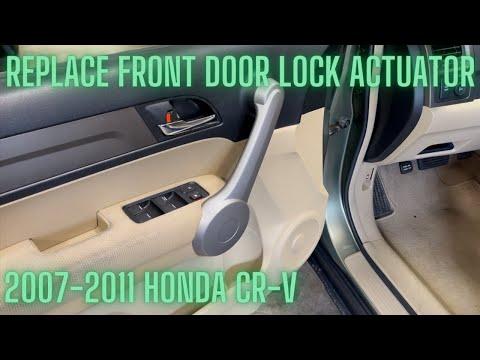







How to Replace the Front Door Lock Actuator (Latch Assembly) on a 2007 Honda CR-V
Step-by-step DIY instructions with required tools/parts, door panel removal, and latch torque specs
How to Replace the Front Door Lock Actuator (Latch Assembly) on a 2007 Honda CR-V
Step-by-step DIY instructions with required tools/parts, door panel removal, and latch torque specs


🔧 CR-V - Front Door Lock Actuator Replacement
On your CR-V, the front door lock actuator is typically part of the door latch/actuator assembly inside the door. When it fails, the door may not lock/unlock with the key fob or power lock switch, or it may work intermittently.
Difficulty Level: Intermediate | Estimated Time: 1.5-3.0 hours
⚠️ Safety & Precautions
- ⚠️ Work with the window fully up to avoid glass damage.
- ⚠️ Disconnect the battery negative cable to prevent accidental window movement and electrical shorts.
- ⚠️ Don’t tear the vapor barrier (plastic sheet); it prevents water leaks.
- ⚠️ Support the door panel so it doesn’t hang by the wiring.
🔧 Required Tools
You'll need the following tools for this repair:
- Safety glasses
- Mechanic gloves
- 10mm socket
- 1/4" drive ratchet
- 6" extension (1/4" drive)
- Torque wrench (inch-pound or low-range ft-lb)
- Torx T30 bit
- Phillips #2 screwdriver
- Trim/panel clip remover tool
- Small flat trim pick
- Needle-nose pliers
- Masking tape
- Magnetic parts tray
🔩 Required Parts
HowToo sells all the parts you need for this repair:
- Front door lock actuator/latch assembly (Driver/LH or Passenger/RH) - Qty: 1
- Door panel clips (assortment) - Qty: 1 set
- Butyl door vapor-barrier tape - Qty: 1
📋 Before You Begin
- 🅿️ Park on level ground, shift to Park, and set the parking brake.
- 🔋 Use a 10mm socket to disconnect the negative battery cable, then wait 2 minutes.
- 🪟 Make sure the window glass is fully raised.
- 🧼 Put masking tape along the painted door edge near the latch to prevent scratches.
🔨 Step-by-Step Instructions
Follow these steps in order:
Step 1: Remove the inner handle trim
- Use a small flat trim pick to carefully pop off the small trim cover near the inside door handle (it hides a screw).
- Remove the exposed screw using a Phillips #2 screwdriver.
Step 2: Remove armrest/door pull screws
- Use the small flat trim pick to lift the cover in the armrest/door pull area (if equipped).
- Remove the screws using a Phillips #2 screwdriver.
Step 3: Remove the window switch panel and unplug it
- Use a trim/panel clip remover tool to lift the power window switch panel from the front edge.
- Unplug the connectors by pressing the tabs with your fingers (or gently with the small flat trim pick).
Step 4: Release the door panel clips and lift the panel off
- Slide the trim/panel clip remover tool along the bottom/side edges to pop the panel clips free.
- Lift the door panel straight upward to unhook it from the top window channel.
- Unplug any remaining connectors using the small flat trim pick as needed.
- Tip: Keep the panel close—don’t yank wires.
Step 5: Peel back the vapor barrier (plastic sheet)
- Carefully peel the vapor barrier back using your hands; use the small flat trim pick only if needed.
- If the sticky butyl is messy or won’t reseal, plan to use butyl door vapor-barrier tape during reassembly.
Step 6: Disconnect the inside handle cable/rod from the latch area
- Locate the inside handle linkage going to the latch.
- Use needle-nose pliers to rotate the plastic retaining clip off the cable/rod, then lift the cable/rod end out.
- Tip: Take a photo before disconnecting.
Step 7: Unplug the actuator electrical connector
- Find the latch/actuator connector near the rear of the door (near the latch).
- Press the tab and unplug it by hand; if stuck, gently help with a small flat trim pick.
Step 8: Remove the latch screws at the door edge
- Open the door and locate the 3 screws on the door edge holding the latch.
- Remove them using a Torx T30 bit with a 1/4" drive ratchet and 6" extension.
- Keep the latch supported so it doesn’t drop inside the door.
Step 9: Remove the latch/actuator assembly from inside the door
- Work the latch/actuator assembly out through the access opening, guiding the cables/rods and wiring through carefully.
- If it hangs up, reposition it—don’t force it against the window track.
Step 10: Transfer any brackets/cables (if your replacement doesn’t include them)
- Compare the old and new units side-by-side.
- If needed, transfer brackets/cable ends using a 10mm socket or Phillips #2 screwdriver (varies by replacement design).
Step 11: Install the new latch/actuator and tighten hardware
- Guide the new latch/actuator into position through the access opening.
- Start the 3 latch screws by hand, then tighten using the Torx T30 bit.
- Torque to 9 Nm (7 ft-lbs) using a torque wrench.
- Reconnect the actuator electrical connector by pushing it in until it clicks.
- Reconnect the inside handle cable/rod and lock the plastic retaining clip back into place using needle-nose pliers.
Step 12: Reinstall the vapor barrier and door panel
- Reseal the vapor barrier using the original butyl; add butyl door vapor-barrier tape if needed.
- Hang the door panel on the top window channel and press downward to seat it.
- Press the clips in around the edges by hand (replace broken clips).
- Reconnect the switch connectors, then snap the switch panel back in.
- Reinstall screws using a Phillips #2 screwdriver and reinstall trim covers.
✅ After Repair
- 🔋 Reconnect the negative battery cable using a 10mm socket.
- 🔒 Test lock/unlock with the key fob and the driver’s master lock switch (both doors should respond correctly).
- 🚪 With the door open, use a screwdriver to gently “click” the latch closed (simulate door closed), then verify the handle opens it; reset by pulling the outside handle.
- 🪟 Reinitialize the auto window (if it acts weird): hold the window switch down until fully open, then hold up until fully closed, then hold up 2 more seconds.
- 💧 Check for wind noise or water leak risk: ensure the vapor barrier is fully sealed.
💰 DIY vs Shop Cost
Shop Cost: $300-$650 (parts + labor)
DIY Cost: $70-$220 (parts only)
You Save: $230-$430 by doing it yourself!
Shop labor rates vary but typically run $100-$150/hour. This repair takes a shop approximately 1.5-3.0 hours.
🎯 Ready to get started?
HowToo makes it easy: same-day/2-day shipping on every part, plus all the tools and specialty tools you need! Check out the parts and tools sections below to add everything to your cart.