








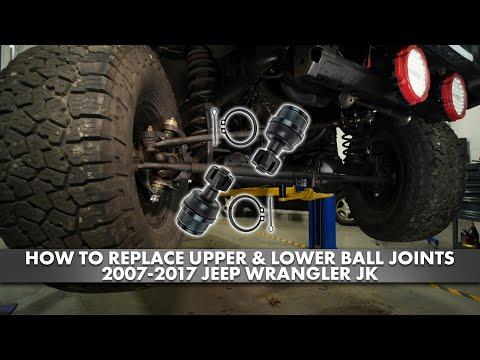







How to Replace Front Ball Joints on a 2007 Jeep Wrangler (Step-by-Step Guide)
Tools, parts, safety tips, and torque specs for pressing in/out upper and lower front ball joints
How to Replace Front Ball Joints on a 2007 Jeep Wrangler (Step-by-Step Guide)
Tools, parts, safety tips, and torque specs for pressing in/out upper and lower front ball joints


🔧 Wrangler - Front Ball Joint Replacement
Your Wrangler’s front ball joints are press-fit pivots in the steering knuckle. When they wear, you can get shimmy, clunks, loose steering, and uneven tire wear. This job involves removing the knuckle and pressing the joints in/out.
Difficulty Level: Advanced | Estimated Time: 4-7 hours
⚠️ Safety & Precautions
- ⚠️ Support the front axle with jack stands; never rely on a jack.
- ⚠️ Wear safety glasses; rust and press tools can eject debris.
- ⚠️ Keep fingers clear of the ball joint press while tightening.
- ⚠️ Do not let the brake caliper hang by the hose; support it with a hanger.
- ⚠️ After ball joints, you should get a front-end alignment to prevent tire wear.
🔧 Required Tools
You'll need the following tools for this repair:
- Floor jack (rated 3-ton minimum)
- Jack stands (rated 3-ton minimum)
- Wheel chocks
- Safety glasses
- Mechanic gloves
- Breaker bar 1/2"
- Torque wrench 1/2" (50-250 ft-lbs range)
- Torque wrench 3/8" (10-100 ft-lbs range)
- Socket set, metric (10mm-21mm)
- Socket set, SAE (3/4" and 13/16")
- 36mm axle nut socket
- Ratchet 3/8"
- Ratchet 1/2"
- Pry bar (18")
- Hammer (2-3 lb)
- Pickle fork ball joint separator (specialty)
- Ball joint press kit with receiver cups (specialty)
- Needle-nose pliers
- Side cutters
- Bungee cord or mechanic wire hanger
- Wire brush
- Penetrating oil
- Brake cleaner
- Shop rags
- Grease gun
🔩 Required Parts
HowToo sells all the parts you need for this repair:
- Front upper ball joint - Qty: 2
- Front lower ball joint - Qty: 2
- Front axle nut - Qty: 2
- Front cotter pins (tie rod end) - Qty: 2
- Chassis grease (NLGI #2) - Qty: 1
📋 Before You Begin
- Park on level ground, put the transmission in 1st gear, and set the parking brake.
- Chock the rear wheels with wheel chocks.
- Loosen (but do not remove) the front lug nuts using a 19mm socket and breaker bar.
- Spray penetrating oil on the axle nut, tie-rod end nut, and ball joint nuts; let it soak 10–15 minutes.
- A “ball joint press” is a big C-clamp tool.
🔨 Step-by-Step Instructions
Follow these steps in order:
Step 1: Lift and secure the front end
- Use a floor jack under the front axle tube to lift the front end.
- Place jack stands under the axle tubes (one per side) and lower onto them.
- Remove the front wheels using a 19mm socket and ratchet.
Step 2: Remove the brake caliper and rotor
- Remove the caliper guide pin bolts using a 13mm socket and ratchet.
- Lift the caliper off and hang it with a bungee cord or mechanic wire hanger.
- Remove the caliper bracket bolts using a 21mm socket and breaker bar.
- Remove the rotor; if stuck, tap the hat area with a hammer (2-3 lb).
- Torque to 35 Nm (26 ft-lbs) for caliper guide pins during reassembly.
- Torque to 136 Nm (100 ft-lbs) for caliper bracket bolts during reassembly.
Step 3: Remove the axle nut and free the axle shaft
- Remove the axle nut using a 36mm axle nut socket and breaker bar.
- If the axle stub is stuck in the hub, tap the end gently with a hammer (2-3 lb) (keep the nut threaded on a few turns to protect the threads).
- Torque to 237 Nm (175 ft-lbs) for the axle nut during reassembly.
Step 4: Disconnect the tie rod end from the knuckle
- Remove the cotter pin using needle-nose pliers or side cutters.
- Remove the tie-rod end nut using a 21mm socket and ratchet.
- Separate the joint using a pickle fork ball joint separator (specialty) and a hammer (2-3 lb).
- Torque to 85 Nm (63 ft-lbs) for the tie-rod end nut during reassembly, then install a new cotter pin.
Step 5: Remove the hub/bearing (unit bearing) from the knuckle
- From the back side of the knuckle, remove the 3 hub/bearing bolts using a 13mm socket and ratchet.
- If the hub is stuck, work it loose with a pry bar (18") and tap around it with a hammer (2-3 lb).
- Pull the hub/bearing off and slide the axle shaft outward enough to clear the knuckle.
- Clean the mating surfaces with a wire brush and brake cleaner.
- Torque to 102 Nm (75 ft-lbs) for hub/bearing bolts during reassembly.
Step 6: Remove the knuckle from the ball joints
- Remove the upper and lower ball joint nuts using a socket set and breaker bar.
- Use a pickle fork ball joint separator (specialty) and hammer (2-3 lb) to separate the knuckle from the ball joint studs.
- Lift the knuckle off and set it on a stable surface.
Step 7: Press out the old ball joints
- Set up the ball joint press kit with receiver cups (specialty) so the cup supports the axle “C” and the press screw pushes the joint out.
- Use a breaker bar 1/2" to tighten the press and push the ball joint out.
- Repeat for the other ball joint.
- If it binds, reposition cups and try again.
Step 8: Press in the new ball joints
- Clean the bores with a wire brush and brake cleaner, then wipe with shop rags.
- Press in the new ball joints using the ball joint press kit with receiver cups (specialty) and a breaker bar 1/2".
- Make sure each joint seats fully (it should sit flush like the old one did).
- If your new joints have grease fittings, install them using a socket set (small socket as needed) and snug gently.
Step 9: Reinstall the knuckle and tighten ball joint nuts
- Set the knuckle back onto the ball joint studs.
- Install the nuts using a socket set and tighten with a torque wrench 1/2".
- Torque to 94 Nm (69 ft-lbs) for the upper ball joint nut.
- Torque to 108 Nm (80 ft-lbs) for the lower ball joint nut.
Step 10: Reinstall hub/bearing, axle nut, brakes, and steering link
- Slide the axle shaft back into place and reinstall the hub/bearing using a 13mm socket and torque wrench 1/2" to Torque to 102 Nm (75 ft-lbs).
- Install the axle nut using a 36mm axle nut socket and torque wrench 1/2" to Torque to 237 Nm (175 ft-lbs).
- Reconnect the tie-rod end using a 21mm socket and torque wrench 1/2" to Torque to 85 Nm (63 ft-lbs), then install a new cotter pin using needle-nose pliers.
- Reinstall the rotor and caliper bracket using a 21mm socket and torque wrench 1/2" to Torque to 136 Nm (100 ft-lbs).
- Reinstall the caliper using a 13mm socket and torque wrench 3/8" to Torque to 35 Nm (26 ft-lbs).
Step 11: Grease the new ball joints (if applicable)
- Use a grease gun with chassis grease (NLGI #2).
- Pump slowly until you see the boot just start to swell.
- Don’t overfill; it can pop the boot.
Step 12: Reinstall wheels and lower the vehicle
- Install the wheels using a 19mm socket and ratchet.
- Lower the vehicle using the floor jack, then torque lug nuts with a torque wrench 1/2" in a star pattern.
✅ After Repair
- Pump the brake pedal until it feels firm before moving the Wrangler.
- Turn the steering wheel lock-to-lock and listen for any clunks.
- Road test at low speed first, then highway speed.
- Get a front-end alignment as soon as possible.
- Re-check for looseness and look for torn boots after 50–100 miles.
💰 DIY vs Shop Cost
Shop Cost: $700-$1400 (parts + labor)
DIY Cost: $150-$400 (parts only)
You Save: $550-$1000 by doing it yourself!
Shop labor rates vary but typically run $100-$150/hour. This repair takes a shop approximately 4-7 hours.
🎯 Ready to get started?
HowToo makes it easy: same-day/2-day shipping on every part, plus all the tools and specialty tools you need! Check out the parts and tools sections below to add everything to your cart.