









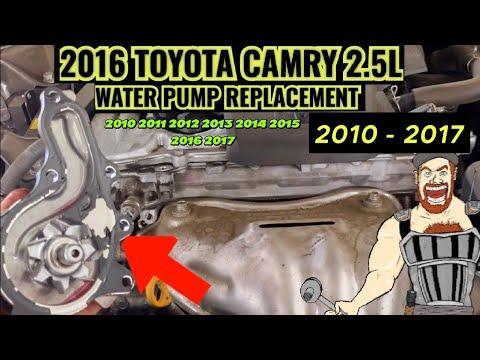






How to Replace the Water Pump on a 2013 Toyota Camry
Step-by-step DIY water pump replacement with tools, parts list, torque specs, safety tips, and cost savings
How to Replace the Water Pump on a 2013 Toyota Camry
Step-by-step DIY water pump replacement with tools, parts list, torque specs, safety tips, and cost savings


🔧 Camry - Water Pump Replacement
You’ll be removing the accessory drive belt and the water pump on your Camry, then installing a new pump and refilling the cooling system. This fixes overheating, coolant leaks at the pump area, and bearing noise from the pump.
Difficulty Level: Intermediate | Estimated Time: 3-4 hours
⚠️ Safety & Precautions
- ⚠️ Let the engine cool completely before starting; hot coolant can cause serious burns.
- ⚠️ Support the car with jack stands, never rely only on a floor jack.
- ⚠️ Wear safety glasses and mechanic gloves when working under the car and around coolant.
- ⚠️ Keep coolant away from children and pets; it is toxic but sweet-tasting.
- ⚠️ Disconnect the negative battery cable if your tools might contact the starter or main power cables.
- ⚠️ Work on level ground and chock the rear wheels to prevent the car from rolling.
🔧 Required Tools
You'll need the following tools for this repair:
- 🧰 Floor jack (rated 2-ton or higher)
- 🧰 Jack stands (rated 2-ton or higher)
- 🧰 Wheel chocks
- 🧰 3/8" drive ratchet
- 🧰 1/2" drive ratchet
- 🧰 10mm socket
- 🧰 12mm socket
- 🧰 14mm socket
- 🧰 10mm deep socket
- 🧰 12mm deep socket
- 🧰 14mm deep socket
- 🧰 3/8" drive torque wrench (5-80 ft-lbs range)
- 🧰 1/2" drive torque wrench (30-150 ft-lbs range)
- 🧰 3/8" drive extension (3"–6")
- 🧰 1/2" drive breaker bar
- 🧰 14mm box-end wrench
- 🧰 Phillips screwdriver
- 🧰 Flathead screwdriver (medium)
- 🧰 Plastic trim clip remover
- 🧰 Drain pan (at least 10-liter capacity)
- 🧰 Needle-nose pliers
- 🧰 Razor scraper or plastic gasket scraper
- 🧰 Nylon scuff pad
- 🧰 Shop towels or rags
- 🧰 Funnel (coolant-safe)
- 🧰 Coolant spill-proof funnel kit (specialty)
- 🧰 Pick tool set (specialty)
- 🧰 Safety glasses
- 🧰 Mechanic gloves
🔩 Required Parts
HowToo sells all the parts you need for this repair:
- 🔩 Water pump assembly (with gasket or O-ring) - Qty: 1
- 🔩 Serpentine drive belt - Qty: 1
- 🔩 Toyota Super Long Life Coolant (pink, premixed 50/50) - Qty: 2 gallons
- 🔩 Thermostat and gasket - Qty: 1 (optional but recommended)
- 🔩 Water pump mounting bolts - Qty: 6 (optional, if originals are corroded)
- 🔩 Water pump pulley bolts - Qty: 4 (optional, if damaged or rusty)
- 🔩 Plastic push clips for splash shield - Qty: 6–10 (optional, if old clips break)
- 🔩 RTV silicone sealant (coolant-safe, if specified by pump maker) - Qty: 1 tube
- 🔩 Brake cleaner or parts cleaner spray - Qty: 1 can
📋 Before You Begin
- Park your Camry on level ground, set the parking brake, and place wheel chocks behind the rear wheels.
- Let the engine cool fully (at least 1–2 hours after driving).
- Open the hood and note the serpentine belt routing diagram sticker; if missing, take a clear photo.
- Loosen the front right wheel lug nuts slightly with the car on the ground.
- If you want extra safety, disconnect the negative battery terminal using a 10mm socket.
- Place your drain pan under the radiator area to catch coolant.
🔨 Step-by-Step Instructions
Follow these steps in order:
Step 1: Raise the front and remove the right wheel
- Use the floor jack on the front center jack point and lift until both front wheels are off the ground.
- Place jack stands under the proper front pinch welds and slowly lower the car onto the stands.
- Use a 14mm socket and 1/2" drive ratchet to remove the front right wheel lug nuts.
- Remove the front right wheel and set it aside.
- Shake car slightly to confirm it’s stable on stands.
Step 2: Remove the right front splash shield
- Turn the steering wheel fully to the left for more space.
- Use a Phillips screwdriver to remove any small screws on the plastic splash shield inside the right wheel well.
- Use a plastic trim clip remover or flathead screwdriver to gently pop out the plastic clips holding the shield.
- Pull the splash shield out to access the side of the engine where the belt and water pump are.
- Keep clips and screws in a cup so you don’t lose them.
Step 3: Drain the coolant
- Place the drain pan under the radiator drain area (bottom of radiator on the passenger side).
- Use a Phillips screwdriver or fingers to open the radiator drain cock (small plastic valve) slowly.
- Remove the radiator cap at the top of the radiator to let coolant flow faster.
- Allow coolant to drain completely, then close the drain cock by hand and gently snug it (no need for big force).
- Do not over-tighten the plastic drain; it can crack.
Step 4: Relieve tension and remove the serpentine belt
- From the wheel well opening, locate the belt tensioner (a spring-loaded pulley pressing on the belt).
- Place a 14mm socket on the tensioner bolt using a breaker bar or long ratchet.
- Rotate the tensioner clockwise to relieve tension on the belt.
- With tension held off, slide the belt off one of the upper pulleys (like the alternator) using your other hand.
- Slowly release the tensioner and remove the belt completely, noting the routing or using your photo.
- If the belt is cracked or glazed, replace it now.
Step 5: Remove the water pump pulley
- From the wheel well, locate the water pump pulley (round metal wheel attached to the pump with 4 bolts).
- If the pulley turns while loosening bolts, temporarily refit the old belt around the pulley to help hold it.
- Use a 10mm socket and 3/8" ratchet to remove the 4 water pump pulley bolts.
- Remove the pulley and set it aside.
- Torque on reassembly for pulley bolts: 21 Nm (15 ft-lbs)
Step 6: Remove the water pump
- Place the drain pan under the water pump area, as some coolant will still come out.
- Locate the water pump on the side of the engine block (behind where the pulley was).
- Use a 10mm socket and 3/8" ratchet with extension to remove the water pump mounting bolts evenly.
- There are several bolts; note their lengths and positions as you remove them.
- Gently tap the pump body with a rubber mallet or handle of a screwdriver if it is stuck, then pull it away from the engine.
- Let any remaining coolant drain into the pan.
- Torque on reassembly for water pump bolts: 10 Nm (89 in-lbs)
Step 7: Clean the gasket surface
- Use a razor scraper or plastic gasket scraper to carefully remove old gasket material from the engine block sealing surface.
- Follow with a nylon scuff pad to make the surface clean and smooth, but do not scratch the metal deeply.
- Spray a little brake cleaner on a rag and wipe the surface until it is clean and dry.
- Do not let debris fall into the open coolant passages.
Step 8: Prepare and install the new water pump
- Compare the new pump to the old one to ensure bolt holes and shape match.
- Install the new gasket or O-ring on the new pump. If the pump instructions say to use sealant, apply a thin even bead of RTV silicone sealant as directed.
- Position the new pump onto the engine, lining up all bolt holes.
- Install all water pump bolts by hand first to avoid cross-threading.
- Use a 10mm socket and 3/8" ratchet to snug the bolts in a criss-cross pattern.
- Then use a 3/8" drive torque wrench and 10mm socket to tighten each bolt to 10 Nm (89 in-lbs) in a criss-cross pattern.
- Even tightening helps prevent leaks and warping.
Step 9: Reinstall the water pump pulley
- Place the pulley back on the water pump hub, lining up the holes.
- Install the 4 pulley bolts by hand.
- Refit the old belt temporarily if needed to hold the pulley from spinning.
- Use a 10mm socket and 3/8" ratchet to snug the bolts evenly.
- Use a 3/8" drive torque wrench and 10mm socket to torque the bolts to 21 Nm (15 ft-lbs).
Step 10: Install the new serpentine belt
- Route the new belt according to the under-hood diagram or your photo, leaving the easiest top pulley for last.
- Place a 14mm socket and breaker bar or long ratchet on the belt tensioner.
- Rotate the tensioner clockwise to create slack and slip the belt over the final pulley.
- Slowly release the tensioner and double-check that the belt is seated correctly in all pulley grooves.
- A mis-seated belt can jump off and cause damage.
Step 11: Reinstall the splash shield and wheel
- Reposition the right front splash shield in the wheel well.
- Install the plastic clips using your plastic trim clip remover or fingers and reinstall any screws with a Phillips screwdriver.
- Put the wheel back on and install the lug nuts by hand.
- Lift the car slightly with the floor jack, remove the jack stands, and lower the car to the ground.
- Use a 14mm socket and 1/2" drive torque wrench to torque the lug nuts in a star pattern to 103 Nm (76 ft-lbs).
Step 12: Refill and bleed the cooling system
- Make sure the radiator drain cock is closed.
- Place a coolant spill-proof funnel into the radiator neck or coolant reservoir, depending on your funnel kit.
- Pour Toyota Super Long Life Coolant (pink, premixed) slowly into the radiator until full.
- Fill the overflow reservoir to the “FULL” line.
- Start the engine and set the heater to maximum heat with the blower on medium.
- Let the engine idle, occasionally revving gently to around 1500–2000 rpm to help push air out.
- Watch for air bubbles in the funnel; keep adding coolant as the level drops.
- Once bubbles stop, the upper radiator hose feels hot, and the cabin heater blows hot, switch off the engine and let it cool.
- After cooling, top off the coolant in radiator and reservoir again if needed, then install and tighten the radiator cap.
Step 13: Reconnect battery and final check
- If you disconnected the battery earlier, reconnect the negative cable using a 10mm socket and snug it firmly.
- Check around the water pump and hose connections for any visible leaks.
- Wipe away any spilled coolant with shop towels.
✅ After Repair
- Start the engine and let it reach normal operating temperature while parked.
- Watch the temperature gauge; it should stay in the normal range, not climb toward hot.
- Inspect around the water pump and under the car for leaks with the engine running.
- Take a short, gentle test drive with the heater on and check again for leaks afterward.
- Recheck coolant level in the reservoir the next morning when the engine is cold and top off to the “FULL” mark if needed.
💰 DIY vs Shop Cost
Shop Cost: $550-$800 (parts + labor)
DIY Cost: $120-$220 (parts only)
You Save: $430-$580 by doing it yourself!
Shop labor rates vary but typically run $100-$150/hour. This repair takes a shop approximately 2-3 hours.
🎯 Ready to get started?
HowToo makes it easy: same-day/2-day shipping on every part, plus all the tools and specialty tools you need! Check out the parts and tools sections below to add everything to your cart.