









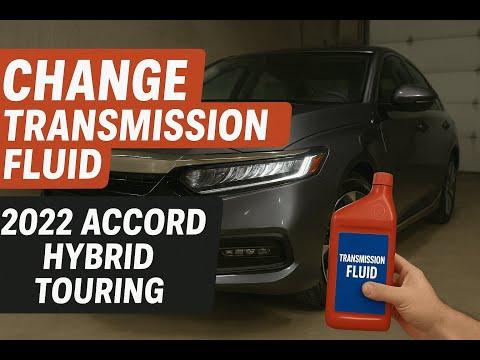







How to Change Transmission Fluid on a 2022 Honda Accord (e-CVT)
Step-by-step DIY drain-and-fill guide with tools, parts list, torque specs, safety tips, and cost savings
How to Change Transmission Fluid on a 2022 Honda Accord (e-CVT)
Step-by-step DIY drain-and-fill guide with tools, parts list, torque specs, safety tips, and cost savings


🔧 Accord - Transmission Fluid Drain & Fill
You’ll be doing a simple drain-and-fill on the e-CVT (Honda hybrid transmission), not a full flush. This replaces a good portion of the old fluid with fresh Honda HCF-2 to help protect the transmission and keep shifts smooth.
Difficulty Level: Intermediate | Estimated Time: 1–1.5 hours
⚠️ Safety & Precautions
- ⚠️ Always support the car with jack stands; never rely only on a floor jack.
- ⚠️ Transmission fluid can be hot; let the engine and transmission cool at least 30–45 minutes after driving.
- ⚠️ Wear safety glasses and nitrile gloves; fluid can irritate skin and eyes.
- ⚠️ Keep the work area clean; spilled fluid is very slippery.
- ⚠️ Only use Honda HCF-2 fluid; using other fluids can damage the e-CVT.
- ⚠️ Do not start the engine with no fluid or low fluid level.
- Battery disconnect is not required, but you can remove the negative terminal for extra safety if you wish.
🔧 Required Tools
You'll need the following tools for this repair:
- 🛠️ Floor jack (rated 3-ton minimum)
- 🛠️ Jack stands (rated 3-ton minimum, Qty: 2–4)
- 🛠️ Wheel chocks
- 🛠️ 3/8" drive ratchet
- 🛠️ 3/8" drive torque wrench (10–80 ft-lbs range)
- 🛠️ 3/8" drive breaker bar
- 🛠️ 17mm socket
- 🛠️ 10mm socket
- 🛠️ Phillips screwdriver #2
- 🛠️ Trim clip removal tool (specialty)
- 🛠️ Long neck fluid funnel
- 🛠️ Clean fluid transfer pump (optional, specialty)
- 🛠️ Drain pan (at least 8-quart capacity)
- 🛠️ Measuring jug or graduated container (marked in quarts/liters)
- 🛠️ Shop rags or paper towels
- 🛠️ Nitrile gloves
- 🛠️ Safety glasses
🔩 Required Parts
HowToo sells all the parts you need for this repair:
- 🔩 Honda HCF-2 transmission fluid - Qty: 4 quarts (approx. 3.3–3.5 quarts used)
- 🔩 Transmission drain plug crush washer - Qty: 1
- 🔩 Transmission fill plug crush washer - Qty: 1 (if separate washer is used on your unit)
- 🔩 Plastic splash shield push clips - Qty: 4–6 (optional, to replace any broken clips)
- 🔩 Brake cleaner spray - Qty: 1 can (for cleaning spilled fluid)
📋 Before You Begin
- Park your Accord on level ground, shift to P, and set the parking brake.
- Let the engine and transmission cool until warm, not hot to the touch.
- Chock the rear wheels to prevent any movement.
- Gather all tools and parts so you don’t have to crawl under the car multiple times.
- If you choose to disconnect the battery: use a 10mm socket to remove the negative terminal and tuck it aside.
🔨 Step-by-Step Instructions
Follow these steps in order:
Step 1: Safely lift and support the car
- Use the floor jack at the front center jacking point to raise the front of your Accord.
- Place jack stands under the left and right front pinch welds (the reinforced seam under the doors).
- Lower the car gently onto the jack stands using the floor jack.
- Give the car a small shake at the fenders to confirm it is stable. Never work under an unsupported car.
Step 2: Remove the lower engine splash shield
- Use a 10mm socket to remove the bolts holding the front splash shield.
- Use a Phillips screwdriver #2 or trim clip removal tool to remove any plastic clips.
- Lower the shield and set it aside, keeping bolts and clips together so you don’t lose them.
Step 3: Locate the transmission drain and fill plugs
- The e-CVT transmission is on the driver’s side of the engine bay.
- Under the car, find the transmission drain plug on the bottom of the transmission case (usually a 17mm bolt facing downward).
- From above or from the front, locate the fill plug on the side/top of the transmission (also typically 17mm).
- Always confirm you can loosen the fill plug before draining.
Step 4: Loosen the fill plug first
- Place some rags below the fill plug in case of drips.
- Use a 17mm socket and 3/8" drive ratchet to crack loose the fill plug, but do not remove it fully yet.
- If it’s very tight, use the breaker bar with the 17mm socket for extra leverage.
Step 5: Drain the old transmission fluid
- Position the drain pan under the transmission drain plug.
- Use a 17mm socket and 3/8" drive ratchet to remove the drain plug carefully.
- Let the fluid drain completely; this may take 5–10 minutes.
- While draining, pour the used fluid from the drain pan into a measuring jug to see exactly how much came out. Refill with the same amount.
Step 6: Reinstall the drain plug with new washer
- Clean the drain plug with a rag.
- Remove the old crush washer from the drain plug and install the new drain plug crush washer.
- Thread the drain plug back into the transmission by hand to avoid cross-threading.
- Use a 17mm socket and 3/8" drive torque wrench to tighten the drain plug to 39 Nm (29 ft-lbs).
Step 7: Fill the transmission with new HCF-2 fluid
- Now remove the fill plug completely using the 17mm socket and 3/8" drive ratchet.
- Insert the long neck fluid funnel into the fill hole (from above if accessible, or use a fluid transfer pump from below).
- Measure out the same amount of new Honda HCF-2 fluid as what you drained (usually around 3.3–3.5 quarts) using the measuring jug.
- Slowly pour the new fluid into the funnel or pump it in until you’ve added that amount. Pour slowly to avoid overflow.
Step 8: Reinstall the fill plug
- If your fill plug uses a crush washer, replace it with a new one.
- Thread the fill plug in by hand to avoid cross-threading.
- Use the 17mm socket and 3/8" drive torque wrench to tighten the fill plug to 44 Nm (33 ft-lbs).
- Wipe any spilled fluid off the transmission case using shop rags and a light spray of brake cleaner.
Step 9: Reinstall the splash shield
- Lift the splash shield back into position.
- Install any plastic clips by hand, then gently push them fully seated; replace broken ones with new plastic splash shield push clips.
- Use the 10mm socket to reinstall and snug all the bolts. Do not overtighten (they are small and easy to strip).
Step 10: Lower the car and circulate the fluid
- Use the floor jack to raise the front slightly and remove the jack stands, then lower the car to the ground.
- If you disconnected the battery earlier, use the 10mm socket to reconnect the negative terminal and tighten snugly.
- Start the engine with your foot on the brake.
- With the engine idling, move the shifter slowly through all positions: P → R → N → D → B (if equipped) → D → N → R → P, pausing 3–5 seconds in each.
- Do this cycle 2–3 times to circulate fluid through the e-CVT. Keep your foot firmly on the brake.
Step 11: Check for leaks
- Switch the engine off and wait a couple of minutes.
- Look under the car around the drain and fill plugs for any signs of fresh fluid leaking.
- If you see leaks, slightly tighten the affected plug using the 17mm socket and 3/8" drive ratchet, but do not exceed the torque specs.
✅ After Repair
- Take a short, gentle test drive (5–10 km) in city conditions.
- Listen for any unusual noises and feel for smooth operation from a stop and at low speeds.
- After the drive, park on level ground, set the parking brake, and check under the car again for leaks.
- Properly dispose of the old transmission fluid at a recycling center or workshop; never pour it on the ground or down drains.
- Note the mileage and date; repeat this drain-and-fill every 40,000–60,000 miles if you want “severe use” protection, even though Honda often calls it “lifetime” fluid.
💰 DIY vs Shop Cost
Shop Cost: $220–$320 (parts + labor)
DIY Cost: $70–$110 (fluid + washers + clips)
You Save: $110–$250 by doing it yourself!
Shop labor rates vary but typically run $100–$150/hour. This repair takes a shop approximately 1.0 hour.
🎯 Ready to get started?
HowToo makes it easy: same-day/2-day shipping on every part, plus all the tools and specialty tools you need! Check out the parts and tools sections above to add everything to your cart.