









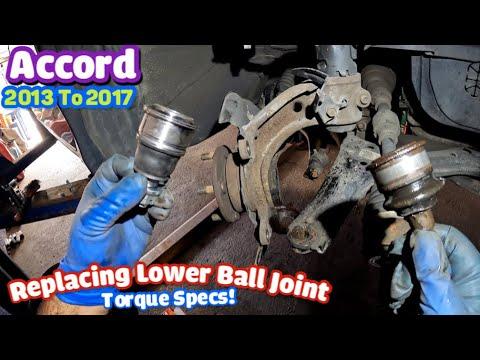







How to Replace Front Lower Ball Joints on a 2013 Honda Accord (DIY Guide)
Step-by-step instructions, required tools/parts, safety tips, and what to check before getting an alignment
How to Replace Front Lower Ball Joints on a 2013 Honda Accord (DIY Guide)
Step-by-step instructions, required tools/parts, safety tips, and what to check before getting an alignment


🔧 Accord - Ball Joint Replacement
Ball joints are the pivot points that let your suspension move while keeping the wheel aligned. On your Accord, the exact procedure changes a lot depending on whether you’re doing the front lower ball joint or a rear suspension ball joint/control arm.
Difficulty Level: Advanced | Estimated Time: 2-4 hours (per side)
I need 2 quick details before I give you the exact OEM-correct steps:
- 🔹 Are you replacing front ball joints or rear ball joints?
- 🔹 Are you replacing the ball joint by itself or the entire control arm (it sometimes comes as an assembly)?
⚠️ Safety & Precautions
- 🔹 Do not work under the car supported only by a jack—use jack stands.
- 🔹 Ball joints can release suddenly when separated; keep hands/face clear of pinch points.
- 🔹 After any ball joint/control arm work, you should get a 4-wheel alignment to prevent tire wear and pulling.
🔧 Required Tools
You'll need the following tools for this repair:
- Floor jack (rated 2-ton minimum)
- Jack stands (rated 2-ton minimum)
- Wheel chocks
- Safety glasses
- Mechanic gloves
- 1/2" drive breaker bar
- 1/2" drive torque wrench (20–200 ft-lbs range)
- Metric socket set (8mm–22mm)
- Metric wrench set (10mm–22mm)
- Pry bar (18")
- Ball joint separator (pickle fork) (specialty)
- Ball joint press kit (C-frame style) (specialty)
- Hammer (2 lb)
- Needle-nose pliers
- Wire brush
- Penetrating oil
🔩 Required Parts
HowToo sells all the parts you need for this repair:
- Ball joint - Qty: 1 (per side)
- Ball joint cotter pin - Qty: 1 (per side)
- Ball joint dust boot (if not included) - Qty: 1 (per side)
- Snap ring/retaining ring (if used, if not included) - Qty: 1 (per side)
- Control arm assembly (if replacing as an assembly) - Qty: 1 (per side)
📋 Before You Begin
- 🔹 Park on level ground, put the transmission in 1st gear, and set the parking brake.
- 🔹 Chock the rear wheels before lifting the front.
- 🔹 Loosen the wheel lug nuts slightly before lifting the car.
- 🔹 Spray penetrating oil on the ball joint nut and pinch/through-bolts and let it soak for 10–15 minutes.
- 🔹 If you’ll use a ball joint press kit: it’s a big C-clamp tool that presses the joint in/out without hammering.
🔨 Step-by-Step Instructions
Follow these steps in order:
Step 1: Lift and secure the car
- Use a floor jack to lift at the front jacking point.
- Set the car onto jack stands at the proper support points.
- Remove the wheel using a 19mm socket and breaker bar.
Step 2: Inspect and identify the joint you’re replacing
- Use a flashlight (phone light is fine) and look for a torn rubber boot and leaking grease.
- Use needle-nose pliers to confirm if there’s a cotter pin through the ball joint stud nut.
Step 3: Stop here so I don’t give you the wrong procedure
- Reply with: Front or Rear, and Ball joint only or Control arm assembly.
- Once you answer, I’ll give you the exact step sequence, including the correct separation method (press-out vs arm replacement) and the correct tightening/torque points for reassembly.
✅ After Repair
- 🔹 Get a 4-wheel alignment as soon as possible.
- 🔹 Test drive at low speed first and listen for clunks over bumps.
- 🔹 Recheck lug nut tightness after 25–50 miles using a torque wrench.
💰 DIY vs Shop Cost
Shop Cost: $350-$900 (parts + labor, per side depending on front/rear and press work)
DIY Cost: $40-$250 (parts only, depending on ball joint vs whole arm)
You Save: $200-$650 by doing it yourself!
Shop labor rates vary but typically run $100-$150/hour. This repair takes a shop approximately 2-4 hours.
🎯 Ready to get started?
HowToo makes it easy: same-day/2-day shipping on every part, plus all the tools and specialty tools you need! Check out the parts and tools sections below to add everything to your cart.