













How to Replace Front Struts on a 2016 Ford F-150 (Step-by-Step DIY Guide)
Complete front strut replacement instructions with tools, parts list, torque specs, safety tips, and post-repair alignment advice
How to Replace Front Struts on a 2016 Ford F-150 (Step-by-Step DIY Guide)
Complete front strut replacement instructions with tools, parts list, torque specs, safety tips, and post-repair alignment advice


F-150 - Front Strut Replacement 🚚
Safety first: Work on a flat surface, chock the rear wheels, use jack stands (never only a jack), and wear eye protection and gloves.
Important: On your F-150, the front uses a coil-over strut assembly, the rear uses shocks (no coil spring). Below is the full front strut assembly replacement. If you also want rear shocks, tell me and I’ll add that too.
Parts & Notes 📦
- 🛠️ Parts you’ll need (per side):
- Complete loaded strut assembly (recommended for beginners) – includes spring, mount, and strut pre-assembled.
- New lower strut bolts/nuts (Ford recommends replacing stretch bolts when removed).
- New sway bar link nut (optional but smart if rusty).
- 🛠️ Avoid bare struts: Do not disassemble the spring yourself unless you have a proper spring compressor and experience. A compressed coil spring can be very dangerous.
Tools Required 🔧
- 🧰 Basic tools:
- Floor jack – to lift the truck.
- Jack stands – solid stands to safely support the truck.
- Wheel chocks – blocks to stop the truck from rolling.
- Lug wrench or 21 mm socket – for wheel nuts.
- 🧰 Socket & wrench sizes (front strut area):
- 18 mm – sway bar link nut, some control arm hardware.
- 21 mm – lower strut bolts/nuts, tie rod nut (if needed).
- 15 mm – some top mount nuts (varies by supplier, but OEM is 15 mm).
- 10 mm – brake hose/ABS wire brackets if you need to move them.
- 🧰 Other helpful tools:
- Breaker bar – long-handled bar to loosen tight bolts.
- Torque wrench – tool that tightens bolts to a specific torque.
- Pry bar – strong bar to gently move suspension parts.
- Hammer / rubber mallet – to tap bolts out if stuck.
- Penetrating oil – helps loosen rusty bolts.
- Paint marker – to mark positions before removal (helps alignment slightly).
Key Torque Specs (Front) 📏
- 🔩 Front wheel lug nuts: 150 lb-ft (203 N·m)
- 🔩 Upper strut mount nuts: 30 lb-ft (40 N·m)
- 🔩 Lower strut-to-knuckle bolts: 350 lb-ft (475 N·m) – very tight, use a big breaker bar
- 🔩 Sway bar link nut (to strut): 85 lb-ft (115 N·m)
Tip: snug everything first, then torque to spec when the truck is back on its wheels or the suspension is supported at ride height.
Prep & Lifting 🧱
- 🛞 1. Park & secure
- Park on level ground, set the parking brake.
- Place wheel chocks behind the rear wheels.
- 🛞 2. Loosen front wheel nuts
- Use a 21 mm socket to loosen (but not remove) the front wheel lug nuts about one turn.
- 🛞 3. Lift the front
- Place the floor jack under the front frame rail or front crossmember (not under suspension arms).
- Lift until the front wheel is off the ground.
- Place jack stands under the frame rails on both sides and gently lower the truck onto them.
- Give the truck a shake to confirm it’s stable.
- 🛞 4. Remove the wheel
- Remove the lug nuts and take off the wheel to expose the strut and suspension.
Removing the Old Front Strut 🧩
- 🔧 5. Locate the strut assembly
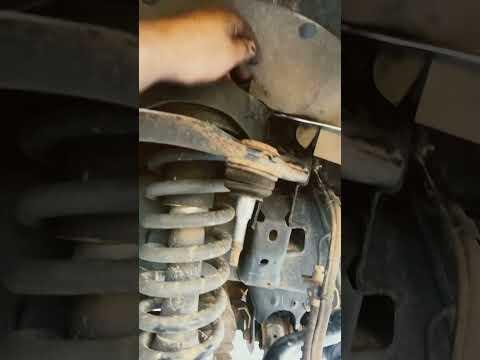
- The strut is the big shock with a coil spring around it, running from the lower control arm/knuckle area up to the body.
- 🔧 6. Disconnect sway bar link from strut
- Find the sway bar link – a rod that connects the sway bar to the strut.
- Use an 18 mm socket to remove the nut holding the link to the strut.
- If the stud spins, use a wrench or Allen key on the stud’s center (if provided) while turning the nut.
- Push the link out of the strut bracket and move it aside.
- 🔧 7. Free any brake/ABS brackets on the strut
- If your strut has a small bracket holding a brake hose or ABS wire, remove the 10 mm bolt and move the line gently aside.
- Do not stretch or kink the brake hose.
- 🔧 8. Mark the lower strut position (optional but helpful)
- Use a paint marker to mark the relationship between the strut and the steering knuckle.
- This can help keep alignment closer to original, but you will still need an alignment after.
- 🔧 9. Remove lower strut bolts
- Support the lower control arm with the floor jack (lightly, don’t lift the truck off the stands).
- Use a 21 mm socket and breaker bar to loosen the two large bolts that clamp the strut to the steering knuckle.
- Remove the nuts, then tap the bolts out with a hammer if they’re stuck. Keep track of bolt direction.
- The bottom of the strut will now be free from the knuckle.
- 🔧 10. Loosen upper strut mount nuts (under hood)
- Open the hood.
- At the top of the strut tower, you’ll see three small nuts around the center (do not loosen the big center nut on a loaded strut).
- Use a 15 mm socket to remove the three nuts. Leave one nut threaded on a few turns until you’re ready to support the strut from below.
- 🔧 11. Remove the strut assembly
- From below, support the strut with one hand (or a helper).
- Remove the last upper nut from the top.
- Carefully lower and wiggle the strut out of the wheel well. You may need to turn the steering slightly for clearance.
Installing the New Loaded Strut 🆕
- 🧩 12. Compare old and new strut
- Check that the new strut assembly matches the old one: same height, same spring orientation, same top mount shape, and same lower mounting ears.
- Note the orientation of the top mount studs and lower bracket so you install it the same way.
- 🧩 13. Position the new strut in the tower
- Feed the new strut up into the wheel well.
- Align the top studs with the holes in the strut tower.
- From the top, install the three upper nuts finger-tight to hold the strut in place (do not fully tighten yet).
- 🧩 14. Attach the lower strut to the knuckle
- Align the lower strut bracket with the steering knuckle.
- Insert the two lower bolts in the same direction they came out.
- Install new nuts and snug them with a 21 mm socket, but don’t torque fully yet.
- 🧩 15. Reconnect sway bar link
- Slide the sway bar link stud back into the strut bracket.
- Install the nut and snug it with an 18 mm socket.
- 🧩 16. Reattach brake/ABS brackets
- Reinstall any 10 mm bolts holding brake hoses or ABS wires to the strut.
Final Tightening & Reassembly 🔐
- ⚙️ 17. Reinstall the wheel
- Put the wheel back on and hand-tighten the lug nuts in a star pattern.
- ⚙️ 18. Lower the truck to load the suspension
- Raise the truck slightly with the jack, remove the jack stands, and lower the truck so the weight is on the wheels.
- This puts the suspension at normal ride height, which is best for final torque.
- ⚙️ 19. Torque everything to spec
- Torque the front wheel lug nuts to 150 lb-ft (203 N·m) in a star pattern.
- Under the hood, torque the upper strut mount nuts to 30 lb-ft (40 N·m).
- From below (you may need to raise and support again to access), torque:
- Lower strut bolts to 350 lb-ft (475 N·m).
- Sway bar link nut to 85 lb-ft (115 N·m).
Post-Repair Checks & Alignment ✅
- 🔍 20. Visual check
- Make sure all tools are removed from under the truck.
- Check that all nuts and bolts you touched are tight and that no brake hoses or wires are twisted or stretched.
- 🚗 21. Short test drive
- Drive slowly around the block.
- Listen for clunks, pops, or rubbing. The truck should feel firm but not harsh.
- 📐 22. Get a professional alignment
- Any time you replace front struts, you should get a 4-wheel alignment to avoid uneven tire wear and poor handling.
Rear Shock Note (Your Truck) 📝
The rear of your F-150 uses shocks only, not struts. They are much simpler to replace (one bolt at the top, one at the bottom per side). If you want, I can give you a short step-by-step for the rear shocks too.
DIY Tips for a Beginner 🧠
- 🧰 Work one side at a time so you can look at the other side as a reference.
- 🧴 Spray penetrating oil on big bolts 10–15 minutes before removal to make life easier.
- 📸 Take pictures before you remove anything so you can compare during reassembly.
HowToo makes it easy: below this answer you’ll see the correct loaded strut assemblies, new hardware, and any tools you’re missing. You can add them to your cart right from the parts section, with fast shipping.
If you tell me whether you’re also doing the rear shocks, I’ll add a quick guide for those as well.